

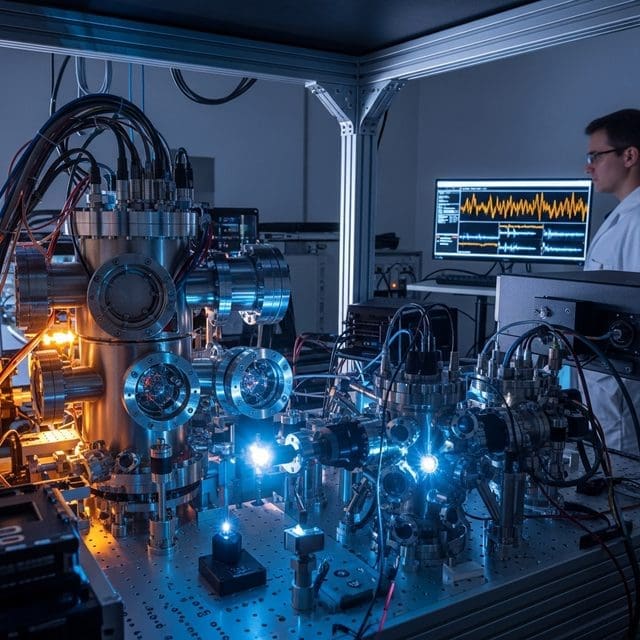
New research from Caltech and Google drastically reduces the hardware requirements for breaking modern encryption, signaling a shift from theoretical physics to engineering reality.
The timeline for quantum computing to move from laboratory curiosity to a tool of strategic consequence has accelerated this week. New research from Caltech and Google indicates that the threshold for breaking modern encryption is significantly lower than previously believed, shifting the focus from theoretical physics to engineering reality. These findings suggest that the cryptographic foundations of the digital economy, including most cryptocurrencies and secure government communications, could be vulnerable within the next decade.
Google researchers published a detailed paper on July 19, 2026, providing resource estimates that challenge long-held assumptions about the safety of 256-bit elliptic-curve cryptography (ECC). Their implementation of Shor’s algorithm is ten times as efficient as previous methods, suggesting that most cryptocurrencies would yield in minutes to a machine with fewer than 500,000 superconducting physical qubits. This represents a massive reduction from earlier estimates that cited a need for tens of millions of qubits, effectively pulling the “quantum threat” years closer to the present. The Google team distinguishes between fast-clock architectures, such as superconducting and photonic systems, and slow-clock architectures like neutral-atom or ion-trap systems, providing a roadmap for how different hardware platforms might execute these attacks.
Parallel to Google’s work, a team at Caltech, in partnership with Oratomic, has proposed a neutral-atom architecture that could achieve similar results with even fewer resources. By leveraging reconfigurable atomic qubits, the Caltech model suggests that standard ECC P-256 discrete logs could be solved in just a few days using approximately 26,000 physical qubits. With current experimental arrays already exceeding 6,100 trapped atoms, the transition to a cryptographically relevant machine is increasingly viewed as an engineering hurdle rather than a conceptual impossibility. Independent analysis from Science News supports this trend, providing a conservative baseline that a machine with roughly 10,000 qubits could crack standard encryption in about 1,000 days.
While these developments raise significant concerns regarding national security and data privacy, other breakthroughs offer potential paths toward more efficient and manageable quantum hardware. At the University of Vienna, researcher Andrii Chumak and his team have successfully extended the lifetime of magnons—magnetic excitations—to 18 microseconds. This 100-fold increase in stability allows magnons to serve as long-lived quantum information carriers. Because these magnetic waves are not limited by fundamental physics but rather by material purity, the discovery suggests that future quantum processors could be reduced to the size of a one-cent coin. Such compact, chip-scale magnonic interconnects could eventually replace the bulky microwave wiring currently required for superconducting-qubit architectures.
Furthermore, researchers at the Institute of Science and Technology Austria have realized an autonomous method for distributed entanglement. By utilizing a “quantum bath” of correlated light particles, they have demonstrated that the inherent loss or “leakiness” in qubits can be harnessed to generate entanglement rather than destroying it. This approach provides a fresh architectural tool for quantum networks, offering a way to circumvent the need for high-fidelity quantum channels by using engineered dissipation to create useful quantum correlations. This is particularly relevant for distributed quantum computing, where real-world fiber links are often noisy and lossy.
These collective advancements signal a shift in the global technological landscape. As the resource requirements for powerful quantum operations drop, the pressure on governments and private industry to migrate toward post-quantum cryptography has intensified. The race is no longer just about who can build the largest machine, but who can most effectively integrate these high-efficiency algorithms into a secure, sovereign infrastructure. For the American public, these developments underscore the need for a principled approach to technological sovereignty, ensuring that the transition to a quantum-enabled world does not compromise individual liberty or national security.

Mason Reed serves as a Staff Writer for Just Right News, where he spearheads the Future Frontiers & Special Projects desk. In an era defined by rapid technological shifts and evolving social landscapes, Mason provides a steady, principled voice, examining the innovations of tomorrow through the lens of traditional American values. His work is most prominently featured in his signature series, “The Next Horizon,” where he explores the intersection of emerging technology, national sovereignty, and the preservation of individual liberty.
A native of San Diego, California, Mason’s worldview was shaped by the unique culture of his hometown. Growing up in a region defined by its strong military presence and its history of maritime industry, he developed a deep-seated respect for the institutions that provide national stability and the entrepreneurial spirit that drives the American economy. This upbringing instilled in him a belief that true progress is not found in discarding the past, but in building upon a foundation of proven principles. His reporting often reflects this San Diego influence, emphasizing the importance of a robust national defense and the necessity of maintaining a competitive edge in the global marketplace.
Now based in San Francisco, Mason operates from the heart of the world’s technological engine. Living and working in the Bay Area provides him with a front-row seat to the advancements—and the ideological challenges—emanating from Silicon Valley. While many in the region embrace a “move fast and break things” mentality, Mason’s reporting serves as a vital counterweight. He offers Just Right News readers a “boots on the ground” perspective, documenting how radical local policies and the concentration of tech power impact the everyday lives of citizens. His proximity to the industry allows him to cut through the marketing jargon of big tech to uncover the real-world implications for privacy, free speech, and the nuclear family.
In his “Future Frontiers” beat, Mason tackles complex subjects ranging from the ethics of artificial intelligence to the burgeoning private space race. He approaches these topics with a healthy skepticism toward centralized bureaucracy, championing instead the decentralized innovations that empower individuals. Through “The Next Horizon,” he highlights the pioneers and thinkers who are working to ensure that the future remains a place where human dignity and constitutional rights are protected. He believes that the rapid pace of change requires more than just technical expertise; it requires a moral compass rooted in the Western tradition.
Throughout his tenure at Just Right News, Mason has remained committed to the idea that the future is something to be shaped, not merely accepted. His writing is characterized by a rigorous defense of American exceptionalism and a belief that the country’s best days lie ahead, provided it remains true to its founding ideals. Whether he is investigating the impact of automation on the American workforce or profiling the next generation of aerospace engineers, Mason Reed ensures that his readers are equipped with the insights they need to navigate a changing world with confidence and clarity.