

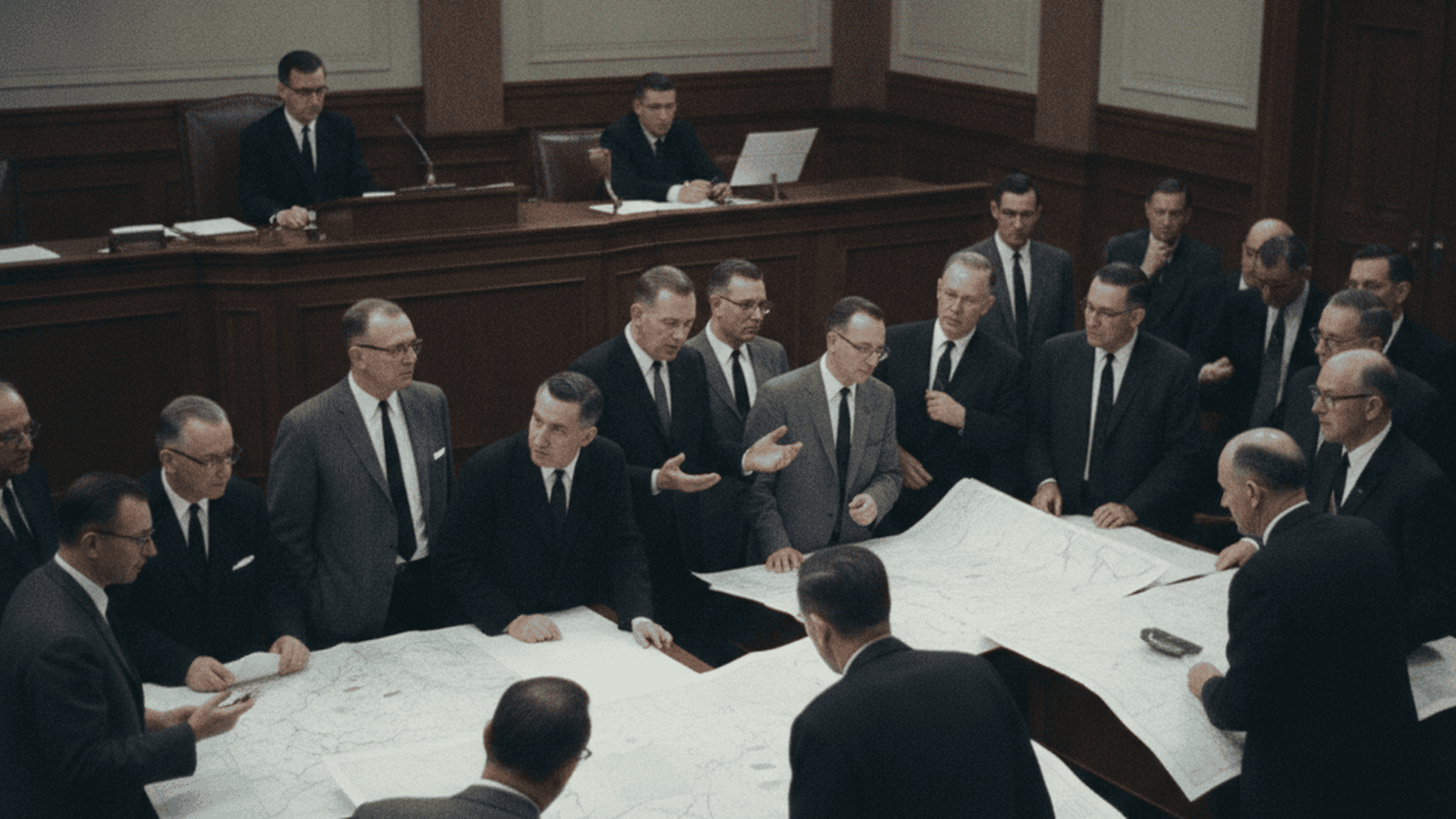
In 1965, Nevada underwent a radical restructuring of its legislative districts following the U.S. Supreme Court’s “one man, one vote” ruling. This reform shifted political power from rural “cow counties” to the rapidly growing urban centers of Las Vegas and Reno, fundamentally altering the state’s political landscape.
TLDR: Following federal court mandates in 1965, Nevada overhauled its legislative apportionment system to reflect population density. This transition ended decades of rural dominance in the state senate, empowering urban voters in Clark and Washoe Counties and fundamentally altering the state’s political landscape during the Civil Rights era.
The 1964 Supreme Court decision in Reynolds v. Sims sent shockwaves through statehouses across the American West, but few felt the impact as acutely as Nevada. The ruling established the “one man, one vote” principle, requiring that state legislative districts be roughly equal in population. In Nevada, this directly challenged the “federal plan,” a system established in the early 20th century where each of the state’s 17 counties received exactly one state senator regardless of its number of residents. By 1965, this arrangement had created a massive democratic disparity. Clark County, home to the booming city of Las Vegas, contained over half the state’s population but held only one-seventeenth of the power in the upper house.
Governor Grant Sawyer, a Democrat who championed modernization, recognized that the federal courts would eventually intervene if the legislature failed to act. The disparity was so great that a voter in rural Storey County had approximately 400 times the legislative influence of a voter in Clark County. Sawyer called a special session in late 1965 specifically to address the constitutional crisis. The atmosphere in Carson City was tense, as rural legislators, often referred to as the “cow county” representatives, fought a desperate rearguard action to maintain their traditional influence. These lawmakers argued that the unique geographic and economic needs of the mining and ranching districts would be ignored by an urban-dominated legislature.
The legal pressure was intensified by the case of Dungan v. Sawyer, in which a federal court panel ruled that Nevada’s Senate was unconstitutionally apportioned. The court gave the legislature a strict deadline to produce a fair map, threatening to impose its own plan if the lawmakers remained deadlocked. Inside the legislative chambers, the debate centered on how to balance the new constitutional requirement with the state’s historical identity. Rural senators feared that Las Vegas and Reno would monopolize state funding for schools, roads, and social services, leaving the rest of the state in decay.
Proponents of reform, largely from the southern part of the state, argued that the existing system was a relic of a bygone era. They pointed out that the rapid industrialization and growth of the gaming and tourism industries necessitated a government that responded to where people actually lived. The tension reached a peak during the twenty-day special session, as various maps were proposed and rejected. Some rural members suggested a “weighted voting” system to preserve their seats, but this was quickly dismissed as legally insufficient under the federal mandate.
Ultimately, the legislature passed a compromise plan that expanded the State Senate to 20 members and the Assembly to 40. Under the new map, Clark County’s representation in the Senate jumped from one seat to eight, while Washoe County, home to Reno, gained six. The remaining rural counties were grouped into multi-county districts to meet the necessary population requirements. This shift effectively transferred the keys of state government to the urban centers, reflecting the demographic realities of the mid-20th century.
The 1965 reapportionment fundamentally changed Nevada’s policy priorities in the years that followed. It led to increased state investment in urban infrastructure and a shift in the political center of gravity toward the south. The reform also paved the way for more diverse representation in the statehouse, as the rigid political gatekeeping of the rural machines diminished. Today, the legacy of this reform remains visible in the continued dominance of the Las Vegas metropolitan area in Nevada’s statewide elections and legislative agenda, ensuring that the state’s governance remains tied to its population centers.

Sophie Carter serves as a Staff Writer for Just Right News, where she anchors the outlet’s critical coverage of Elections, Influence, and Democracy Infrastructure. In an era where the mechanics of voting and the flow of political capital are under constant scrutiny, Sophie provides a steady, principled voice dedicated to the preservation of American institutional integrity and the rule of law.
Raised in Charlotte, North Carolina, Sophie’s perspective was forged in a community that balances rapid modern growth with a deep respect for tradition and civic duty. Growing up in the Queen City, she witnessed firsthand how a robust local culture depends on the trust between the citizen and the state. This upbringing instilled in her a foundational belief that the right to vote is a sacred trust—one that must be protected from both administrative overreach and the encroaching influence of special interest groups. Her reporting reflects these North Carolina roots, emphasizing the importance of community-led governance and the preservation of the individual’s voice in the face of nationalized political movements.
Now based in Atlanta, Georgia, Sophie operates from the heart of one of the nation’s most pivotal and contested political landscapes. Her location allows her to report from the front lines of the debate over election security, legislative reform, and the modernization of voting systems. For Sophie, the “infrastructure” of democracy is not merely a matter of machines and ballots; it is the collection of laws, people, and transparent processes required to maintain public confidence. Her work often highlights the necessity of clear, enforceable standards that ensure every legal vote is counted fairly and that the machinery of our republic remains accountable to the taxpayers who fund it.
Central to her work at Just Right News is her acclaimed feature series, “The Price of a Vote.” Through this ongoing project, Sophie explores the complex web of influence that shapes modern campaigns and policy decisions. She delves into how high-level lobbying, non-governmental organizations, and shifting bureaucratic regulations impact the weight of an individual citizen’s ballot. By examining the financial and structural pressures placed on the electoral process, she provides readers with a comprehensive look at the forces vying for control over the American political system.
Sophie’s approach to journalism is rooted in a commitment to the constitutional framework. She views her role as a watchdog for the voter, ensuring that the systems meant to serve the public remain transparent and free from corruption. Whether she is analyzing the implementation of new voting technologies or investigating the influence of outside money on state-level policy, her work is characterized by a rigorous adherence to facts and a refusal to succumb to the sensationalism that often plagues modern political reporting.
At Just Right News, Sophie Carter continues to be a vital resource for readers who value clarity, conviction, and a defense of traditional American values. Her deep ties to the Southeast and her specialized focus on the mechanics of our republic make her an essential voice in the ongoing conversation about the future of American self-governance. Through her reporting, she remains dedicated to the idea that a secure and honest electoral system is the bedrock of a free and prosperous society.