

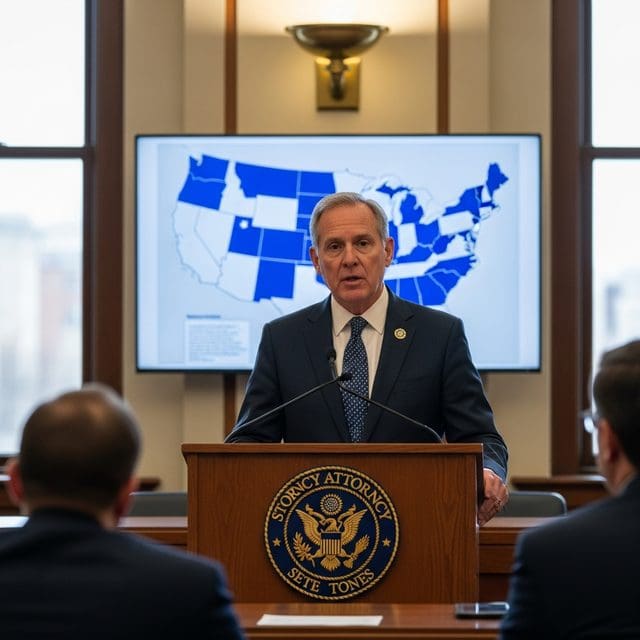
State leaders are utilizing the Tenth Amendment to block federal media merger approvals and demand accountability for federal law enforcement actions within state borders.
The constitutional architecture of the United States is being tested as state capitals move to reclaim authority from a centralized federal apparatus. Leveraging the ‘Fifty Laboratories of Power’ doctrine, state attorneys general and local legislators are no longer waiting for Washington to set the pace. Instead, they are utilizing state-level antitrust laws and public safety mandates to challenge federal preemption on issues ranging from corporate consolidation to the conduct of federal agents.
California Attorney General Rob Bonta, leading a coalition of eleven other states, filed a landmark lawsuit to block the $110 billion acquisition of Warner Bros. Discovery by Paramount. This legal challenge arrives as a direct counter-maneuver to the Trump administration’s previous clearance of the deal. While federal regulators signaled approval, state leaders argue the merger represents a monopolistic threat to competition and consumer choice within their specific jurisdictions. By filing this separate state-level action, the coalition asserts that federal approval does not grant immunity from the rigorous consumer protection standards maintained by individual states.
The conflict is set to intensify with a federal court hearing in Oakland scheduled for July 16. Paramount has signaled its intent to seek a dismissal, but the states’ persistence underscores a broader trend: state officials are increasingly skeptical of federal oversight in the digital age. This is a fundamental assertion of the right of states to protect local economies from the ripple effects of massive corporate consolidations that Washington has permitted.
Simultaneously, the friction between state sovereignty and federal power has turned tragic in the realm of law enforcement. In Maine, the Speaker of the House confirmed a fatal shooting occurred in Biddeford involving U.S. Immigration and Customs Enforcement (ICE) agents. This incident follows the death of Lorenzo Salgado Araujo, who was shot by federal agents during a Tuesday enforcement stop in Texas. These fatalities have triggered a wave of demands from state lawmakers for independent inquiries that bypass federal internal reviews.
In Texas, the call for accountability is particularly pointed. Lawmakers are framing these incidents as part of a pattern of federal immigration-force violence, noting ten fatal shootings by federal immigration officials since the start of the current presidential term. The demand for independent investigations represents a significant push for state-level oversight of federal actors. For decades, federal agencies have operated with insulation from local scrutiny, but recent violence has prompted legislatures to assert that no official is above the transparency requirements of the community where they operate.
This resurgence of state activism extends into regulatory spheres. In California, the enactment of the Private Works Change Order Fair Payment Act demonstrates a commitment to protecting local construction interests through state-specific mandates. Furthermore, the bipartisan 21st Century ROAD to Housing Act shows how state-level planning associations are navigating federal frameworks to address local crises.
From the media markets of the West Coast to the border towns of Texas and the communities of Maine, the message from the statehouses is clear: the Tenth Amendment is a living tool for governance. By challenging federal mergers and demanding accountability for federal agents, these states are proving that decentralized power remains the most effective check against the overreach of a disconnected federal government.

Dylan Brooks serves as the Senior Correspondent for Statehouses and Local Governance at Just Right News, where he brings a principled, constitutionalist lens to the often-overlooked machinery of state-level politics. As the lead voice behind the acclaimed feature series “Fifty Laboratories of Power,” Dylan has dedicated his career to the idea that the most impactful governance happens closest to home. His reporting consistently champions the Tenth Amendment, exploring how individual states can serve as testing grounds for innovative, conservative policy solutions that prioritize personal liberty and fiscal responsibility.
A native of Des Moines, Iowa, Dylan’s journalistic philosophy was forged in the heart of the American Midwest. Growing up in a community where local school board meetings and town halls were the bedrock of civic life, he developed a deep appreciation for the “retail politics” of the heartland. This upbringing instilled in him a fundamental belief that the American experiment is best preserved when power is decentralized. He carries the values of his Iowa roots into every assignment, maintaining a healthy skepticism of federal overreach and a steadfast commitment to the concerns of everyday citizens over the interests of the administrative state.
Now based in Madison, Wisconsin, Dylan operates from one of the nation’s most pivotal political battlegrounds. His location in a state capital known for its rigorous policy debates allows him to provide Just Right News readers with a front-row seat to the legislative process. From Madison, he tracks the ripple effects of statehouse decisions on local municipalities, ensuring that the connection between high-level policy and community impact is never lost. His work often highlights the success of conservative governors and legislatures in fostering economic growth, protecting parental rights, and securing the integrity of local institutions.
As an African American man in the conservative media landscape, Dylan offers a vital perspective on how limited government and free-market principles empower individuals and families. He frequently reports on how deregulation and school choice initiatives provide new avenues for success in underserved communities, challenging the monolithic narratives often presented by legacy media outlets. Dylan’s work is characterized by a commitment to the facts and a refusal to shy away from the complex realities of modern governance.
Throughout his tenure at Just Right News, Dylan has become a trusted authority for readers who value a rigorous, principled approach to the news. Whether he is dissecting a complex state budget or profiling a local grassroots movement, his goal remains the same: to provide the American public with the information they need to hold their local leaders accountable. By focusing on the “Fifty Laboratories of Power,” Dylan Brooks ensures that the vital work being done in statehouses across the country receives the national attention it deserves, always through a lens that respects the traditions and sovereignty of the American people.