

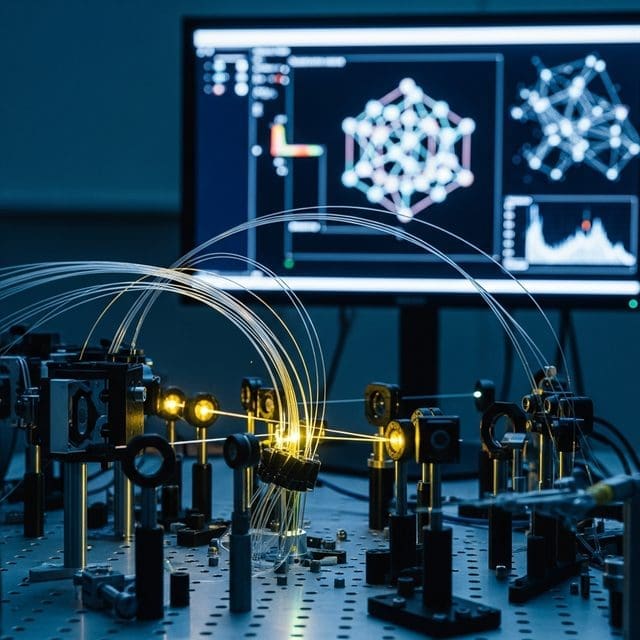
Researchers have unveiled a programmable light-based simulator and a physics-informed AI engine that together slash the hardware and computational costs of discovering next-generation quantum materials.
The frontier of quantum physics is shifting from theoretical speculation to practical engineering. This week, two major breakthroughs—one in photonic simulation and another in artificial intelligence—demonstrate how researchers are overcoming the hardware and computational bottlenecks that have long hindered the quantum revolution. These advancements suggest a future where the high costs of centralized, large-scale quantum infrastructure are no longer the primary barrier to innovation.
At the University of Ottawa and the Nexus for Quantum Technologies Institute, researchers have developed a programmable quantum simulator that uses light to model quantum matter. Unlike traditional quantum computers that require scaling up physical circuits to handle more complex problems, this photonic architecture can simulate approximately 300 distinct quantum processes using the same hardware. By using reconfigurable optical setups rather than building larger circuits, the team has provided a near-term path for materials discovery that avoids the astronomical costs of massive hardware scaling.
This photonic approach is significant because it addresses the hardware complexity that has acted as a bottleneck for years. By reusing the same optical hardware for hundreds of different configurations, the team has shown that we do not necessarily need to wait for fault-tolerant, general-purpose quantum computers to achieve useful physics results. This development favors agile, programmable simulators over the slow, resource-heavy projects often favored by large-scale institutional players.
Simultaneously, a team at the University of Manchester’s National Graphene Institute has addressed the challenge of finding the “holy grail” of condensed matter: flat-band 2D materials. These materials are essential for developing unconventional superconductivity and topological phases, which are central to next-generation quantum devices. Traditionally, finding these materials required exhaustive, expensive electronic calculations for every candidate, a process that could take years of supercomputing time.
The Manchester researchers, led by Dr. Xiangwen Wang and Dr. Qian Yang, developed a physics-informed machine-learning engine to triage over 10,000 unlabeled materials. By training the AI to recognize geometric signatures of atoms and specific physical scores, they achieved a staggering 98.2% accuracy in identifying promising candidates. Dr. Qian Yang noted that this method allows physical intuition to guide the search from the beginning, effectively turning human insight into a high-speed digital filter that tells experimentalists exactly which materials are worth synthesizing.
Furthering the hardware evolution, researchers at ETH Zurich are exploring mechanical vibrations as a superior alternative to magnetic memory for quantum computing. These “vibrating memories” store quantum information using mechanical modes, which provide a different environment that can preserve data significantly longer than current electromagnetic approaches. This advancement in mechanical storage could be integrated into existing superconducting platforms, offering a new engineering knob for large-scale architectures without requiring entirely new qubit types.
These developments represent a vital shift toward decentralized innovation. By creating tools that are more efficient and less dependent on massive, centralized infrastructure, the scientific community is ensuring that the benefits of the quantum age can be realized through ingenuity and precise engineering. The ability to simulate and discover new materials rapidly ensures that the next generation of sovereign technology is built on a foundation of efficient science that respects the limits of our resources while expanding the limits of our knowledge.

Mason Reed serves as a Staff Writer for Just Right News, where he spearheads the Future Frontiers & Special Projects desk. In an era defined by rapid technological shifts and evolving social landscapes, Mason provides a steady, principled voice, examining the innovations of tomorrow through the lens of traditional American values. His work is most prominently featured in his signature series, “The Next Horizon,” where he explores the intersection of emerging technology, national sovereignty, and the preservation of individual liberty.
A native of San Diego, California, Mason’s worldview was shaped by the unique culture of his hometown. Growing up in a region defined by its strong military presence and its history of maritime industry, he developed a deep-seated respect for the institutions that provide national stability and the entrepreneurial spirit that drives the American economy. This upbringing instilled in him a belief that true progress is not found in discarding the past, but in building upon a foundation of proven principles. His reporting often reflects this San Diego influence, emphasizing the importance of a robust national defense and the necessity of maintaining a competitive edge in the global marketplace.
Now based in San Francisco, Mason operates from the heart of the world’s technological engine. Living and working in the Bay Area provides him with a front-row seat to the advancements—and the ideological challenges—emanating from Silicon Valley. While many in the region embrace a “move fast and break things” mentality, Mason’s reporting serves as a vital counterweight. He offers Just Right News readers a “boots on the ground” perspective, documenting how radical local policies and the concentration of tech power impact the everyday lives of citizens. His proximity to the industry allows him to cut through the marketing jargon of big tech to uncover the real-world implications for privacy, free speech, and the nuclear family.
In his “Future Frontiers” beat, Mason tackles complex subjects ranging from the ethics of artificial intelligence to the burgeoning private space race. He approaches these topics with a healthy skepticism toward centralized bureaucracy, championing instead the decentralized innovations that empower individuals. Through “The Next Horizon,” he highlights the pioneers and thinkers who are working to ensure that the future remains a place where human dignity and constitutional rights are protected. He believes that the rapid pace of change requires more than just technical expertise; it requires a moral compass rooted in the Western tradition.
Throughout his tenure at Just Right News, Mason has remained committed to the idea that the future is something to be shaped, not merely accepted. His writing is characterized by a rigorous defense of American exceptionalism and a belief that the country’s best days lie ahead, provided it remains true to its founding ideals. Whether he is investigating the impact of automation on the American workforce or profiling the next generation of aerospace engineers, Mason Reed ensures that his readers are equipped with the insights they need to navigate a changing world with confidence and clarity.