

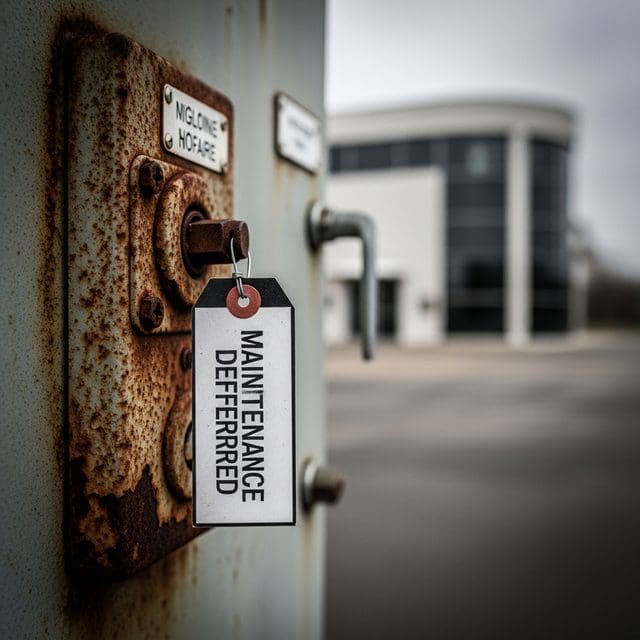
A forensic look at infrastructure data reveals how thousand-dollar deferrals are cascading into billion-dollar liabilities across federal agencies and global telecommunications networks.
The ledger of infrastructure management is increasingly defined by a dangerous fiscal trend: the deferral of essential maintenance to protect short-term balance sheets. While bureaucratic rhetoric often focuses on new visionary projects, the underlying data reveals a mounting pile of liabilities that threaten both public safety and taxpayer interests. Whether in the halls of federal agencies or the server rooms of global telecommunications giants, the math of neglect is beginning to catch up with the decision-makers.
Recent internal disclosures from Telstra provide a stark case study in this false economy. Engineers at the telecommunications giant confirmed that the time-keeping equipment responsible for a nationwide Triple Zero emergency call outage had been flagged for replacement years ago. The cost of the fix was estimated in the low thousands of dollars. By placing the upgrade in the ‘too hard’ basket, the organization now faces an Australian Communications and Media Authority investigation and potential fines reaching into the tens of millions. The data-driven reality is a failure ratio where a $5,000 deferral resulted in a $10,000,000-plus liability. Furthermore, post-incident checks identified 333 failed emergency calls, with six cases requiring immediate welfare intervention, proving that the cost of failure is measured in human risk as much as currency.
This pattern of neglect is not isolated to the private sector. Government Accountability Office (GAO) data indicates that deferred maintenance and repair costs for U.S. civilian agencies surged by $29 billion—a 58% increase—between fiscal years 2017 and 2022. When combined with the Congressional Budget Office’s assessment of a $50 billion backlog across 101,500 military buildings, the total federal maintenance liability now sits near $79 billion. These figures represent a structurally growing backlog in federal real property that is often ignored during high-profile budget debates. These are not merely suggestions; they are unfunded mandates for future taxpayers that reduce operational efficiency across the entire government portfolio.
In the high-stakes semiconductor sector, the financial forensics of capital expenditure (capex) show a different but equally volatile trend. China’s CXMT is currently utilizing extensive local government financing, tax breaks, and land grants to artificially accelerate its build-out. This state-backed spending model aims to bypass the disciplined capital allocation cycles seen by commercial rivals like Samsung, SK Hynix, and Micron. As SK Hynix prepares for its Nasdaq listing—which may become the second-largest equity offering ever, trailing only SpaceX—the market is demanding more transparent return-on-investment metrics. Investors are increasingly wary of the ‘valuation discount’ applied to firms that cannot demonstrate disciplined fab efficiency and return on new infrastructure spending.
The broader systemic risk is highlighted by Freedom of Information (FOI) material regarding emergency network redundancy. Data shows that failsafes intended to route emergency calls onto alternative networks have failed repeatedly across different carriers. This suggests that the problem is not merely a single software defect but a systemic design flaw in national redundancy architecture. When oversight gaps in governance meet a culture of deferred maintenance, the result is a fragile infrastructure that costs more to fix in a crisis than it would have cost to maintain in a period of stability.
The common thread across these data points is the cost of delay. Every dollar ‘saved’ today by ignoring a maintenance schedule is eventually repaid with interest in the form of emergency repairs, regulatory fines, and diminished operational efficiency. For the fiscal watchdog, the message is clear: the most expensive way to run a budget is to pretend the bills aren’t coming due. Real accountability requires moving these items out of the ‘too hard’ basket and back onto the balance sheet where they belong.

Max Grant serves as the Senior Correspondent for Data and Financial Forensics at Just Right News, where he brings a meticulous, investigative eye to the complex world of numbers. In an era where media narratives often overshadow objective reality, Max operates on a simple but firm principle: while rhetoric can be manipulated, the ledger never lies. As the architect behind the acclaimed feature series “Numbers That Talk,” he has carved out a vital niche in conservative journalism, translating dense financial data into clear, actionable insights for the American public.
Max’s journey to the forefront of financial reporting began in Buffalo, New York. Growing up in the Queen City, he was raised with the grit and grounded perspective typical of the Rust Belt. Buffalo is a place that understands the value of a dollar and the consequences of economic shifts on the working class. This upbringing instilled in Max a deep-seated respect for fiscal responsibility and a healthy skepticism toward bureaucratic overreach. He carries the spirit of his hometown into every investigation, viewing his work not just as reporting, but as a form of public service dedicated to protecting the interests of taxpayers and everyday citizens.
Now based in Brooklyn, New York, Max operates from the heart of one of the world’s most influential financial and cultural hubs. This vantage point allows him to keep a close watch on the institutions that drive the global economy. Living and working in a city often defined by progressive policy experiments, Max provides a necessary counter-perspective, using his forensic skills to analyze the real-world costs of local and national governance. His proximity to the financial district ensures he is never far from the source of the data he deconstructs, yet he remains firmly rooted in the conservative values that prioritize transparency and individual liberty.
His beat, Data and Financial Forensics, is more than just a job title; it is a commitment to uncovering the truth hidden within spreadsheets and annual reports. In “Numbers That Talk,” Max dives deep into federal spending, corporate accountability, and the intricate web of international finance. He has a unique ability to spot the anomalies that others miss, identifying where public funds are being mismanaged or where economic policies are failing to deliver on their promises. His reporting is characterized by a relentless pursuit of clarity, stripping away the jargon to show readers exactly how their money is being used and how the economy is truly performing.
At Just Right News, Max Grant is recognized as a steady hand and a sharp mind. He understands that for a free society to function, its citizens must have access to the facts regarding their financial future. By combining his British heritage’s tradition of rigorous inquiry with an American drive for accountability, Max ensures that the numbers don’t just sit on a page—they tell the story of where the country has been and where it is headed. His work stands as a testament to the power of forensic journalism in holding the powerful to account and championing the principles of a transparent, fiscally sound nation.