

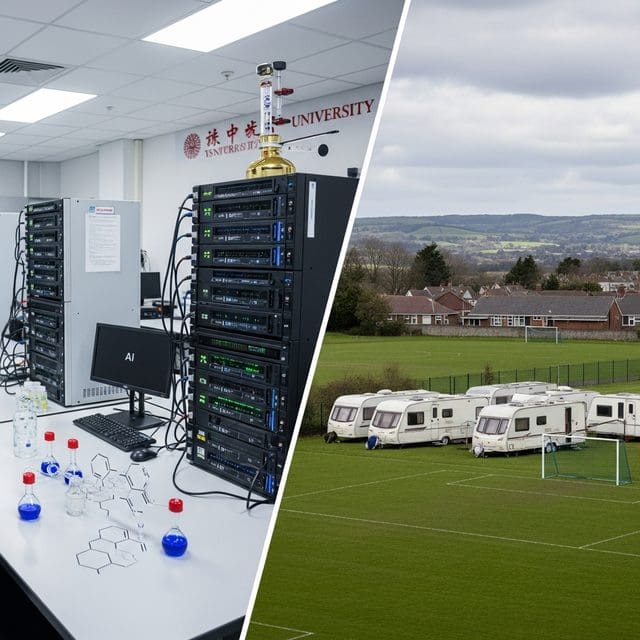
Nobel laureate Omar Yaghi’s move to China and high-stakes labor disputes at Ateneo highlight a shifting global market for elite human capital and institutional accountability.
The global competition for high-level human capital reached a turning point this week as Nobel-winning chemist Omar M. Yaghi departed UC Berkeley for Tsinghua University in Beijing. Yaghi, a 2025 Nobel laureate, will lead a new AI-assisted materials discovery institute. This move is a strategic win for China, as Yaghi’s work utilizes artificial intelligence to accelerate the synthesis of new materials. It highlights a trend where top-tier research talent is increasingly mobile, seeking environments that offer aggressive funding and specialized technological infrastructure over traditional Western institutional prestige.
While elite research shifts across borders, universities are also grappling with the legal complexities of their workforce. In the Philippines, the Department of Labor and Employment (DOLE) summoned basketball coach Tab Baldwin following the tragic drowning deaths of two players during a team-building activity. Ateneo’s legal team maintains that Baldwin is a consultant rather than a formal employee. This distinction is central to the DOLE probe, as it impacts liability and the application of labor code requirements. The case raises questions about how modern universities classify and protect the workers responsible for student safety.
In the K-12 sector, maintaining the integrity of the learning environment remains a challenge. Caldicot Comprehensive School in south Wales was forced to cancel physical education and its annual sports day after an unauthorized encampment of more than a dozen caravans occupied the school’s playing fields. Monmouthshire County Council is currently navigating the legal process to resolve the occupation. This incident, alongside heatwave-related closures affecting over 300 schools across England and Wales, demonstrates the persistent logistical hurdles that disrupt consistent student development and the protection of public infrastructure.
Despite these frictions, the value of diverse educational pathways is being validated through individual achievement. British tennis player Arthur Fery, who utilized the American collegiate system at Stanford University, is projected to reach world No. 36 and become the British No. 1 on July 13, 2026. Fery’s success serves as a practical example of how market-aligned, international educational experiences prepare individuals for elite performance. His journey from U.S. college ranks to the Wimbledon semi-finals underscores the student-athlete model as a legitimate engine for upward mobility.
Technological innovation continues to emerge from the university sector even as administrative challenges mount. Researchers at the University of Ottawa developed a programmable quantum simulator using shaped light, while the University of Santiago identified new quantum vacuum phenomena to reduce energy in chemical bond breaking. These breakthroughs remind us that the primary value of the university remains its ability to produce tangible scientific progress. However, as the Yaghi departure suggests, the location of that progress is no longer guaranteed to remain within Western borders.
The current landscape reveals a stark contrast: while individual achievers leverage global systems for success, institutions struggle with the bureaucratic and legal frameworks required to manage their assets. For parents and workers, the message is clear: personal responsibility and specialized training remain the most reliable drivers of success in an increasingly volatile and competitive educational market. The shift toward AI-driven research and the scrutiny of university labor practices suggest that old models of institutional permanence are being replaced by a more fluid, merit-based global system.
Daniel Owens serves as a Senior Correspondent for Just Right News, where he leads the newsroom’s coverage of Education, Workforce, and Upward Mobility. In an era where the national conversation often overlooks the practical foundations of success, Owens brings a principled perspective to the forefront of the media landscape. His work is defined by a commitment to the idea that a strong society is built on the pillars of quality education, a robust work ethic, and the removal of bureaucratic barriers to individual achievement.
Born and raised in Cleveland, Ohio, Owens’s worldview was shaped by the industrial landscape of the Midwest. Growing up in a city known for its grit and resilience, he witnessed firsthand the transformative power of steady employment and the devastating effects of economic stagnation. This background instilled in him a deep respect for the American worker and a healthy skepticism toward top-down government solutions that often fail to reach the communities they intend to help. As an African American man who has navigated the path to professional success, Owens approaches his beat with a nuanced understanding of how meritocracy and personal responsibility intersect with opportunity. He frequently draws on his roots to highlight the importance of family stability and community-led initiatives in fostering the next generation of leaders.
At Just Right News, Owens is the architect of the acclaimed feature series, “The Learning Curve.” Through this platform, he explores the evolving landscape of American schooling, from the rise of the school choice movement to the revitalization of trade schools and vocational training. He frequently challenges the status quo of higher education, advocating for a return to academic rigor and the practical alignment of degrees with market demands. For Owens, education is not merely about obtaining credentials; it is about equipping young people with the tools necessary to lead self-sufficient, meaningful lives. His reporting on “The Learning Curve” has become essential reading for parents and policymakers who believe that educational competition and parental rights are the keys to a brighter future.
Now based in Raleigh, North Carolina, Owens finds himself at the heart of one of the nation’s most dynamic regions for innovation and growth. Raleigh’s unique blend of traditional values and a fast-paced economy provides the perfect backdrop for his reporting on the modern workforce. From the tech hubs of the Research Triangle to the rural communities of the South, he tracks how shifts in the economy are impacting families and local industries. His reporting often highlights the success stories of entrepreneurs and workers who are thriving by embracing the values of hard work and innovation.
Throughout his career, Daniel Owens has remained a steadfast voice for the student seeking a better path and the worker striving for a better life. His reporting for Just Right News serves as a vital resource for readers who value common-sense solutions to the challenges of the 21st-century economy. By focusing on the intersection of policy and the human spirit, Owens continues to provide a roadmap for how individuals and communities can achieve lasting upward mobility.