

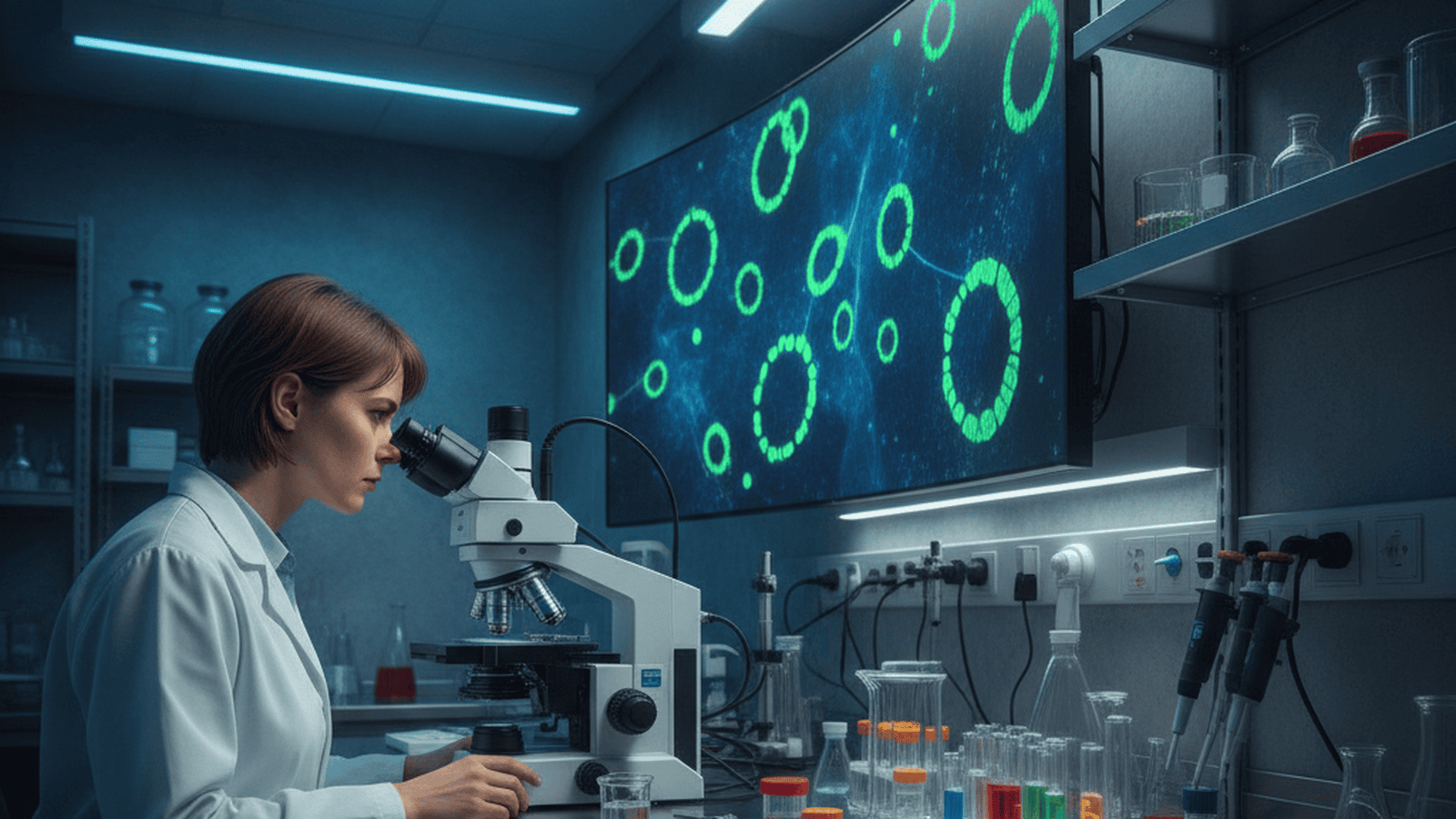
Scientists have identified extrachromosomal DNA (ecDNA) as a key factor in how tumors evolve and resist chemotherapy. These circular DNA fragments carry oncogenes and replicate independently, allowing cancer cells to adapt to environmental pressures far faster than previously understood.
TLDR: Researchers at Stanford and UCSD have discovered that circular fragments of extrachromosomal DNA (ecDNA) are responsible for the rapid evolution and drug resistance of aggressive tumors. This finding shifts the focus of oncology from chromosomal mutations to these mobile genetic elements, offering new targets for therapy.
Researchers at Stanford University and the University of California, San Diego, have uncovered a fundamental mechanism that explains why some of the most aggressive cancers remain stubbornly resistant to treatment. The study focuses on extrachromosomal DNA (ecDNA), small circular fragments of genetic material that exist outside the traditional 23 pairs of chromosomes. This discovery challenges long-held assumptions about how cancer genes are organized and inherited within malignant cells. For decades, the prevailing theory of cancer genetics centered on mutations occurring within the chromosomes. However, this new research demonstrates that ecDNA plays a disproportionately large role in driving tumor growth and survival. These circular fragments often carry multiple copies of oncogenes—genes that have the potential to cause cancer—and can replicate at high rates within a single cell nucleus.
The physical structure of ecDNA provides a significant advantage to cancer cells. Unlike chromosomal DNA, which is tightly packed and highly regulated, ecDNA is remarkably accessible. This open configuration allows the cell’s machinery to transcribe genetic instructions much more rapidly than it could from a standard chromosome. The result is an overabundance of proteins that promote rapid cell division and protect the tumor from external threats, including chemotherapy. One of the most striking findings of the study is how ecDNA contributes to genetic diversity within a single tumor. During normal cell division, chromosomes are duplicated and distributed equally between the two daughter cells. In contrast, ecDNA is inherited randomly. When a cancer cell divides, one daughter cell might receive dozens of ecDNA circles while the other receives none. This stochastic process ensures that the tumor population remains highly heterogeneous.
This internal diversity is the primary engine of drug resistance. When a patient undergoes treatment, the vast majority of cancer cells may die. However, because of the random distribution of ecDNA, a small subset of cells likely possesses the specific genetic configuration needed to survive the drug. These resistant cells then multiply, leading to a recurrence of the cancer that is no longer sensitive to the original therapy. The research was part of a global effort supported by Cancer Grand Challenges, involving a multidisciplinary team known as eDyNAmiq. Led by Dr. Paul Mischel at Stanford and Dr. Howard Chang, the team integrated genomics, mathematical modeling, and clinical data to map the prevalence of ecDNA. Their findings suggest that ecDNA is not just a passive bystander but an active participant in the tumor’s survival strategy. When exposed to targeted therapies, the ecDNA can rearrange itself, swapping out genes or amplifying specific sequences that neutralize the drug’s effect.
The research team utilized advanced imaging techniques and sophisticated computational tools to track ecDNA across thousands of tumor samples. Their analysis revealed that ecDNA is present in nearly half of all human cancers, particularly in the most lethal forms such as glioblastoma and esophageal cancer. Crucially, these circular fragments are almost never found in healthy human tissue. This stark difference between cancerous and healthy cells makes ecDNA an ideal target for the next generation of precision medicines. Scientists are now looking for ways to exploit the unique vulnerabilities of ecDNA. For instance, because these circles lack the protective structures of chromosomes, they may be more susceptible to certain types of molecular interference. This discovery fundamentally changes the understanding of cancer evolution and the trajectory of oncology research. By identifying ecDNA as a primary driver of resistance, scientists can now develop drugs specifically designed to disrupt the maintenance or inheritance of these circular fragments. Future clinical trials will likely focus on combining traditional therapies with new agents that target ecDNA-positive tumors, potentially turning once-untreatable cancers into manageable conditions.

Susan Carter serves as a Senior Correspondent for Just Right News, where she leads the network’s comprehensive coverage of Health, Medicine, and Public Policy. With a career dedicated to dissecting the complexities of the American healthcare system, Susan brings a principled perspective to the most pressing debates of the day. Her reporting is characterized by a commitment to individual liberty, fiscal responsibility, and a healthy skepticism of government overreach, making her a vital voice for audiences seeking clarity in an increasingly regulated landscape.
Raised in Minneapolis, Minnesota, Susan’s professional outlook is deeply informed by the values of the American heartland. Growing up in the Twin Cities, she witnessed firsthand the importance of community-driven solutions and the resilience of the individual. This Midwestern foundation instilled in her a firm belief that the best answers to public policy challenges often come from local innovation and personal responsibility rather than top-down federal mandates. Her background allows her to translate complex legislative jargon into stories that resonate with families who value common sense and local autonomy.
Now based in Baltimore, Maryland, Susan operates from a unique vantage point at the intersection of medical innovation and urban policy. Living and working in a city renowned for its world-class medical institutions and significant public health challenges, she has a front-row seat to the realities of the modern healthcare landscape. Her proximity to these hubs of research and policy allows her to scrutinize how government intervention affects the quality of care and the freedom of medical professionals. In Baltimore, she sees the tangible results of policy decisions, using the city as a lens through which to examine the broader national health debate and the impact of federal spending on local communities.
As the lead for the acclaimed feature series “The Cost of Care,” Susan dives deep into the economic realities facing patients and providers alike. Her work focuses on the necessity of price transparency, the benefits of market competition, and the preservation of the sacred doctor-patient relationship. She is a staunch advocate for the idea that a well-informed public is the best defense against bureaucratic inefficiency. Through this series, she has exposed the hidden drivers of rising medical expenses, always seeking to empower the individual consumer over the massive institution.
Susan’s reporting on public policy is characterized by a commitment to rigorous inquiry and a focus on constitutional limits. Whether she is analyzing new pharmaceutical regulations, investigating the impact of federal health mandates, or exploring the future of medical technology, her goal remains the same: to provide Just Right News audiences with the facts they need to navigate a complex world. By blending her Midwestern sensibilities with the insights gained from her base in Maryland, Susan Carter has become a trusted authority for those who believe that personal freedom and public health are inextricably linked. Her work continues to challenge the status quo, advocating for a system that respects the taxpayer and prioritizes the patient.