

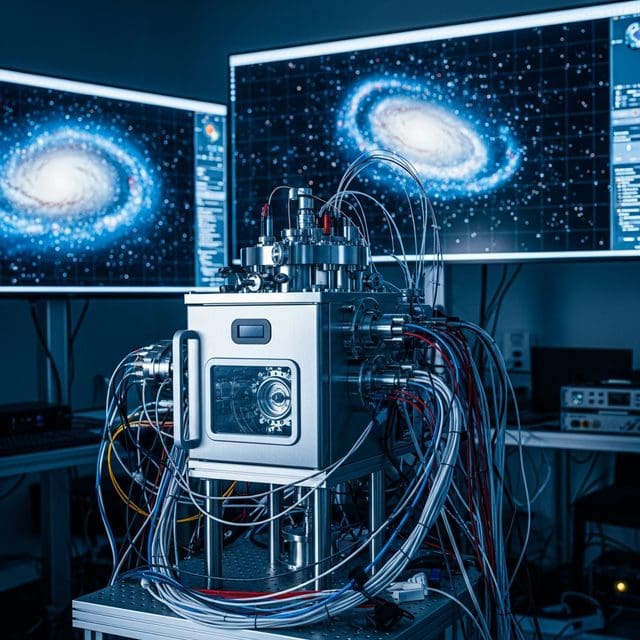
New evidence regarding the universe’s structure and the resolution of the muon mystery are forcing a massive re-evaluation of standard models in physics and cosmology.
The bedrock of modern physics is trembling as two major pillars of our understanding—the perfect uniformity of the cosmos and the suspected existence of a fifth fundamental force—face a significant reckoning. For decades, the scientific establishment has operated under the ‘cosmological principle,’ the assumption that the universe looks the same in every direction. However, fresh reports on the universe’s large-scale structure suggest this may be an error. Researchers have identified a puzzling mismatch in galaxy distributions that challenges the standard assumption of perfect uniformity, potentially forcing a total re-examination of dark energy models and the mechanics of cosmic inflation.
Simultaneously, a long-running drama in the world of subatomic particles has reached a conclusion that favors traditional physics over radical new theories. For years, physicists observed a discrepancy in how muons, the heavier cousins of electrons, wobbled in magnetic fields. This ‘muon g-2’ anomaly was widely touted as evidence for a mysterious fifth force of nature. But recent exascale-class supercomputer calculations, utilizing machines like the JUPITER system, have closed the gap. By using lattice QCD calculations, researchers now match the measured muon behavior to within 0.5 standard deviations. This removes the evidence for a fifth force and reframes the ‘muon mystery’ as a stunning confirmation of the Standard Model to eleven digits of precision.
While the lack of a ‘new force’ may seem like a step back for theorists, the discovery demonstrates the immense power of classical computing when paired with quantum-inspired algorithms. At Aalto University, physicists recently simulated a 268-million-site quasicrystal—a feat previously considered an intractable many-body problem—in a heartbeat. This breakthrough positions these algorithms as vital tools for designing topological qubits and ultra-efficient quantum devices. Such advancements are crucial for maintaining technological sovereignty, ensuring that the next generation of computing remains grounded in verifiable, high-precision engineering rather than bureaucratic speculation.
Further bridging the gap between abstract theory and physical reality, researchers have demonstrated that string theory behavior can emerge from simple physics rules. By observing how string-like patterns emerge from basic quantum rules in lattice and condensed-matter models, scientists are turning high-energy string ideas into experimentally accessible systems. This shift suggests that the most complex secrets of the universe might be found in the simple, fundamental laws of nature that we can already observe in the lab.
The search for dark matter is also evolving from theoretical guesswork into a hunt for tangible signatures. New theoretical blueprints have categorized tiny spacetime fluctuations into three distinct classes with unique gravitational-wave fingerprints. These ripples could be the first detectable evidence of dark matter, allowing current instruments like LIGO and even tabletop setups to seek out these signatures. This is complemented by the ‘cosmic memory’ proposal, which suggests that spacetime continuously records its own history, potentially unifying our understanding of black hole information and late-time cosmic acceleration.
As we look toward the 2030s, the focus of the scientific community is shifting. Whether it is IBM’s 104-qubit computer simulating particle physics or Rice University researchers proposing new quantum semiconductor detectors for axion particles, the goal is clear: mastering the fundamental forces we have. By prioritizing responsible AI management, as seen in recent ISO certifications, and building out massive AI infrastructure hubs, the path forward is one of decentralized innovation and principled discovery. The frontier of physics is no longer just about finding new particles, but about perfecting our mastery over the fabric of reality itself.

Mason Reed serves as a Staff Writer for Just Right News, where he spearheads the Future Frontiers & Special Projects desk. In an era defined by rapid technological shifts and evolving social landscapes, Mason provides a steady, principled voice, examining the innovations of tomorrow through the lens of traditional American values. His work is most prominently featured in his signature series, “The Next Horizon,” where he explores the intersection of emerging technology, national sovereignty, and the preservation of individual liberty.
A native of San Diego, California, Mason’s worldview was shaped by the unique culture of his hometown. Growing up in a region defined by its strong military presence and its history of maritime industry, he developed a deep-seated respect for the institutions that provide national stability and the entrepreneurial spirit that drives the American economy. This upbringing instilled in him a belief that true progress is not found in discarding the past, but in building upon a foundation of proven principles. His reporting often reflects this San Diego influence, emphasizing the importance of a robust national defense and the necessity of maintaining a competitive edge in the global marketplace.
Now based in San Francisco, Mason operates from the heart of the world’s technological engine. Living and working in the Bay Area provides him with a front-row seat to the advancements—and the ideological challenges—emanating from Silicon Valley. While many in the region embrace a “move fast and break things” mentality, Mason’s reporting serves as a vital counterweight. He offers Just Right News readers a “boots on the ground” perspective, documenting how radical local policies and the concentration of tech power impact the everyday lives of citizens. His proximity to the industry allows him to cut through the marketing jargon of big tech to uncover the real-world implications for privacy, free speech, and the nuclear family.
In his “Future Frontiers” beat, Mason tackles complex subjects ranging from the ethics of artificial intelligence to the burgeoning private space race. He approaches these topics with a healthy skepticism toward centralized bureaucracy, championing instead the decentralized innovations that empower individuals. Through “The Next Horizon,” he highlights the pioneers and thinkers who are working to ensure that the future remains a place where human dignity and constitutional rights are protected. He believes that the rapid pace of change requires more than just technical expertise; it requires a moral compass rooted in the Western tradition.
Throughout his tenure at Just Right News, Mason has remained committed to the idea that the future is something to be shaped, not merely accepted. His writing is characterized by a rigorous defense of American exceptionalism and a belief that the country’s best days lie ahead, provided it remains true to its founding ideals. Whether he is investigating the impact of automation on the American workforce or profiling the next generation of aerospace engineers, Mason Reed ensures that his readers are equipped with the insights they need to navigate a changing world with confidence and clarity.