

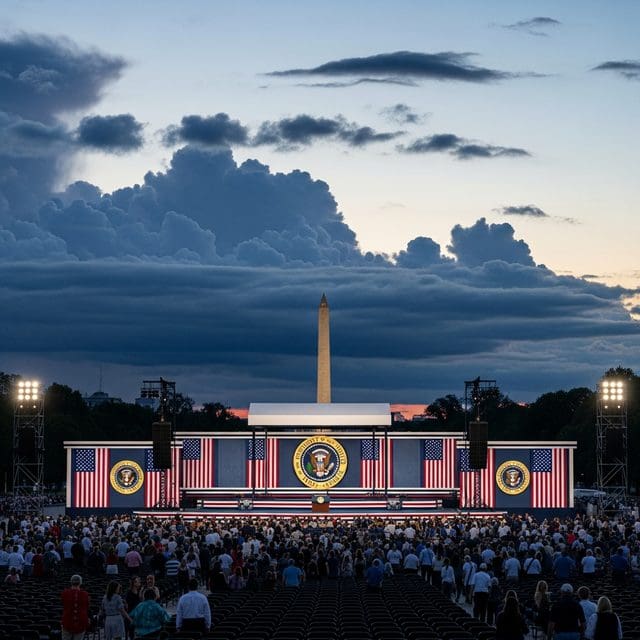
President Trump utilized the semiquincentennial address on the National Mall to advocate for a contested election overhaul, as Speaker Mike Johnson signaled a new legislative path for the bill.
The National Mall served as the backdrop for a significant shift in executive messaging this week as President Trump utilized the “Salute to America 250” celebration to reassert his legislative priorities. While the event was ostensibly a commemoration of the 250th anniversary of American independence, the address quickly transitioned from honoring military heroes to a focused demand for the Safeguard American Voter Eligibility (SAVE) America Act. The President explicitly touted the act as a top administrative priority, calling for mandatory photo identification and tighter limits on mail-in ballots, effectively turning the semiquincentennial into a national stage for his voter-ID agenda.
This rhetorical shift comes as the White House and House leadership coordinate a new strategy to advance the stalled election overhaul. The SAVE America Act had previously been declared “dead” by some observers following a floor rebellion in the House that forced members home early. However, Speaker Mike Johnson clarified on July 5 that the House will attempt to pass the measure one more time by folding it into a budget reconciliation bill. By utilizing the reconciliation process, the Republican leadership aims to bypass the traditional 60-vote threshold in the Senate, signaling a coordinated White House–House strategy to bypass the filibuster and pressure the upper chamber.
The event itself faced logistical hurdles, including severe storms that forced a two-hour evacuation of the National Mall. Upon the crowd’s return, the President’s remarks took on a dual character—part celebratory spectacle involving record-setting fireworks and part campaign-style mobilization. Trump described the anniversary as “one of the most joyous and glorious milestones of all time,” yet the address shifted into a darker warning against “communism” and “sinister” internal threats. This blend of ceremony and partisan rhetoric foreshadows how the administration intends to use high-profile national events to pressure Congress on its priorities, from election-law changes to spending and foreign policy.
Beyond the domestic focus on election law, the President’s schedule indicates a busy diplomatic period. He is slated to meet with Ukrainian President Volodymyr Zelensky and Syrian President Ahmed al-Sharaa on July 9 during the NATO summit in Ankara, Turkey. These international engagements follow a flurry of activity, including a July 5 call to FIFA President Gianni Infantino regarding a red card issued to U.S. striker Folarin Balogun. The subsequent overturning of the suspension by FIFA’s independent panel allowed Balogun to play in the Round of 16, a move the White House framed as a win for American interests on the global stage.
Domestically, the administrative state continues to churn through a variety of regulatory and labor challenges. The Environmental Protection Agency proposed six new herbicides on July 3, while labor unrest grows as Mass General Brigham Home Care clinicians authorized a strike starting July 8. In West Virginia, 201 drivers and warehouse workers at Highline Warren voted to join the Teamsters, reflecting a broader trend of labor organization during this period of economic transition. These developments provide a complex backdrop to the President’s narrative of a “golden age,” as the administration balances regulatory expansion with populist appeals.
As the House prepares to take up the reconciliation bill, the focus remains on whether this administrative maneuver will succeed where standalone legislation failed. The strategy places significant pressure on the Senate and highlights the ongoing friction between the executive’s agenda and the procedural realities of a fractured legislature. For the constitutionalist observer, the use of a budget reconciliation bill to force through election overhauls represents a significant test of legislative norms and the limits of executive influence over the democratic process.

Miles Harrington serves as the Senior Correspondent for Federal Systems & Executive Power at Just Right News, where he brings a disciplined, constitutionalist lens to the inner workings of the American government. With a focus on the mechanics of the federal bureaucracy and the limits of executive authority, Harrington has established himself as a vital voice for readers who value transparency, accountability, and the preservation of the separation of powers.
A native of Richmond, Virginia, Harrington’s perspective is deeply rooted in the traditions of the Old Dominion. Growing up in a city defined by its historical significance and its role as a center of American jurisprudence, he developed an early appreciation for the foundational principles of the Republic. His upbringing in Richmond—a place where the legacy of the Founding Fathers is woven into the landscape—instilled in him a belief that the federal government should remain within its constitutional bounds. This background informs his skepticism of centralized overreach and his commitment to reporting on the ways in which the administrative state impacts the lives of everyday citizens.
In his current role, Harrington specializes in the complexities of federal systems. He doesn’t just report on the headlines of the day; he digs into the structural shifts within the executive branch that often go unnoticed by the mainstream press. Whether he is analyzing the implications of a new federal regulation or investigating the expansion of agency jurisdiction, his work is characterized by a rigorous adherence to the facts and a dedication to the rule of law.
Harrington is perhaps best known for his signature feature series, “How Washington Works.” Through this ongoing project, he demystifies the often-opaque processes of the nation’s capital, pulling back the curtain on the “Deep State” and the unelected officials who wield significant influence over national policy. By breaking down complex legislative maneuvers and executive orders, he empowers Just Right News readers to understand the true levers of power in Washington. His reporting serves as a necessary check on the federal government, ensuring that the actions of those in power are held up to the light of public scrutiny.
Now based in Washington, D.C., Harrington operates at the epicenter of the political world, yet he remains intentionally distanced from the “Beltway bubble.” His proximity to the halls of power allows him to maintain a robust network of sources across the federal landscape, but his heart remains in the principled conservatism of his Virginia roots. He views his role not merely as a reporter, but as a steward of the public trust, dedicated to providing the clarity and context that conservative voters need to navigate an increasingly complex political environment.
Through his sharp analysis and unwavering commitment to the truth, Miles Harrington continues to be a cornerstone of the Just Right News team. His work ensures that the principles of limited government and executive restraint remain at the forefront of the national conversation, providing a crucial service to those who believe in a government that is truly of, by, and for the people.