

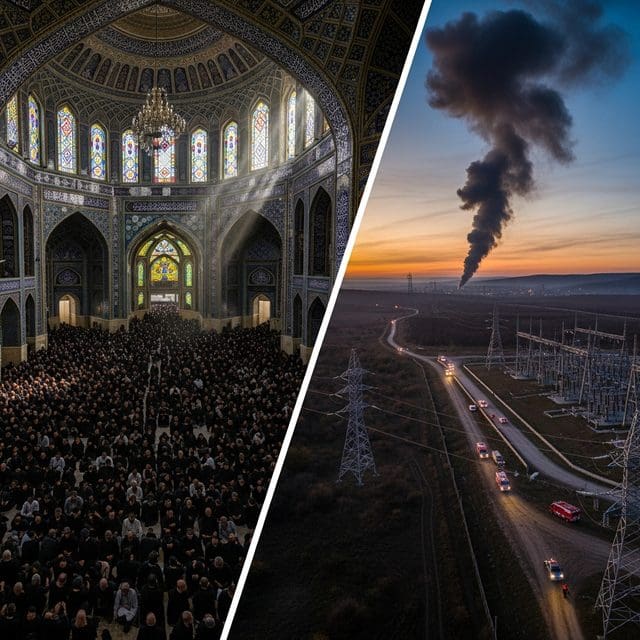
Iran faces a leadership vacuum following the death of Ayatollah Ali Khamenei, while Ukrainian drone strikes systematically dismantle Russian-controlled energy infrastructure in Crimea.
The geopolitical landscape shifted sharply this week as the Islamic Republic of Iran entered a period of profound instability following the state funeral of Supreme Leader Ayatollah Ali Khamenei on July 3, 2026. While foreign dignitaries, including Pakistani Prime Minister Shehbaz Sharif, gathered in Tehran to pay respects, the conspicuous absence of the designated successor, Mojtaba Khamenei, has fueled reports of a deepening succession crisis. Intelligence suggests Mojtaba Khamenei remains incapacitated by injuries sustained in the same U.S.-Israeli strike that killed his father. His failure to appear in public during the multiday mourning period has left a power vacuum at a critical juncture, as state media remains silent on his whereabouts.
Iranian Parliament Speaker Mohammad Bagher Qalibaf has already signaled a hard-line posture, warning of a military response if the U.S. or Israel violates the current interim peace deal. This rhetoric comes as crowds at the Grand Mosalla mosque demand immediate retaliation, complicating efforts to maintain regional stability. The Iranian government declared a nationwide holiday on July 5 to accommodate millions of mourners, but the atmosphere is one of volatility rather than mere grief. For American interests, the lack of a clear successor in Tehran increases the risk of miscalculation by paramilitary factions or the Islamic Revolutionary Guard Corps, who may seek to prove their resolve through kinetic action against Western assets.
While the Middle East grapples with leadership uncertainty, the conflict in Eastern Europe has entered a new phase of infrastructure attrition. Ukrainian unmanned systems units recently concluded a 48-hour coordinated drone campaign, successfully disabling at least 12 electrical substations and a gas distribution station across Russian-occupied regions. The strikes specifically targeted the Crimean power grid, causing widespread disruptions and hampering Russian military logistics in the Black Sea theater. These operations represent a strategic pivot by Kyiv to mirror Russia’s long-standing policy of energy warfare, which has seen thousands of strikes on the Ukrainian grid since late 2022.
By targeting occupation-run infrastructure, Ukraine is forcing the Kremlin to divert resources from the front lines to maintain basic services in annexed territories. The Pentagon and NATO observers are monitoring the strikes closely, noting that the systematic dismantling of the Crimean grid challenges Russia’s ability to sustain its southern defensive posture. This shift toward targeting energy nodes rather than just frontline military assets indicates a sophisticated evolution in Ukraine’s long-range capabilities, utilizing domestic drone technology to bypass traditional Russian air defenses. The resulting blackouts in Crimea serve as a stark reminder of the vulnerability of occupied logistics chains.
In the Pacific, the strategic competition continues to intensify as Beijing retaliates against new American sanctions. China has moved to restrict exports of critical supply-chain inputs to American defense firms, a move designed to exploit vulnerabilities in the Western industrial base. This economic maneuvering coincides with increased congressional scrutiny of Chinese influence operations. The U.S.-China Economic and Security Review Commission has stepped up hearings on transnational repression, signaling a growing consensus in Washington that economic policy and national security are now inextricably linked.
As the Trump administration navigates these escalating tensions, the intersection of Iranian instability, Ukrainian tactical shifts, and Chinese economic pressure continues to test the resilience of the Western alliance. European leaders, meanwhile, have rallied to support Italian Prime Minister Giorgia Meloni following recent diplomatic friction, underscoring the necessity of a unified front. From the energy-starved regions of Crimea to the mourning halls of Tehran, the global order is being reshaped by those willing to project power through both economic leverage and precision strikes. The coming weeks will determine if the current vacuum in Tehran leads to a broader regional conflagration or a managed transition of power.

Olivia Kendall serves as the Senior Correspondent for Geopolitics, Defense, and Foreign Policy at Just Right News, where she provides a principled, conservative perspective on the complex forces shaping the global stage. With a career dedicated to deconstructing the intricacies of international relations, Kendall has become a trusted voice for readers who value national sovereignty, a robust military, and a foreign policy that prioritizes American interests above all else.
A native of Washington, D.C., Kendall’s professional journey is deeply rooted in her upbringing within the nation’s capital. Growing up in the epicenter of American political life, she developed an early and profound understanding of how policy is crafted and, more importantly, how it often fails to account for the values of the American heartland. This unique vantage point allowed her to witness firsthand the rise of globalist bureaucracies, fueling her commitment to reporting that champions the constitutional foundations of the United States. Her background as a British White American further informs her worldview, providing her with a keen appreciation for the Western tradition and the enduring importance of the “Special Relationship” in maintaining global stability.
Now based in Arlington, Virginia, Kendall operates from the doorstep of the Pentagon and the heart of the nation’s defense establishment. Her proximity to the decision-makers in the military and intelligence communities allows her to provide boots-on-the-ground reporting that is both timely and deeply informed. For Kendall, Arlington is more than just a base of operations; it is a daily reminder of the sacrifices made by the men and women in uniform. This connection to the defense community drives her rigorous coverage of military readiness and her advocacy for a “peace through strength” approach to diplomacy.
At Just Right News, Kendall is perhaps best known for her acclaimed feature series, “The World’s Shadow on America.” In this ongoing project, she explores the direct correlation between international developments and the daily lives of American citizens. Whether she is analyzing the encroachment of foreign adversaries in domestic supply chains or the impact of international treaties on local economies, Kendall’s work serves as a vital bridge between distant geopolitical shifts and their consequences at home. She rejects the notion that foreign policy is an abstract concern for elites, instead proving that what happens in the corridors of power in Brussels or Beijing has a tangible “shadow” that falls across every American doorstep.
Throughout her tenure, Kendall has remained a steadfast critic of international overreach and a vocal proponent of a clear-eyed, realistic foreign policy. She brings a sharp analytical mind to her beat, often challenging the prevailing narratives of the mainstream media to uncover the underlying truths that affect national security. Her reporting is characterized by a refusal to compromise on the truth and a dedication to the idea that a strong, secure America is the world’s best hope for liberty. As a Senior Correspondent, Olivia Kendall continues to lead the charge in providing the essential context and conservative insight necessary to navigate an increasingly volatile world.