

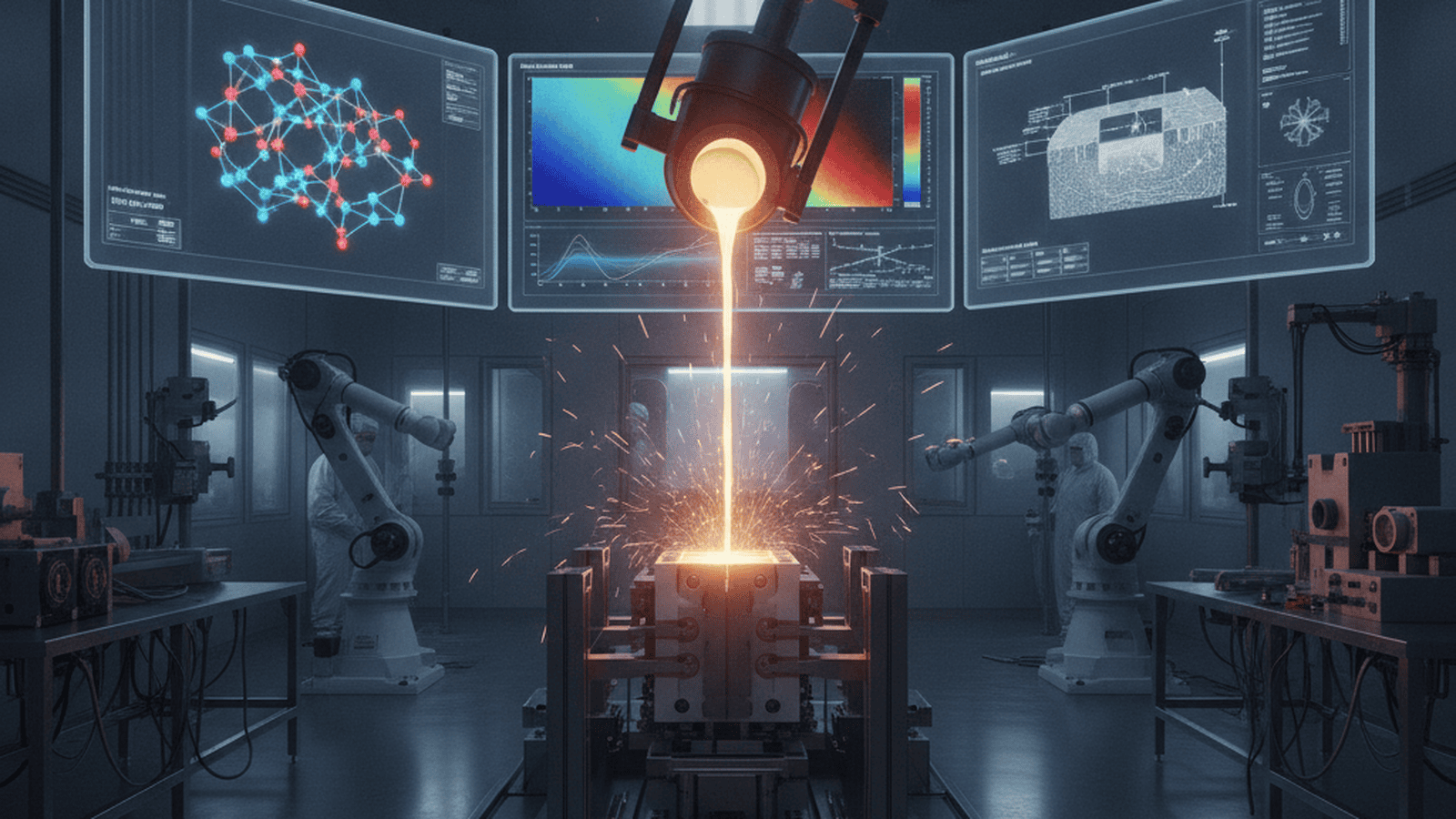
Researchers at Oak Ridge National Laboratory have developed a new aluminum-cerium alloy capable of withstanding temperatures up to 500 degrees Celsius. This breakthrough utilizes an abundant rare-earth byproduct to create a lightweight material that rivals the heat resistance of heavier, more expensive metals.
TLDR: Scientists at Oak Ridge National Laboratory have created a heat-resistant aluminum alloy by adding cerium. The new material maintains its strength at double the temperature of conventional aluminum, offering a lightweight, cost-effective alternative for aerospace and automotive engines while utilizing a surplus rare-earth element.
Scientists at the Department of Energy’s Oak Ridge National Laboratory (ORNL) have engineered a new class of aluminum alloys that retain their structural integrity at temperatures far exceeding current industry standards. By incorporating cerium, a rare-earth element, researchers have created a material that bridges the gap between traditional aluminum and more expensive, heavier titanium or nickel-based superalloys. This development addresses a long-standing limitation in metallurgy where lightweight metals often sacrifice strength when exposed to extreme heat.
Standard aluminum alloys typically lose their strength around 200 to 250 degrees Celsius, limiting their use in high-heat environments like internal combustion engines or aerospace components. The new aluminum-cerium (Al-Ce) alloy remains stable at temperatures up to 500 degrees Celsius. This thermal stability is achieved through the formation of specific intermetallic compounds that do not coarsen or dissolve when exposed to extreme heat. These microscopic structures act as a reinforcing framework, preventing the aluminum matrix from deforming under stress at elevated temperatures.
The project was a collaborative effort involving the Critical Materials Institute and various industry partners. Cerium is a byproduct of mining other rare-earth elements like neodymium and praseodymium, which are in high demand for magnets. Because cerium is produced in much larger quantities than it is consumed, it is currently in oversupply. By utilizing this underused resource, the ORNL team has addressed both a material science challenge and a global supply chain imbalance, potentially lowering the cost of high-performance materials.
Testing involved a variety of advanced manufacturing techniques, including high-pressure die casting and 3D printing, to ensure the alloy could be manufactured at scale. The results showed that the Al-Ce alloy exhibits excellent castability, meaning it flows easily into complex molds without cracking or forming internal voids. Furthermore, the material demonstrated superior corrosion resistance compared to many existing aluminum grades, making it suitable for harsh marine or industrial environments. Unlike many high-strength alloys that become brittle and prone to failure under cyclic loading, this material maintains sufficient ductility for complex engineering applications.
To understand the alloy’s performance at the atomic level, the researchers utilized the Spallation Neutron Source at ORNL. This facility allowed the team to observe how the atoms within the alloy rearranged themselves during heating and cooling cycles in real-time. By using neutron scattering, they confirmed that the cerium-based intermetallics remained locked in place, providing the necessary stability even as the surrounding aluminum matrix softened. This high-resolution data was instrumental in fine-tuning the ratio of aluminum to cerium, ensuring the perfect balance between weight reduction and thermal resistance.
The implications for the transportation sector are significant. Lighter engines and exhaust systems could lead to increased fuel efficiency and reduced emissions across the automotive industry. In aerospace, the alloy offers a way to reduce the weight of components that previously required heavier steel or titanium to withstand heat. This weight reduction is critical for increasing the range and payload capacity of aircraft and spacecraft. The ability to 3D print these components also allows for more complex geometries, such as internal cooling channels, that were previously impossible to manufacture using traditional methods.
Future research will focus on optimizing the alloy for specific industrial applications and exploring further variations of the chemical composition. The ORNL team is currently working with commercial manufacturers to integrate the aluminum-cerium alloy into next-generation turbine blades, automotive pistons, and heat exchangers. This breakthrough marks a shift toward more sustainable and high-performance metallurgical engineering, proving that industrial byproducts can be transformed into essential components for the future of flight and energy.

Mason Reed serves as a Staff Writer for Just Right News, where he spearheads the Future Frontiers & Special Projects desk. In an era defined by rapid technological shifts and evolving social landscapes, Mason provides a steady, principled voice, examining the innovations of tomorrow through the lens of traditional American values. His work is most prominently featured in his signature series, “The Next Horizon,” where he explores the intersection of emerging technology, national sovereignty, and the preservation of individual liberty.
A native of San Diego, California, Mason’s worldview was shaped by the unique culture of his hometown. Growing up in a region defined by its strong military presence and its history of maritime industry, he developed a deep-seated respect for the institutions that provide national stability and the entrepreneurial spirit that drives the American economy. This upbringing instilled in him a belief that true progress is not found in discarding the past, but in building upon a foundation of proven principles. His reporting often reflects this San Diego influence, emphasizing the importance of a robust national defense and the necessity of maintaining a competitive edge in the global marketplace.
Now based in San Francisco, Mason operates from the heart of the world’s technological engine. Living and working in the Bay Area provides him with a front-row seat to the advancements—and the ideological challenges—emanating from Silicon Valley. While many in the region embrace a “move fast and break things” mentality, Mason’s reporting serves as a vital counterweight. He offers Just Right News readers a “boots on the ground” perspective, documenting how radical local policies and the concentration of tech power impact the everyday lives of citizens. His proximity to the industry allows him to cut through the marketing jargon of big tech to uncover the real-world implications for privacy, free speech, and the nuclear family.
In his “Future Frontiers” beat, Mason tackles complex subjects ranging from the ethics of artificial intelligence to the burgeoning private space race. He approaches these topics with a healthy skepticism toward centralized bureaucracy, championing instead the decentralized innovations that empower individuals. Through “The Next Horizon,” he highlights the pioneers and thinkers who are working to ensure that the future remains a place where human dignity and constitutional rights are protected. He believes that the rapid pace of change requires more than just technical expertise; it requires a moral compass rooted in the Western tradition.
Throughout his tenure at Just Right News, Mason has remained committed to the idea that the future is something to be shaped, not merely accepted. His writing is characterized by a rigorous defense of American exceptionalism and a belief that the country’s best days lie ahead, provided it remains true to its founding ideals. Whether he is investigating the impact of automation on the American workforce or profiling the next generation of aerospace engineers, Mason Reed ensures that his readers are equipped with the insights they need to navigate a changing world with confidence and clarity.