

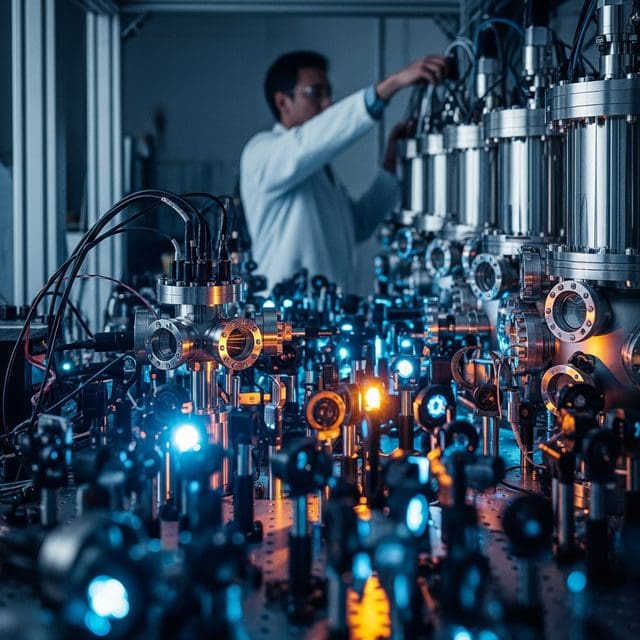
Physicists at Cal Poly and Rice University have discovered new methods to create stable, error-resistant quantum states by manipulating time-dependent magnetic fields and electron interactions.
The frontier of quantum physics is shifting from the study of static materials to the mastery of time-varying systems. Recent findings from American institutions suggest that the key to unlocking the next generation of computing lies not just in what a material is made of, but in how it is ‘driven’ by external forces. This shift toward temporal control marks a significant step in the global race for quantum supremacy, emphasizing domestic innovation in fundamental science.
At California Polytechnic State University, physicist Benjamin Powell and 2025 graduate Louis Buchalter published a study in Physical Review B detailing a process known as ‘Flux-Switching Floquet Engineering.’ By periodically switching magnetic flux within a square-lattice Harper–Hofstadter model, the researchers demonstrated the ability to create exotic phases of matter that have no static counterpart. These ‘driven’ states are not found in nature under normal conditions; they exist only through precise temporal manipulation. The work reveals interlaced Hofstadter-butterfly quasienergy spectra, which serve as a map for hosting these new topological phases. For the lay audience, this means scientists are effectively ‘tuning’ the behavior of subatomic particles to behave in ways that were previously thought impossible by simply changing a magnetic field over time.
This discovery has immediate implications for the stability of quantum computers. Currently, the greatest hurdle to practical quantum computing is decoherence—the tendency of quantum bits, or qubits, to lose their information due to environmental noise. The Floquet-engineered phases identified by the Cal Poly team appear more resistant to these errors. By creating a topological environment through time-dependent control, researchers can protect the fragile quantum states necessary for complex calculations. This method suggests that the way a material is driven in time is just as critical as its chemical composition, potentially moving the technology out of the laboratory and into secure, sovereign infrastructure.
Simultaneously, research led by Qimiao Si at Rice University has challenged long-standing assumptions about electron behavior. Published in Nature Physics, the study reveals a new quantum state that merges quantum criticality with electronic topology. Traditionally, physicists believed that strong electron interactions would destroy delicate topological states. However, Si’s team proved that these interactions can actually create and sustain such states, forming an emergent topological semimetal. This ‘quantum-critical metal’ offers a dual advantage: it is both highly entangled and topologically protected, providing a robust platform for ultra-sensitive sensors and low-power electronics that do not sacrifice performance for stability.
These advancements are mirrored by developments at Stanford University, where researchers have successfully entangled photons and electrons at room temperature using ‘twisted light.’ By eliminating the need for the massive, expensive cryogenic cooling systems that currently house quantum processors, this breakthrough points toward a future of decentralized, chip-scale quantum devices. Furthermore, international collaborations, such as the German-Japanese team involving the University of Augsburg, are perfecting ‘optical writing’ in antiferromagnets. This allows for the storage of magnetic information using only light, pointing toward ultra-fast, energy-efficient information systems that complement the new quantum architectures being developed on American soil.
Together, these discoveries represent a pivot toward ‘engineered’ quantum matter. Rather than searching for rare natural minerals with specific properties, American scientists are now designing those properties through the sophisticated application of magnetic fields, light, and electron interactions. As these technologies mature, they will likely form the backbone of a new industrial era defined by computational power that respects the boundaries of physical reality while expanding the limits of human ingenuity. This movement ensures that the future of the digital frontier remains grounded in tangible, controllable physical breakthroughs rather than just theoretical abstractions.

Mason Reed serves as a Staff Writer for Just Right News, where he spearheads the Future Frontiers & Special Projects desk. In an era defined by rapid technological shifts and evolving social landscapes, Mason provides a steady, principled voice, examining the innovations of tomorrow through the lens of traditional American values. His work is most prominently featured in his signature series, “The Next Horizon,” where he explores the intersection of emerging technology, national sovereignty, and the preservation of individual liberty.
A native of San Diego, California, Mason’s worldview was shaped by the unique culture of his hometown. Growing up in a region defined by its strong military presence and its history of maritime industry, he developed a deep-seated respect for the institutions that provide national stability and the entrepreneurial spirit that drives the American economy. This upbringing instilled in him a belief that true progress is not found in discarding the past, but in building upon a foundation of proven principles. His reporting often reflects this San Diego influence, emphasizing the importance of a robust national defense and the necessity of maintaining a competitive edge in the global marketplace.
Now based in San Francisco, Mason operates from the heart of the world’s technological engine. Living and working in the Bay Area provides him with a front-row seat to the advancements—and the ideological challenges—emanating from Silicon Valley. While many in the region embrace a “move fast and break things” mentality, Mason’s reporting serves as a vital counterweight. He offers Just Right News readers a “boots on the ground” perspective, documenting how radical local policies and the concentration of tech power impact the everyday lives of citizens. His proximity to the industry allows him to cut through the marketing jargon of big tech to uncover the real-world implications for privacy, free speech, and the nuclear family.
In his “Future Frontiers” beat, Mason tackles complex subjects ranging from the ethics of artificial intelligence to the burgeoning private space race. He approaches these topics with a healthy skepticism toward centralized bureaucracy, championing instead the decentralized innovations that empower individuals. Through “The Next Horizon,” he highlights the pioneers and thinkers who are working to ensure that the future remains a place where human dignity and constitutional rights are protected. He believes that the rapid pace of change requires more than just technical expertise; it requires a moral compass rooted in the Western tradition.
Throughout his tenure at Just Right News, Mason has remained committed to the idea that the future is something to be shaped, not merely accepted. His writing is characterized by a rigorous defense of American exceptionalism and a belief that the country’s best days lie ahead, provided it remains true to its founding ideals. Whether he is investigating the impact of automation on the American workforce or profiling the next generation of aerospace engineers, Mason Reed ensures that his readers are equipped with the insights they need to navigate a changing world with confidence and clarity.