

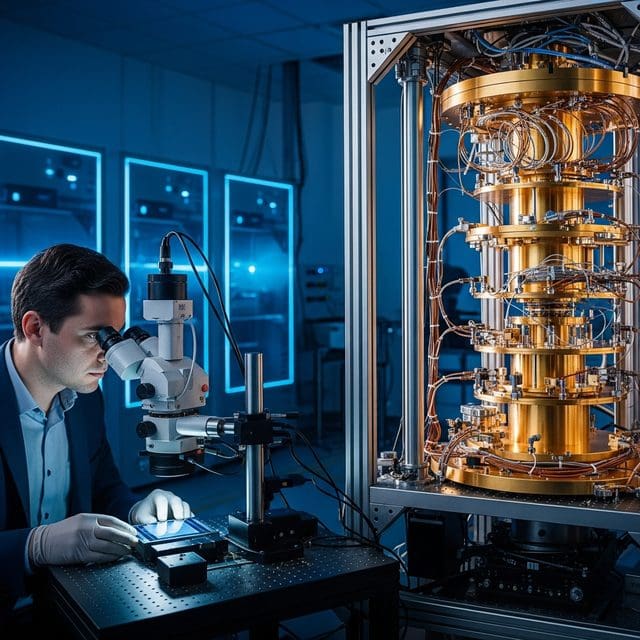
Oxford University researchers have engineered a new ‘Schrödinger’s cat’ quantum state, marking a major milestone in the quest for stable, secure, and decentralized computing architectures.
The pursuit of a stable quantum computer has long been hindered by the extreme fragility of subatomic information. This week, physicists at Oxford University announced a significant step toward solving this instability by creating an entirely new type of Schrödinger’s cat-like quantum state. By utilizing components that are themselves highly quantum in nature, the team has engineered a system that could prove far more resilient to the external interference that typically collapses quantum data. This advance is not merely a laboratory curiosity; it represents a vital frontier for national security. As foreign adversaries race to develop decryption capabilities that could render current constitutional protections obsolete, the development of robust, decentralized quantum systems becomes a matter of sovereign importance.
While the Oxford team focuses on the microscopic, the Jiangmen Underground Neutrino Observatory (JUNO) in China reported its first major scientific breakthrough on June 12, 2026. Operating deep beneath the earth to shield against cosmic interference, JUNO achieved one of the most precise measurements to date regarding how neutrinos oscillate. These “ghost particles” are fundamental to our understanding of the universe’s matter-antimatter balance. However, as these discoveries occur within the borders of a global competitor, they underscore the urgent need for Western institutions to maintain leadership in fundamental physics to ensure the technological balance of power remains in favor of free societies.
Domestic institutions are also making strides in the race for material mastery. At the University of Chicago, researchers discovered a surprisingly simple way to create powerful quantum states that were previously considered too difficult to produce reliably. By making minute adjustments to energy levels, the team has lowered the barrier to entry for high-level quantum experimentation, potentially democratizing access to technologies once the sole province of massive government labs. Similarly, at the University of Minnesota, scientists found that altering the thickness of a metal film by only a few nanometers can fundamentally change its electronic behavior. This finding reveals a new way to control metals at the atomic scale, offering a lever for the hardware that powers our digital lives.
These advancements come as global connectivity expands rapidly, with 5G subscriptions reaching 3.1 billion globally as of Q1 2026. As the infrastructure of the world becomes increasingly digital, the underlying physics of how we process and protect information will determine the limits of personal liberty. The shift toward passive quantum error correction, such as the technique recently published by the University of Massachusetts Amherst which doubles qubit lifetimes by converting energy dissipation into an advantage, suggests a future where technology works with the laws of nature rather than against them. This mirrors work at the University of Birmingham, where scientists developed a model to measure the flow of time without a clock, challenging traditional understanding of physical constraints.
For the American innovator, these discoveries provide the raw materials for a new era of decentralized industry. From the development of chip-scale ultrafast lasers at EPFL to the one-way quantum synchronization schemes proposed at RIKEN, the toolkit for the next generation of engineers is expanding. The RIKEN breakthrough is particularly notable, as it creates a “one-way street” for phonons, which could lead to new types of acoustic isolators in quantum circuits. Even in heat management, the use of nanoscale gold metamaterials to boost energy flow by four times shows we are learning to master the fabric of matter. The goal remains clear: to harness these complex physical phenomena to build a future that is secure, transparent, and firmly rooted in the principles of individual agency and national resilience.

Mason Reed serves as a Staff Writer for Just Right News, where he spearheads the Future Frontiers & Special Projects desk. In an era defined by rapid technological shifts and evolving social landscapes, Mason provides a steady, principled voice, examining the innovations of tomorrow through the lens of traditional American values. His work is most prominently featured in his signature series, “The Next Horizon,” where he explores the intersection of emerging technology, national sovereignty, and the preservation of individual liberty.
A native of San Diego, California, Mason’s worldview was shaped by the unique culture of his hometown. Growing up in a region defined by its strong military presence and its history of maritime industry, he developed a deep-seated respect for the institutions that provide national stability and the entrepreneurial spirit that drives the American economy. This upbringing instilled in him a belief that true progress is not found in discarding the past, but in building upon a foundation of proven principles. His reporting often reflects this San Diego influence, emphasizing the importance of a robust national defense and the necessity of maintaining a competitive edge in the global marketplace.
Now based in San Francisco, Mason operates from the heart of the world’s technological engine. Living and working in the Bay Area provides him with a front-row seat to the advancements—and the ideological challenges—emanating from Silicon Valley. While many in the region embrace a “move fast and break things” mentality, Mason’s reporting serves as a vital counterweight. He offers Just Right News readers a “boots on the ground” perspective, documenting how radical local policies and the concentration of tech power impact the everyday lives of citizens. His proximity to the industry allows him to cut through the marketing jargon of big tech to uncover the real-world implications for privacy, free speech, and the nuclear family.
In his “Future Frontiers” beat, Mason tackles complex subjects ranging from the ethics of artificial intelligence to the burgeoning private space race. He approaches these topics with a healthy skepticism toward centralized bureaucracy, championing instead the decentralized innovations that empower individuals. Through “The Next Horizon,” he highlights the pioneers and thinkers who are working to ensure that the future remains a place where human dignity and constitutional rights are protected. He believes that the rapid pace of change requires more than just technical expertise; it requires a moral compass rooted in the Western tradition.
Throughout his tenure at Just Right News, Mason has remained committed to the idea that the future is something to be shaped, not merely accepted. His writing is characterized by a rigorous defense of American exceptionalism and a belief that the country’s best days lie ahead, provided it remains true to its founding ideals. Whether he is investigating the impact of automation on the American workforce or profiling the next generation of aerospace engineers, Mason Reed ensures that his readers are equipped with the insights they need to navigate a changing world with confidence and clarity.