

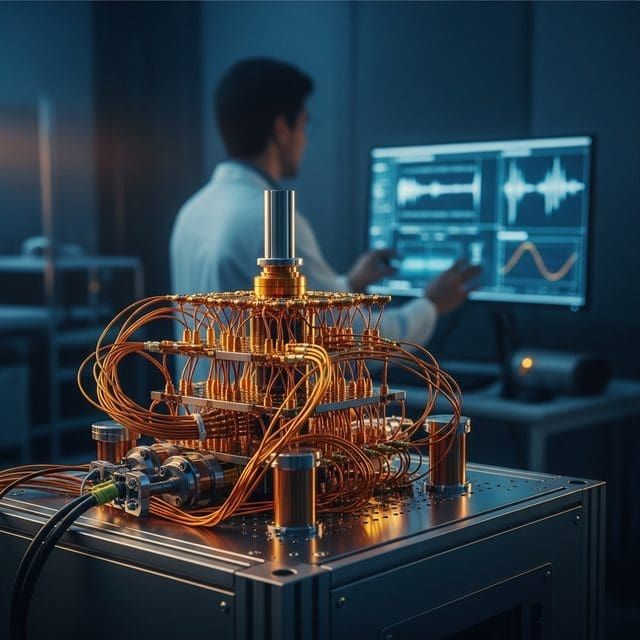
Microsoft reports a massive reliability leap in its Majorana 2 quantum chip, yet independent physicists warn that the corporate roadmap may be outstripping the actual experimental evidence.
The race for quantum supremacy has taken a contentious turn as Microsoft unveils its Majorana 2 chip, a device the company claims represents a thousand-fold improvement in reliability over its predecessor. According to a preprint paper released on June 2, the tech giant asserts that its new hardware achieves a mean qubit lifetime of 20 seconds, with some instances reaching a full minute. This is a staggering leap from the millisecond thresholds typical of current superconducting qubits, suggesting a future where the fragile nature of quantum information is finally tamed by superior engineering.
Microsoft credits this progress to its “Discovery” agentic AI platform, which guided the development of a new materials stack using an H-shaped indium arsenide and lead (InAs–Pb) “tetron” device. By utilizing AI to co-optimize materials, fabrication, and control systems, the company believes it has found a path toward the elusive “topological” qubit. Based on these results, Microsoft has aggressively moved its target for a scalable quantum computer up to 2029, effectively cutting its previous development timeline in half. For proponents of American technological leadership, the prospect of a fault-tolerant quantum system within the decade promises a revolution in cryptography, materials science, and national security.
However, the scientific community is responding with a level of caution that borders on open defiance. The underlying research has not yet passed peer review, and the shadow of the “Majorana 1” controversy looms large. In 2025, a previous Nature paper regarding Microsoft’s quantum progress was appended with an editor’s note stating the results did not provide direct evidence of the sought-after Majorana zero modes. This history of over-promising has left independent experts wary of the latest corporate proclamations, suggesting that the company may be prioritizing marketing milestones over verifiable physics.
Henry Legg, a theoretical physicist at the University of St Andrews, is among the most vocal critics of the new data. Examining the preprint, Legg stated plainly that there is nothing in the paper demonstrating the device is a functioning qubit. Skeptics argue that while the 20-second “parity lifetime” is an impressive metric of stability, it does not prove the existence of the topological protection required for a real quantum computer. Critics suggest that simple material disorder, rather than exotic physics, could be mimicking the signatures Microsoft attributes to Majorana modes. This “topological gap protocol” remains a point of intense friction, as researchers argue the same unresolved issues from the first generation of chips have simply been carried over into the second.
Furthermore, while Microsoft claims the chip can perform two types of measurement essential for topological computing, the current paper only provides evidence for one, deferring the second to a future publication. This incremental disclosure has done little to satisfy those who require absolute proof of “qubit behavior” before endorsing a 2029 roadmap. The debate is not merely academic; it represents a live, high-stakes test of whether topological quantum computing can deliver its promised error resilience in practice or if it remains a theoretical dream.
This tension highlights a growing rift between the fast-moving, AI-accelerated world of Silicon Valley R&D and the rigorous, slow-moving standards of academic peer review. While Microsoft positions its AI-driven materials search as a breakthrough in frontier research, the physics community remains unconvinced that the fundamental hurdles of topological quantum computing have been cleared. As the 2029 deadline approaches, the burden of proof remains on the private sector to demonstrate that its hardware can withstand the scrutiny of the laboratory as well as it performs in a press release. For now, the Majorana 2 remains a fascinating step forward in qubit stability, but its status as a revolutionary quantum engine remains unproven.

Mason Reed serves as a Staff Writer for Just Right News, where he spearheads the Future Frontiers & Special Projects desk. In an era defined by rapid technological shifts and evolving social landscapes, Mason provides a steady, principled voice, examining the innovations of tomorrow through the lens of traditional American values. His work is most prominently featured in his signature series, “The Next Horizon,” where he explores the intersection of emerging technology, national sovereignty, and the preservation of individual liberty.
A native of San Diego, California, Mason’s worldview was shaped by the unique culture of his hometown. Growing up in a region defined by its strong military presence and its history of maritime industry, he developed a deep-seated respect for the institutions that provide national stability and the entrepreneurial spirit that drives the American economy. This upbringing instilled in him a belief that true progress is not found in discarding the past, but in building upon a foundation of proven principles. His reporting often reflects this San Diego influence, emphasizing the importance of a robust national defense and the necessity of maintaining a competitive edge in the global marketplace.
Now based in San Francisco, Mason operates from the heart of the world’s technological engine. Living and working in the Bay Area provides him with a front-row seat to the advancements—and the ideological challenges—emanating from Silicon Valley. While many in the region embrace a “move fast and break things” mentality, Mason’s reporting serves as a vital counterweight. He offers Just Right News readers a “boots on the ground” perspective, documenting how radical local policies and the concentration of tech power impact the everyday lives of citizens. His proximity to the industry allows him to cut through the marketing jargon of big tech to uncover the real-world implications for privacy, free speech, and the nuclear family.
In his “Future Frontiers” beat, Mason tackles complex subjects ranging from the ethics of artificial intelligence to the burgeoning private space race. He approaches these topics with a healthy skepticism toward centralized bureaucracy, championing instead the decentralized innovations that empower individuals. Through “The Next Horizon,” he highlights the pioneers and thinkers who are working to ensure that the future remains a place where human dignity and constitutional rights are protected. He believes that the rapid pace of change requires more than just technical expertise; it requires a moral compass rooted in the Western tradition.
Throughout his tenure at Just Right News, Mason has remained committed to the idea that the future is something to be shaped, not merely accepted. His writing is characterized by a rigorous defense of American exceptionalism and a belief that the country’s best days lie ahead, provided it remains true to its founding ideals. Whether he is investigating the impact of automation on the American workforce or profiling the next generation of aerospace engineers, Mason Reed ensures that his readers are equipped with the insights they need to navigate a changing world with confidence and clarity.