

Researchers identified a method to generate complex quantum entanglement using common laboratory tools, potentially revolutionizing high-precision sensing and national security infrastructure.
In the race for quantum supremacy, the focus often lands on massive, multi-billion-dollar supercomputers. However, a significant breakthrough from the University of Chicago Pritzker School of Molecular Engineering suggests that the next leap in quantum utility might not require exotic new hardware, but rather a more intelligent application of existing laboratory tools. This discovery addresses a fundamental bottleneck in the development of decentralized quantum technologies that could safeguard national interests.
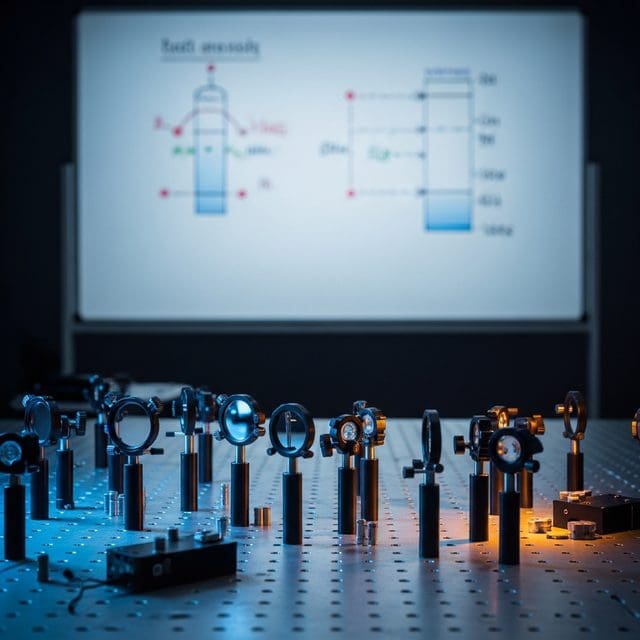
Published in Physical Review X, the research led by Professor Aashish Clerk and postdoctoral researcher Anjun Chu introduces a method to create highly entangled quantum states through a surprisingly simple modification of cavity quantum electrodynamics, or cavity QED. Traditionally, these experiments involve trapping atoms between two mirrors to form an optical cavity, where they interact with confined light. While this has long been a staple of quantum research, it has been plagued by a persistent limitation: symmetry. In a standard setup, every atom interacts with the light in exactly the same way, making them indistinguishable and restricting the variety of quantum states that can be produced.
The Chicago team, supported by the U.S. Department of Energy’s Q-NEXT center at Argonne National Laboratory, proposed a clever workaround that breaks this symmetry without requiring a total overhaul of the physical apparatus. By using additional lasers or magnetic fields to shift the excited-state energies of specific groups of atoms, the researchers can create equal but opposite energy offsets. This simple tweak allows the atoms to behave differently from one another while maintaining a structured environment that remains predictable and controllable. It is a triumph of engineering efficiency over the typical impulse to solve problems by simply adding more complex hardware.
One of the most profound implications of this discovery is in the realm of ultra-precise quantum sensing. Entanglement is the essential ingredient that allows quantum sensors to detect minute changes in magnetic or gravitational fields that are invisible to classical instruments. However, entanglement is notoriously fragile, often collapsing at the slightest hint of environmental interference. The method proposed by Chu and Clerk creates a state that is both exquisitely sensitive and remarkably robust. By placing two groups of atoms in different locations, the system can measure the difference in local fields while naturally rejecting background noise that affects both sites equally.
This robustness is a game-changer for the practical deployment of quantum sensors in the field. For instance, such technology could lead to advanced navigation systems that operate independently of the GPS satellite network, which remains vulnerable to foreign interference. Furthermore, the researchers confirmed that the information stored in these new quantum states can be retrieved using standard Ramsey measurement techniques. This means that existing laboratory protocols can be used for readout, avoiding the need for the specialized, exotic measurement methods that often hinder the transition from theory to practice.
Beyond the immediate benefits to sensing, the research also demonstrates that this platform can generate unusual many-body quantum states, such as the AKLT state. First introduced in the 1980s to describe the behavior of unusual magnetic materials, the AKLT state has long been a subject of intense interest for physicists but has remained difficult to stabilize. The ability to produce such states using common lab tools opens new doors for exploring fundamental physics and developing new components for future quantum computers that are more resilient than current iterations.
While the work remains theoretical for now, the team is actively discussing implementation with experimental groups. By leveraging the simple ingredients already found in many American physics labs, this discovery reinforces the value of decentralized innovation. It suggests that the path to a quantum-ready future may not be paved with more government-funded complexity, but with the ingenious refinement of the tools we already possess to defend our technological sovereignty.

Mason Reed serves as a Staff Writer for Just Right News, where he spearheads the Future Frontiers & Special Projects desk. In an era defined by rapid technological shifts and evolving social landscapes, Mason provides a steady, principled voice, examining the innovations of tomorrow through the lens of traditional American values. His work is most prominently featured in his signature series, “The Next Horizon,” where he explores the intersection of emerging technology, national sovereignty, and the preservation of individual liberty.
A native of San Diego, California, Mason’s worldview was shaped by the unique culture of his hometown. Growing up in a region defined by its strong military presence and its history of maritime industry, he developed a deep-seated respect for the institutions that provide national stability and the entrepreneurial spirit that drives the American economy. This upbringing instilled in him a belief that true progress is not found in discarding the past, but in building upon a foundation of proven principles. His reporting often reflects this San Diego influence, emphasizing the importance of a robust national defense and the necessity of maintaining a competitive edge in the global marketplace.
Now based in San Francisco, Mason operates from the heart of the world’s technological engine. Living and working in the Bay Area provides him with a front-row seat to the advancements—and the ideological challenges—emanating from Silicon Valley. While many in the region embrace a “move fast and break things” mentality, Mason’s reporting serves as a vital counterweight. He offers Just Right News readers a “boots on the ground” perspective, documenting how radical local policies and the concentration of tech power impact the everyday lives of citizens. His proximity to the industry allows him to cut through the marketing jargon of big tech to uncover the real-world implications for privacy, free speech, and the nuclear family.
In his “Future Frontiers” beat, Mason tackles complex subjects ranging from the ethics of artificial intelligence to the burgeoning private space race. He approaches these topics with a healthy skepticism toward centralized bureaucracy, championing instead the decentralized innovations that empower individuals. Through “The Next Horizon,” he highlights the pioneers and thinkers who are working to ensure that the future remains a place where human dignity and constitutional rights are protected. He believes that the rapid pace of change requires more than just technical expertise; it requires a moral compass rooted in the Western tradition.
Throughout his tenure at Just Right News, Mason has remained committed to the idea that the future is something to be shaped, not merely accepted. His writing is characterized by a rigorous defense of American exceptionalism and a belief that the country’s best days lie ahead, provided it remains true to its founding ideals. Whether he is investigating the impact of automation on the American workforce or profiling the next generation of aerospace engineers, Mason Reed ensures that his readers are equipped with the insights they need to navigate a changing world with confidence and clarity.