

The closure of a historic Massachusetts school reveals the human cost of economic consolidation and the rising cost of living facing American families.
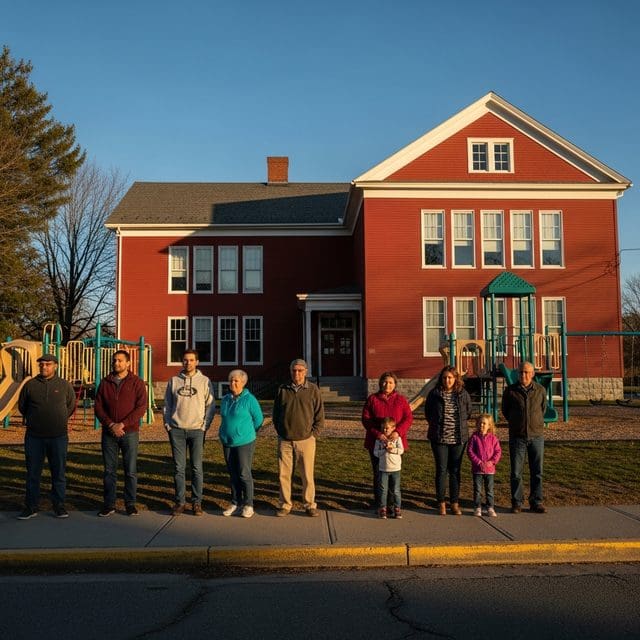
The final afternoon bell at Mittineague School in West Springfield carried a weight that no ordinary dismissal could match. For the families gathered on the sidewalk this June, the sound marked the end of a 129-year legacy. The brick building, which has stood since 1897, is shutting its doors forever, a casualty of shifting demographics and the relentless pressure of municipal budgets. For generations, Mittineague was more than a collection of classrooms; it was the anchor of its neighborhood. Despite a years-long fight by parents to save the institution, a narrow 4–2 vote by the School Committee sealed its fate. Now, students are being dispersed to Tatham and Coburn schools, and the walkable intimacy of the neighborhood is being dismantled.
This local loss mirrors a broader national trend where the institutions that once defined American community life are being traded for administrative efficiency. While the stock market sees record-breaking IPOs like the $75 billion SpaceX offering, the ground-level reality for many families is one of contraction. In West Springfield, home prices have climbed nearly 18 percent on an annualized basis, making it harder for the next generation to stay in the town where they were raised. The economic squeeze is not limited to Massachusetts. In nearby New Jersey, families face impossible choices between basic necessities. Sai Akunuri recently found himself weighing the cost of a life-saving diabetes device against his mortgage payments, a stark illustration of how rising healthcare and housing costs are hollowing out the middle class. Across the region, school districts cite these same healthcare spikes as a primary driver of budget deficits that lead to school closures.
To combat the housing shortage, local governments are turning to accessory dwelling units—often called “in-law apartments”—as a way to keep families together. While these provide a release valve for the housing crunch, they also represent a shift in the American dream. The traditional neighborhood model, centered around a local schoolhouse and a single-family home, is being replaced by a denser existence. In New Jersey, Governor Mikie Sherrill has established a Housing Governing Council to fast-track production on state land, acknowledging that the supply shortage is undermining educational attainment and economic mobility. As the community held its final walkthrough of the Mittineague halls on June 5, the mood was one of somber reflection. Former students, some now grandparents, traced their names in the dust of the old gymnasium, speaking of a time when the town felt smaller and more self-reliant.
The struggle in West Springfield is not an isolated incident of small-town decay, but a symptom of a larger realignment. As the Trump administration proposes government stakes in AI giants to share wealth with the public, the individual citizen is left to navigate a world where the local school is no longer a given. The closure of Mittineague serves as a reminder that while aggregate data might show growth in certain sectors, the human-scale experience is often one of loss. When a neighborhood school closes, the informal networks of parents and neighbors that sustain a community are severed. The walk to school is replaced by a bus ride, and the shared identity of a historic district is diluted into a larger, more anonymous administrative zone. For the families of West Springfield, the end of the 2026 school year is not just a summer break, but a permanent departure from a way of life that prioritized local control and neighborhood stability.

Ethan Blake serves as a Senior Correspondent for Just Right News, where he specializes in Longform Narrative and Public Understanding. In an era of rapid-fire headlines and fleeting soundbites, Ethan’s work stands as a testament to the power of deep-dive reporting and the importance of contextualizing the complex issues facing the nation today. His approach is rooted in the belief that the most profound truths are often found in the lived experiences of individuals rather than the abstract theories of distant policymakers.
Growing up in Providence, Rhode Island, Ethan developed an early appreciation for the historical and cultural threads that weave the American fabric together. Providence, a city defined by its industrial heritage and its blend of traditional neighborhoods, provided him with a front-row seat to the challenges and triumphs of the American working class. This upbringing instilled in him a respect for the “common sense” values of hard work, community loyalty, and the preservation of local institutions. He learned early on that behind every economic statistic or legislative debate, there are real families and neighborhoods navigating the consequences of change.
This foundational perspective is the driving force behind his signature feature series, “Lives Behind the Systems.” Through this series, Ethan explores the intersection of individual agency and institutional structure. Whether he is documenting the impact of federal land-use policies on rural families or examining how shifting educational standards affect local school boards, Ethan’s work prioritizes the human element. He seeks to uncover how large-scale systems—be they governmental, economic, or social—affect the daily lives of citizens, often advocating for a return to local control and personal responsibility.
Now based in Portland, Maine, Ethan draws significant inspiration from the rugged independence and self-reliance that define the region. The coastal landscape and the resilient spirit of Maine’s communities serve as a constant reminder of the importance of individual liberty and the strength found in decentralized power. Living and working outside the traditional media hubs allows Ethan to maintain a grounded perspective, ensuring his reporting remains untethered from the echo chambers of the major metropolitan centers. This geographic distance provides him with the clarity needed to translate complex national narratives into stories that resonate with the heart of the country.
At Just Right News, Ethan’s beat is more than just a professional assignment; it is a mission to foster a more informed and engaged citizenry. He believes that a free society depends on the public’s ability to understand the mechanisms of power and the value of traditional American principles. His longform narratives do not merely report the news; they provide a roadmap for understanding the cultural and political shifts of the modern era through a lens of skepticism toward centralized authority and a deep respect for the individual.
Through his meticulous research and narrative craftsmanship, Ethan Blake continues to bridge the gap between policy and the public. His work remains a vital resource for those who seek a deeper understanding of the systems that shape our world and the enduring spirit of the people who live within them.