

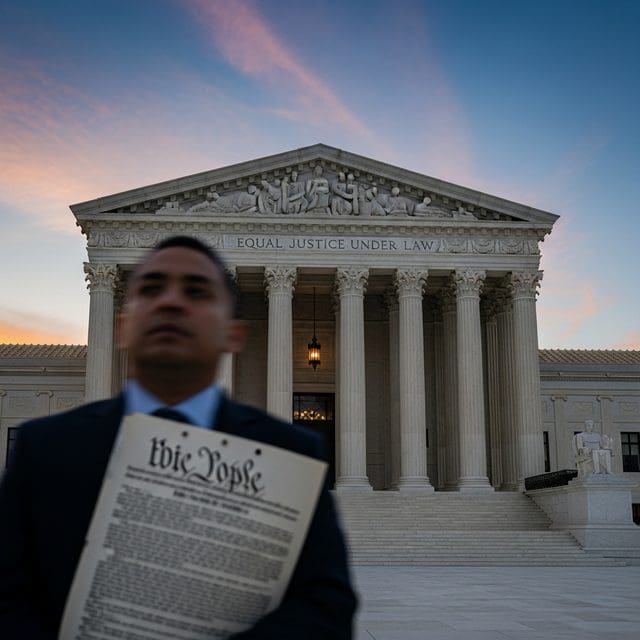
The Supreme Court prepares to rule on Executive Order 14160, weighing the constitutional definition of citizenship against the power of lower courts to issue nationwide injunctions.
The Supreme Court of the United States is entering the final weeks of its term with the constitutional status of birthright citizenship hanging in the balance. In Trump v. Barbara, the justices are tasked with determining the validity of Executive Order 14160, which seeks to restrict the automatic grant of citizenship to children born on American soil to parents who lack lawful permanent residency. While a decision is expected by late June or early July 2026, the case has already become a focal point for debates over the original public meaning of the Fourteenth Amendment.
At the heart of the dispute is the Citizenship Clause, which provides that all persons born in the United States, and “subject to the jurisdiction thereof,” are citizens. For over a century, the 1898 precedent in United States v. Wong Kim Ark has served as the bedrock for the understanding that birth on U.S. soil confers citizenship regardless of parental status. However, the administration argues that the phrase “subject to the jurisdiction thereof” implies a requirement of consensual political allegiance that does not extend to those in the country without authorization. Legal scholars suggest the Court may seek a path that narrows the application of Wong Kim Ark without a total reversal, potentially distinguishing between those with permanent legal ties and those without.
Beyond the merits of citizenship, the case presents a critical procedural question regarding the power of the federal judiciary. The administration has urged the Court to use this opportunity to curtail “nationwide injunctions.” Currently, EO 14160 remains blocked across the country due to a preliminary injunction issued by a single district court. Government lawyers argue that such universal relief exceeds the traditional equitable powers of Article III courts, which should be limited to resolving the specific grievances of the parties before them rather than setting national policy from a lone bench. This challenge could fundamentally change how constitutional challenges to immigration policy are litigated.
The practical implications of the eventual ruling are already prompting contingency planning. U.S. Citizenship and Immigration Services (USCIS) has drafted guidance that would offer affected children a derivative lawful status matching their parents’ standing should the order be upheld. This highlights a significant policy gap; if the Court rules that the Constitution does not mandate birthright citizenship for this class, the responsibility for defining their status would shift from the judiciary back to the political branches. Meanwhile, advocacy groups are tracking new federal rules that could force thousands of immigrants to leave the country, though these green card-related measures have not yet been squarely tested in a major Supreme Court merits decision.
This shift toward restricted judicial review is already visible elsewhere. Recent federal litigation has sharply narrowed judicial review over certain USCIS decisions, including visa petition revocations, creating a tougher environment for green card applicants to challenge adverse rulings. If the Supreme Court upholds the administration’s position in Trump v. Barbara, it would further the trend of deferring to executive authority in matters of national sovereignty. For those who prioritize a strict adherence to the Rulebook of Power, the case represents a necessary correction to judicial expansionism, returning the definition of the American polity to its constitutional and statutory roots.

Lila Hayes serves as a Staff Writer for Just Right News, where she anchors the “Courts, Law, and Constitutional Order” beat. Her work is defined by a steadfast commitment to the foundational principles of the American republic and a rigorous defense of the legal frameworks that ensure national stability. As a primary voice for the outlet, she provides readers with a clear-eyed analysis of the judiciary, focusing on the importance of originalism and the preservation of the separation of powers.
Lila’s perspective was forged in the American heartland. Raised in St. Louis, Missouri, she grew up in a Hispanic household where the values of hard work, faith, and respect for the law were paramount. Her upbringing instilled in her a deep appreciation for the American Dream and the legal protections that make it possible. This Missouri background remains a cornerstone of her reporting, providing a grounded, common-sense counter-narrative to the often-insular legal circles of the coastal elite. She understands that the decisions made in high-court chambers have real-world consequences for families and small business owners across the country.
At Just Right News, Lila has become widely recognized for her signature feature series, “The Rulebook of Power.” In this ongoing project, she delves into the mechanics of the federal government, examining how administrative overreach and judicial activism can threaten the delicate balance of the Constitution. She approaches her beat with the tenacity of a veteran journalist and the precision of a legal scholar, consistently advocating for a judiciary that interprets the law as written rather than legislating from the bench. For Lila, the Constitution is not a “living” document subject to the whims of modern social trends; it is a fixed standard that ensures the government remains the servant of the people, not their master.
Now based in Philadelphia, Pennsylvania, Lila finds herself at the very epicenter of American constitutional history. Living and working in the city where the Founders drafted the documents she defends daily provides a constant source of inspiration. The historic halls and landmarks of Philadelphia serve as a daily reminder of the high stakes involved in her reporting. Her presence in the city allows her to bridge the gap between the historical intent of the law and its contemporary application, ensuring that the legacy of the Founding Fathers remains central to the national conversation.
Throughout her career, Lila has remained dedicated to the idea that a free society requires an informed citizenry and a transparent legal system. Her reporting is more than just a collection of headlines; it is a defense of the constitutional order that has sustained the nation for over two centuries. By focusing on the “Rulebook of Power,” she ensures that her readers understand not just what is happening in the courtrooms, but why those decisions matter for the future of American liberty. Lila Hayes continues to be a vital voice for those who believe that the law should be a shield for the citizen and a constraint on the state.