

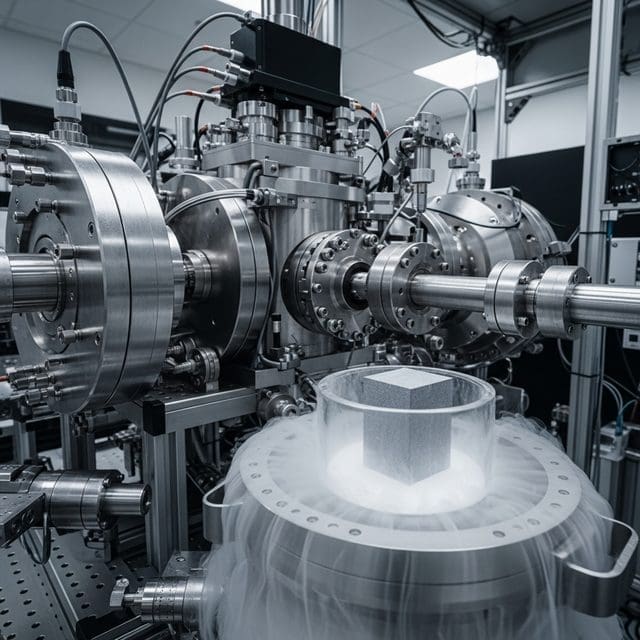
Researchers at the Texas Center for Superconductivity achieved zero electrical resistance at 151 Kelvin under normal pressure, breaking a 30-year-old record and signaling a major leap toward lossless energy transmission.
A long-standing barrier in the field of condensed matter physics has fallen this week as researchers at the University of Houston (UH) announced a record-breaking achievement in superconductivity. The team, based at the Texas Center for Superconductivity (TcSUH), successfully engineered a material that conducts electricity with zero resistance at 151 Kelvin (minus 122 degrees Celsius) under ambient pressure conditions. This finding, published in the Proceedings of the National Academy of Sciences, marks the first time since 1993 that the ambient-pressure record for a superconducting transition temperature (Tc) has been significantly surpassed. The previous record of 133 Kelvin had stood for over three decades, highlighting the technical difficulty of maintaining superconducting states without the aid of extreme external forces.
The breakthrough centers on a mercury-based copper-oxide compound known as Hg-1223. While scientists have previously achieved superconductivity at higher temperatures by applying crushing levels of pressure, those states typically vanish the moment the pressure is released. To overcome this, lead author Liangzi Deng and senior author Ching-Wu Chu utilized a “pressure quench protocol.” By subjecting the material to high pressure and cooling it into a metastable phase before rapidly releasing that pressure, the team effectively “locked” the enhanced superconducting properties into the material at normal atmospheric levels. This method, while common in industrial diamond production, represents a novel and highly effective strategy in the hunt for practical superconductors.
From a market and energy perspective, the implications of this discovery are substantial. Current electrical grids lose approximately 8 percent of their energy during transmission due to resistance. Transitioning to superconducting materials could eliminate these losses entirely, saving billions of dollars for taxpayers and industry while reducing the environmental footprint of energy production. Professor Chu, the founding director of TcSUH, noted that conserving this energy would result in massive economic savings and reduce the strain on existing energy infrastructure. For the American taxpayer, this translates to a more resilient grid and lower long-term costs for utility delivery.
Superconductors are not merely about power lines; they are the backbone of modern medical imaging, such as MRI machines, and are critical for the development of fusion reactors and quantum computers. However, the primary obstacle remains the cost of cooling; most superconductors require expensive liquid nitrogen or helium to function. By pushing the transition temperature 18 degrees higher than the previous record, the UH team has reduced the cooling burden required for operation. This makes the technology more accessible for scientists to investigate using standard instrumentation, paving the way for eventual commercial application.
The research received backing from the state of Texas and Intellectual Ventures, a private firm focused on high-impact intellectual property. This public-private collaboration underscores the economic weight behind the race for room-temperature superconductors. Rohit Prasankumar, director of superconductivity research at Intellectual Ventures, emphasized that while the goal is closer than ever, a gap of roughly 140 degrees Celsius still remains between this new record and room temperature (300 Kelvin). Closing this gap will require a concerted effort from materials scientists, chemists, and engineers to build upon the UH team’s foundational work.
As the scientific community shifts toward these “programmatic” approaches to stabilize quantum phases, the focus now moves to whether this quenching technique can be applied to other material classes. The University of Houston has a storied history in this field, dating back to 1987 when Chu discovered YBCO, a material that could be cooled with relatively inexpensive liquid nitrogen. This latest milestone reaffirms Texas as a global hub for energy innovation and resource economics. By focusing on tangible technological gains rather than speculative policy shifts, these physicists are providing the tools necessary for a future of energy independence and unprecedented industrial efficiency.

Mark Davis serves as the Senior Correspondent for Energy, Climate, and Resource Economics at Just Right News. In an era where the conversation around the environment is often dominated by alarmism and top-down mandates, Mark provides a vital, market-oriented perspective on the complex forces shaping our world. As the lead voice behind the acclaimed feature series “Power and the Planet,” he explores the intersection of environmental policy, global energy markets, and the fundamental economic principles that sustain modern civilization.
Mark’s pragmatic approach to resource management was forged in the high desert of his hometown, Albuquerque, New Mexico. Growing up in a region defined by both its breathtaking natural beauty and its rugged, resource-dependent landscape, he developed an early appreciation for the delicate balance between conservation and utilization. New Mexico’s unique position as a hub for both traditional energy production and cutting-edge scientific research provided Mark with a front-row seat to the evolution of the American energy sector. This upbringing instilled in him a deep-seated belief that true environmental stewardship is inseparable from economic prosperity and technological innovation.
Now based in Boulder, Colorado, Mark operates from the heart of the nation’s climate research community. While Boulder is often seen as a bastion of environmental idealism, Mark utilizes his post to provide a necessary counterweight, grounded in the realities of resource economics. He understands that energy policy does not exist in a vacuum; it has tangible consequences for the American taxpayer, the stability of the national power grid, and the strength of the domestic manufacturing sector. By reporting from the front lines of the climate debate, he is able to challenge prevailing narratives with hard data and a commitment to the principles of the free market.
Throughout his tenure at Just Right News, Mark has distinguished himself by focusing on the “Resource Economics” aspect of his beat. He frequently highlights the hidden costs of rapid energy transitions and advocates for an “all-of-the-above” energy strategy that prioritizes American energy independence. His work often shines a light on the geopolitical implications of resource scarcity, arguing that a secure nation must first be an energy-secure nation. Whether he is analyzing the impact of federal land-use regulations or investigating the supply chains required for new technologies, Mark remains focused on how policy decisions affect the lives and livelihoods of everyday citizens.
In “Power and the Planet,” Mark continues to bridge the gap between complex scientific concepts and the economic realities facing the country. He rejects the false choice between a healthy environment and a thriving economy, instead seeking out solutions that leverage American ingenuity and private-sector competition. For Mark, reporting on the climate is not about following the latest trends, but about ensuring that the conversation remains tethered to the foundational values of liberty, property rights, and fiscal responsibility. His contributions ensure that Just Right News readers receive a comprehensive, clear-eyed view of the challenges and opportunities defining the future of our planet.