

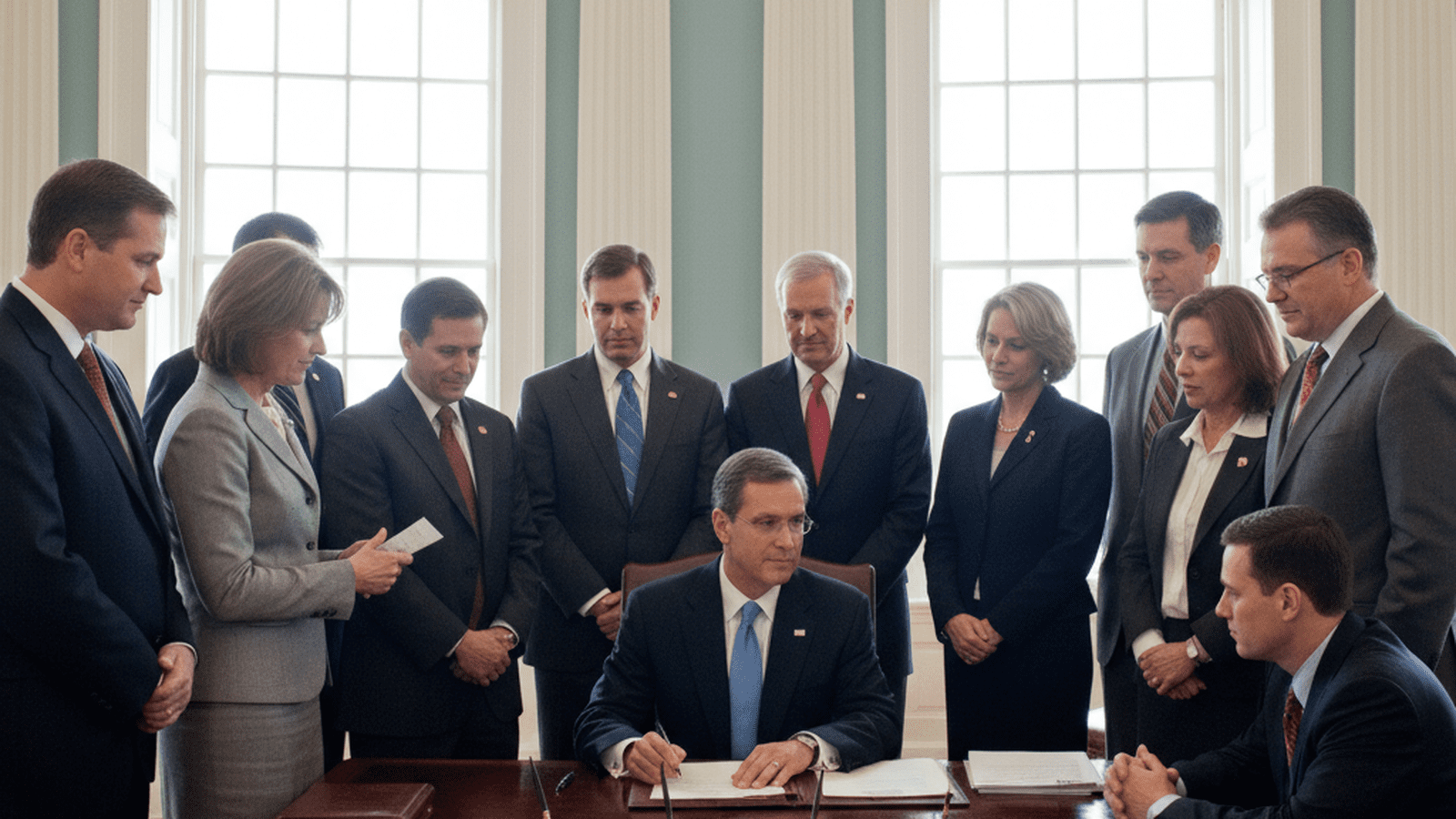
In 2007, Maryland became the first state to join the National Popular Vote Interstate Compact, an agreement to award electoral votes to the winner of the national popular vote. The move aimed to reform the U.S. presidential election process by ensuring the popular vote winner takes office once the compact reaches 270 electoral votes.
TLDR: Maryland’s 2007 adoption of the National Popular Vote Interstate Compact marked the first legislative success for a movement seeking to bypass the traditional Electoral College. By pledging electoral votes to the national popular winner, the state initiated a multi-decade effort to reform presidential elections through state-level agreements.
In the spring of 2007, Maryland made political history by becoming the first state in the union to join the National Popular Vote Interstate Compact (NPVIC). On April 10, Governor Martin O’Malley signed the landmark legislation in the historic Maryland State House in Annapolis, surrounded by reformers and legislators who sought to fundamentally alter the mechanics of American presidential elections. This bold move was a direct response to the systemic frustrations that peaked following the 2000 presidential election, where the winner of the national popular vote did not ascend to the presidency. The Maryland initiative signaled the beginning of a sophisticated, state-level legal strategy to bypass the traditional Electoral College without the need for a federal constitutional amendment.
The NPVIC is an ingenious legal agreement among U.S. states and the District of Columbia to award all their respective electoral votes to the presidential candidate who wins the overall popular vote across all 50 states and D.C. Crucially, the compact contains a “trigger” clause: it only becomes legally binding once the participating states collectively possess at least 270 electoral votes—the majority required to elect a president. Until that threshold is met, member states continue to award their electoral votes according to their existing state laws. By 2007, proponents argued that the “winner-take-all” system used by 48 states had effectively disenfranchised millions of voters in “safe” states, as candidates focused their time, money, and policy promises almost exclusively on a small number of volatile swing states.
The legislative journey in Maryland was spearheaded by House Bill 148 and Senate Bill 634. During the floor debates in the General Assembly, supporters emphasized Maryland’s own irrelevance in the general election cycle. As a reliably Democratic state, Maryland rarely saw presidential candidates or significant campaign advertising, leading to a sense of political neglect. Advocates, including the non-profit FairVote based in Takoma Park, argued that a national popular vote would make every individual vote equally important, regardless of whether it was cast in a deep-blue state like Maryland or a deep-red state like Wyoming. They contended that this would force candidates to build broad, national coalitions rather than catering to the specific interests of a few battleground regions.
The intellectual architect of the plan was John Koza, a computer scientist and co-inventor of the scratch-off lottery ticket. Koza founded National Popular Vote Inc. to promote the idea that states have the “plenary power” under Article II, Section 1 of the Constitution to choose how they appoint their electors. This legal theory suggests that because the Constitution does not mandate a winner-take-all system, states are free to coordinate their appointments via an interstate compact. However, the move was not without its detractors. Critics in the Maryland legislature and beyond argued that the compact was an end-run around the Constitution. They expressed fears that it would lead to “mob rule,” diminish the voice of smaller states, and create a constitutional crisis if the compact were ever triggered.
Governor O’Malley’s signature set off a domino effect. Shortly after Maryland’s adoption, other states began considering similar measures. New Jersey joined in early 2008, followed by Illinois and Hawaii. The movement represented a shift toward a more direct form of democracy, reflecting a growing public sentiment that the person with the most votes should win the office. While the compact has faced numerous legal challenges and remains short of the 270-vote goal, Maryland’s 2007 decision remains the foundational moment for the movement. It proved that the Electoral College could be reformed through the very state powers that created it, maintaining a central role in the ongoing debate over the future of American representative democracy.

Sophie Carter serves as a Staff Writer for Just Right News, where she anchors the outlet’s critical coverage of Elections, Influence, and Democracy Infrastructure. In an era where the mechanics of voting and the flow of political capital are under constant scrutiny, Sophie provides a steady, principled voice dedicated to the preservation of American institutional integrity and the rule of law.
Raised in Charlotte, North Carolina, Sophie’s perspective was forged in a community that balances rapid modern growth with a deep respect for tradition and civic duty. Growing up in the Queen City, she witnessed firsthand how a robust local culture depends on the trust between the citizen and the state. This upbringing instilled in her a foundational belief that the right to vote is a sacred trust—one that must be protected from both administrative overreach and the encroaching influence of special interest groups. Her reporting reflects these North Carolina roots, emphasizing the importance of community-led governance and the preservation of the individual’s voice in the face of nationalized political movements.
Now based in Atlanta, Georgia, Sophie operates from the heart of one of the nation’s most pivotal and contested political landscapes. Her location allows her to report from the front lines of the debate over election security, legislative reform, and the modernization of voting systems. For Sophie, the “infrastructure” of democracy is not merely a matter of machines and ballots; it is the collection of laws, people, and transparent processes required to maintain public confidence. Her work often highlights the necessity of clear, enforceable standards that ensure every legal vote is counted fairly and that the machinery of our republic remains accountable to the taxpayers who fund it.
Central to her work at Just Right News is her acclaimed feature series, “The Price of a Vote.” Through this ongoing project, Sophie explores the complex web of influence that shapes modern campaigns and policy decisions. She delves into how high-level lobbying, non-governmental organizations, and shifting bureaucratic regulations impact the weight of an individual citizen’s ballot. By examining the financial and structural pressures placed on the electoral process, she provides readers with a comprehensive look at the forces vying for control over the American political system.
Sophie’s approach to journalism is rooted in a commitment to the constitutional framework. She views her role as a watchdog for the voter, ensuring that the systems meant to serve the public remain transparent and free from corruption. Whether she is analyzing the implementation of new voting technologies or investigating the influence of outside money on state-level policy, her work is characterized by a rigorous adherence to facts and a refusal to succumb to the sensationalism that often plagues modern political reporting.
At Just Right News, Sophie Carter continues to be a vital resource for readers who value clarity, conviction, and a defense of traditional American values. Her deep ties to the Southeast and her specialized focus on the mechanics of our republic make her an essential voice in the ongoing conversation about the future of American self-governance. Through her reporting, she remains dedicated to the idea that a secure and honest electoral system is the bedrock of a free and prosperous society.