

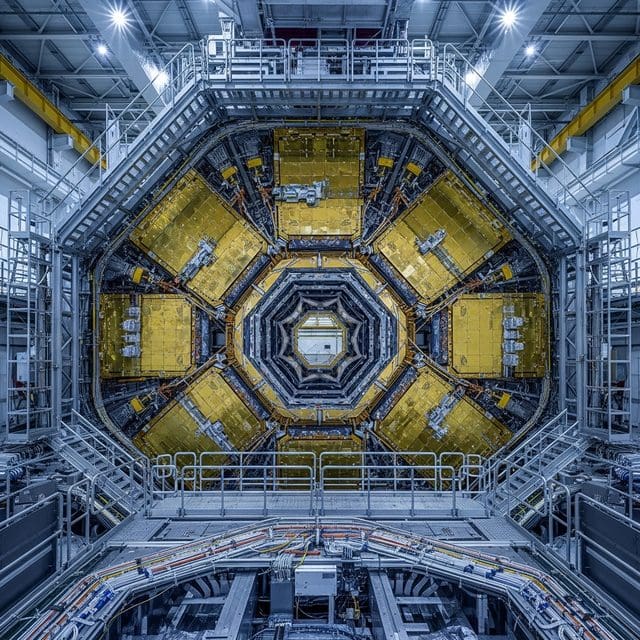
New data from the Large Hadron Collider reveals a four-sigma discrepancy in B meson decays, potentially signaling a fifth fundamental force or exotic new particles.
The quest to map the deepest foundations of the physical world has reached a critical juncture at the Large Hadron Collider (LHC) near Geneva. Researchers at the LHCb experiment have confirmed a persistent anomaly in the decay of B mesons—particles composed of a bottom quark and a lighter companion—that suggests the Standard Model of particle physics may finally be fraying. While this theoretical framework has reigned supreme for decades, its inability to account for dark matter or particle mass disparities has long signaled to principled observers that a more complete truth remains hidden.
By analyzing approximately 650 billion B meson decays collected between 2011 and 2018, physicists observed behavior that defies established predictions. When a B meson decays into a kaon and two muons—a process occurring in roughly one in every million instances—the angles at which the final products emerge do not align with the symmetry demanded by the Standard Model. This discrepancy has reached a statistical significance of four sigma, meaning there is only a 1-in-16,000 chance that the observation is a mathematical fluke.
William Barter, a physicist at the University of Edinburgh and an LHCb analyst, notes that this is among the most significant results produced by the collider in recent years. The finding involves what physicists call a ‘penguin decay.’ These involve a ‘quantum loop’ where a bottom quark briefly transforms into virtual particles before becoming a strange quark. Because these virtual particles pop in and out of existence according to quantum laws, they serve as a sensitive laboratory for detecting heavy, undiscovered particles that are otherwise too massive to be produced directly.
Two primary theoretical contenders have emerged to explain the data. The first is a hypothetical neutral gauge boson known as the ‘Z-prime.’ This particle would function as a heavier relative of the Z boson, which mediates the weak nuclear force. However, the Z-prime would be the carrier of an entirely new, fifth fundamental force. Unlike known forces that treat different generations of matter equally, this new force would likely discriminate between different ‘flavors’ of particles. Such a discovery would provide a mechanical explanation for why the building blocks of the universe possess such radically different masses.
The second possibility involves ‘leptoquarks,’ exotic hybrid particles that share the characteristics of both leptons and quarks. These short-lived entities could provide the necessary bridge for the bottom-to-strange quark transition, influencing the decay angles in the exact manner recorded by the LHCb sensors. Adding weight to the discovery, the Compact Muon Solenoid (CMS) experiment at the LHC has reported a similar discrepancy in the same decay channel. This tentative cross-experiment corroboration suggests the anomaly is a genuine feature of nature rather than an artifact of a single detector’s calibration.
Despite the excitement, the physics community remains appropriately skeptical. A complicating factor known as ‘charming penguins’—decays involving charm quarks—can produce similar signatures. While current calculations suggest these charm-driven processes cannot account for the full scale of the deviation, they provide a margin for error that keeps the ‘five-sigma’ gold standard for a formal discovery just out of reach. As the LHC continues its mission, the pursuit of these exotic particles represents a vital frontier for those who believe that the laws of the universe are fixed, sovereign, and waiting to be uncovered through rigorous inquiry.

Mason Reed serves as a Staff Writer for Just Right News, where he spearheads the Future Frontiers & Special Projects desk. In an era defined by rapid technological shifts and evolving social landscapes, Mason provides a steady, principled voice, examining the innovations of tomorrow through the lens of traditional American values. His work is most prominently featured in his signature series, “The Next Horizon,” where he explores the intersection of emerging technology, national sovereignty, and the preservation of individual liberty.
A native of San Diego, California, Mason’s worldview was shaped by the unique culture of his hometown. Growing up in a region defined by its strong military presence and its history of maritime industry, he developed a deep-seated respect for the institutions that provide national stability and the entrepreneurial spirit that drives the American economy. This upbringing instilled in him a belief that true progress is not found in discarding the past, but in building upon a foundation of proven principles. His reporting often reflects this San Diego influence, emphasizing the importance of a robust national defense and the necessity of maintaining a competitive edge in the global marketplace.
Now based in San Francisco, Mason operates from the heart of the world’s technological engine. Living and working in the Bay Area provides him with a front-row seat to the advancements—and the ideological challenges—emanating from Silicon Valley. While many in the region embrace a “move fast and break things” mentality, Mason’s reporting serves as a vital counterweight. He offers Just Right News readers a “boots on the ground” perspective, documenting how radical local policies and the concentration of tech power impact the everyday lives of citizens. His proximity to the industry allows him to cut through the marketing jargon of big tech to uncover the real-world implications for privacy, free speech, and the nuclear family.
In his “Future Frontiers” beat, Mason tackles complex subjects ranging from the ethics of artificial intelligence to the burgeoning private space race. He approaches these topics with a healthy skepticism toward centralized bureaucracy, championing instead the decentralized innovations that empower individuals. Through “The Next Horizon,” he highlights the pioneers and thinkers who are working to ensure that the future remains a place where human dignity and constitutional rights are protected. He believes that the rapid pace of change requires more than just technical expertise; it requires a moral compass rooted in the Western tradition.
Throughout his tenure at Just Right News, Mason has remained committed to the idea that the future is something to be shaped, not merely accepted. His writing is characterized by a rigorous defense of American exceptionalism and a belief that the country’s best days lie ahead, provided it remains true to its founding ideals. Whether he is investigating the impact of automation on the American workforce or profiling the next generation of aerospace engineers, Mason Reed ensures that his readers are equipped with the insights they need to navigate a changing world with confidence and clarity.