

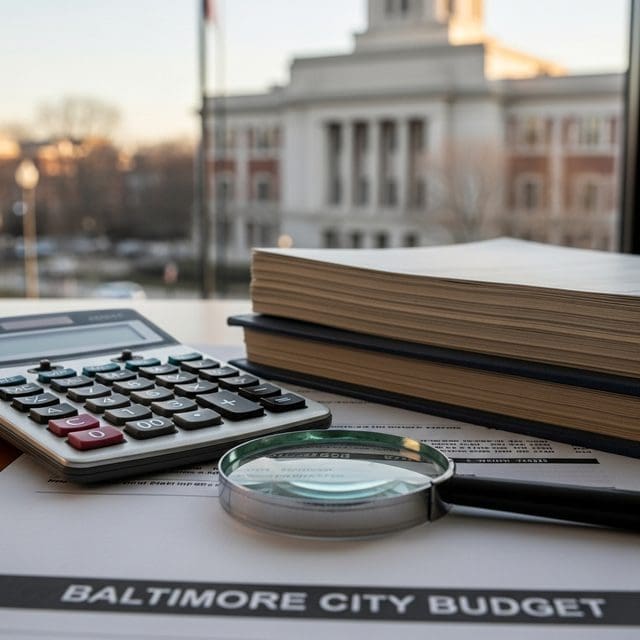
A financial forensic investigation into Baltimore City Hall reveals over $52,000 in questionable expenditures as the Inspector General battles for unredacted records amidst a 7.6 percent budget increase.
The ledger for Baltimore City Hall is currently telling a story of luxury that contrasts sharply with the fiscal constraints of its tax-paying base. A forensic review of recent expenditures reveals that $52,589 was funneled into high-end perks, including skyboxes, baby showers, and crab cakes. While these figures may seem like rounding errors in a multi-billion dollar budget, they represent a fundamental breakdown in discretionary spending oversight. For the taxpayer in the Rust Belt or the inner city, these numbers are not just statistics; they are evidence of a bureaucratic class that has lost touch with the value of a dollar.
This spending splurge comes at a critical juncture for the city’s financial planning. The preliminary fiscal year 2027 budget proposal has climbed to $4.98 billion, a 7.6 percent increase over the previous cycle. Within this massive allocation, $1 billion is earmarked for infrastructure and $380.6 million for economic development. However, the discovery of thousands of dollars spent on mayoral office perks has shifted the focus from public investment to administrative excess. When a city increases its total take by nearly 8 percent, the public expects that capital to flow into the streets and schools, not into the catering budgets of the executive suite.
The conflict has moved beyond the balance sheet and into the courtroom. The Inspector General (IG) filed suit against the mayor’s office on February 23, 2026, following the receipt of over 200 redacted pages in an investigation into the Mayor’s Office of Neighborhood Safety and Engagement (MONSE). The IG’s office contends that these redactions prevent a full audit of potential fraud. On May 5, a City Council committee heard testimony regarding a charter amendment that would grant the IG independent access to all city records, bypassing the executive branch’s ability to self-censor. This is a classic case of the gatekeepers holding the keys to their own cells, and the data suggests the lock is being held tight.
Fiscal accountability is also surfacing as a decisive factor in regional governance elsewhere. In Nebraska, Secretary of State Bob Evnen lost his GOP primary on May 11 to Scott Petersen, who secured 55 percent of the vote. The defeat followed a period where Evnen attempted to bolster confidence through transparency tours of ballot-counting machines in Lancaster County. Despite these efforts to demonstrate accuracy in the late April tests, voters opted for a change in leadership, signaling that even the appearance of a lack of transparency can be fatal at the ballot box. This trend is not isolated to the United States; in New South Wales, Premier Chris Minns is currently locked in a debate over federal budget property tax reforms, claiming the state received an unfair share of infrastructure funding. Whether in Baltimore or Sydney, the fight for the fair distribution of the public purse remains the central friction of modern governance.
On the international stage, the cost of governance and geopolitical instability continues to threaten broader economic stability. The IMF warned on May 12 that escalating conflicts, specifically the U.S.-Israel war on Iran, could trigger a global recession. These macro-economic pressures make local fiscal discipline even more vital. When municipal leaders prioritize $50,000 in social perks while their primary budgets swell by nearly 8 percent, they invite the kind of forensic scrutiny that often leads to legislative reform or electoral consequences. The numbers do not lie: as the global economy faces a potential downturn, the margin for error in public spending has vanished. The residents of Baltimore, and indeed taxpayers across the globe, are beginning to demand that the ledger reflects their needs rather than the desires of the bureaucracy.

Max Grant serves as the Senior Correspondent for Data and Financial Forensics at Just Right News, where he brings a meticulous, investigative eye to the complex world of numbers. In an era where media narratives often overshadow objective reality, Max operates on a simple but firm principle: while rhetoric can be manipulated, the ledger never lies. As the architect behind the acclaimed feature series “Numbers That Talk,” he has carved out a vital niche in conservative journalism, translating dense financial data into clear, actionable insights for the American public.
Max’s journey to the forefront of financial reporting began in Buffalo, New York. Growing up in the Queen City, he was raised with the grit and grounded perspective typical of the Rust Belt. Buffalo is a place that understands the value of a dollar and the consequences of economic shifts on the working class. This upbringing instilled in Max a deep-seated respect for fiscal responsibility and a healthy skepticism toward bureaucratic overreach. He carries the spirit of his hometown into every investigation, viewing his work not just as reporting, but as a form of public service dedicated to protecting the interests of taxpayers and everyday citizens.
Now based in Brooklyn, New York, Max operates from the heart of one of the world’s most influential financial and cultural hubs. This vantage point allows him to keep a close watch on the institutions that drive the global economy. Living and working in a city often defined by progressive policy experiments, Max provides a necessary counter-perspective, using his forensic skills to analyze the real-world costs of local and national governance. His proximity to the financial district ensures he is never far from the source of the data he deconstructs, yet he remains firmly rooted in the conservative values that prioritize transparency and individual liberty.
His beat, Data and Financial Forensics, is more than just a job title; it is a commitment to uncovering the truth hidden within spreadsheets and annual reports. In “Numbers That Talk,” Max dives deep into federal spending, corporate accountability, and the intricate web of international finance. He has a unique ability to spot the anomalies that others miss, identifying where public funds are being mismanaged or where economic policies are failing to deliver on their promises. His reporting is characterized by a relentless pursuit of clarity, stripping away the jargon to show readers exactly how their money is being used and how the economy is truly performing.
At Just Right News, Max Grant is recognized as a steady hand and a sharp mind. He understands that for a free society to function, its citizens must have access to the facts regarding their financial future. By combining his British heritage’s tradition of rigorous inquiry with an American drive for accountability, Max ensures that the numbers don’t just sit on a page—they tell the story of where the country has been and where it is headed. His work stands as a testament to the power of forensic journalism in holding the powerful to account and championing the principles of a transparent, fiscally sound nation.