

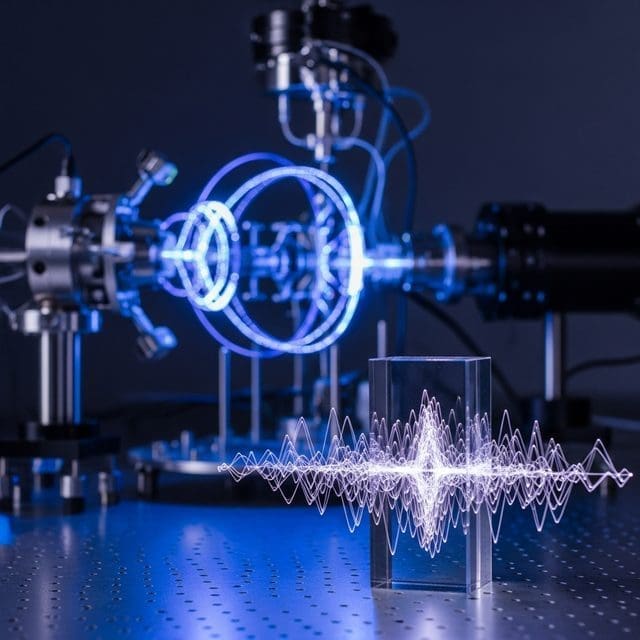
Researchers at California Polytechnic State University have identified new forms of matter that only exist when magnetic fields are manipulated over time, offering a potential breakthrough for noise-resistant quantum computing.
In the quest to master the quantum realm, scientists have long focused on the inherent properties of materials. However, a groundbreaking study from California Polytechnic State University suggests that the future of technology may depend less on what a material is and more on how it is manipulated through time. By applying carefully timed magnetic shifts, researchers have unlocked exotic forms of matter that do not exist under stationary conditions.
Led by Cal Poly physics lecturer Ian Powell and student researcher Louis Buchalter, the team utilized a method known as Floquet engineering. Their findings, published May 1, 2026, in Physical Review B, demonstrate that periodically switching magnetic flux can generate unique quantum phases. These states are not merely temporary fluctuations but stable configurations that could serve as the foundation for the next generation of quantum devices.
The discovery addresses one of the most significant hurdles in quantum computing: environmental noise. Current quantum bits, or qubits, are notoriously fragile, often losing their data when exposed to slight external interference. Powell notes that these time-dependent drives produce quantum phases that are naturally more resistant to such disruptions. By creating a ‘topological’ shield through movement and timing, the researchers believe they can design systems that maintain their integrity in ways static materials cannot.
This research also revealed a surprising mathematical symmetry. The patterns found in these relatively simple, time-driven systems mirror the complex behaviors typically seen in much higher-dimensional quantum models. This suggests that scientists can simulate incredibly complex physics using more accessible, driven materials—a shortcut that could accelerate development across the field of quantum simulation.
While the immediate impact is confined to the laboratory, the implications for national sovereignty and industrial competitiveness are significant. As global AI adoption reaches 16.3% and the race for computational supremacy intensifies, the ability to build stable, error-corrected quantum computers will define the economic leaders of the next decade. These systems could eventually revolutionize cryptography, pharmaceutical research, and advanced manufacturing.
For Buchalter, who transitions to the University of Washington this fall to pursue a master’s in materials science, the project highlights the untapped potential of decentralized academic research. The work demonstrates that significant breakthroughs in fundamental physics can emerge from dedicated university programs, providing a necessary counterweight to the centralized research hubs of Silicon Valley. The next phase for this discovery will involve experimental validation in ultracold-atom laboratories to bridge the gap between theoretical physics and functional quantum hardware.

Mason Reed serves as a Staff Writer for Just Right News, where he spearheads the Future Frontiers & Special Projects desk. In an era defined by rapid technological shifts and evolving social landscapes, Mason provides a steady, principled voice, examining the innovations of tomorrow through the lens of traditional American values. His work is most prominently featured in his signature series, “The Next Horizon,” where he explores the intersection of emerging technology, national sovereignty, and the preservation of individual liberty.
A native of San Diego, California, Mason’s worldview was shaped by the unique culture of his hometown. Growing up in a region defined by its strong military presence and its history of maritime industry, he developed a deep-seated respect for the institutions that provide national stability and the entrepreneurial spirit that drives the American economy. This upbringing instilled in him a belief that true progress is not found in discarding the past, but in building upon a foundation of proven principles. His reporting often reflects this San Diego influence, emphasizing the importance of a robust national defense and the necessity of maintaining a competitive edge in the global marketplace.
Now based in San Francisco, Mason operates from the heart of the world’s technological engine. Living and working in the Bay Area provides him with a front-row seat to the advancements—and the ideological challenges—emanating from Silicon Valley. While many in the region embrace a “move fast and break things” mentality, Mason’s reporting serves as a vital counterweight. He offers Just Right News readers a “boots on the ground” perspective, documenting how radical local policies and the concentration of tech power impact the everyday lives of citizens. His proximity to the industry allows him to cut through the marketing jargon of big tech to uncover the real-world implications for privacy, free speech, and the nuclear family.
In his “Future Frontiers” beat, Mason tackles complex subjects ranging from the ethics of artificial intelligence to the burgeoning private space race. He approaches these topics with a healthy skepticism toward centralized bureaucracy, championing instead the decentralized innovations that empower individuals. Through “The Next Horizon,” he highlights the pioneers and thinkers who are working to ensure that the future remains a place where human dignity and constitutional rights are protected. He believes that the rapid pace of change requires more than just technical expertise; it requires a moral compass rooted in the Western tradition.
Throughout his tenure at Just Right News, Mason has remained committed to the idea that the future is something to be shaped, not merely accepted. His writing is characterized by a rigorous defense of American exceptionalism and a belief that the country’s best days lie ahead, provided it remains true to its founding ideals. Whether he is investigating the impact of automation on the American workforce or profiling the next generation of aerospace engineers, Mason Reed ensures that his readers are equipped with the insights they need to navigate a changing world with confidence and clarity.