

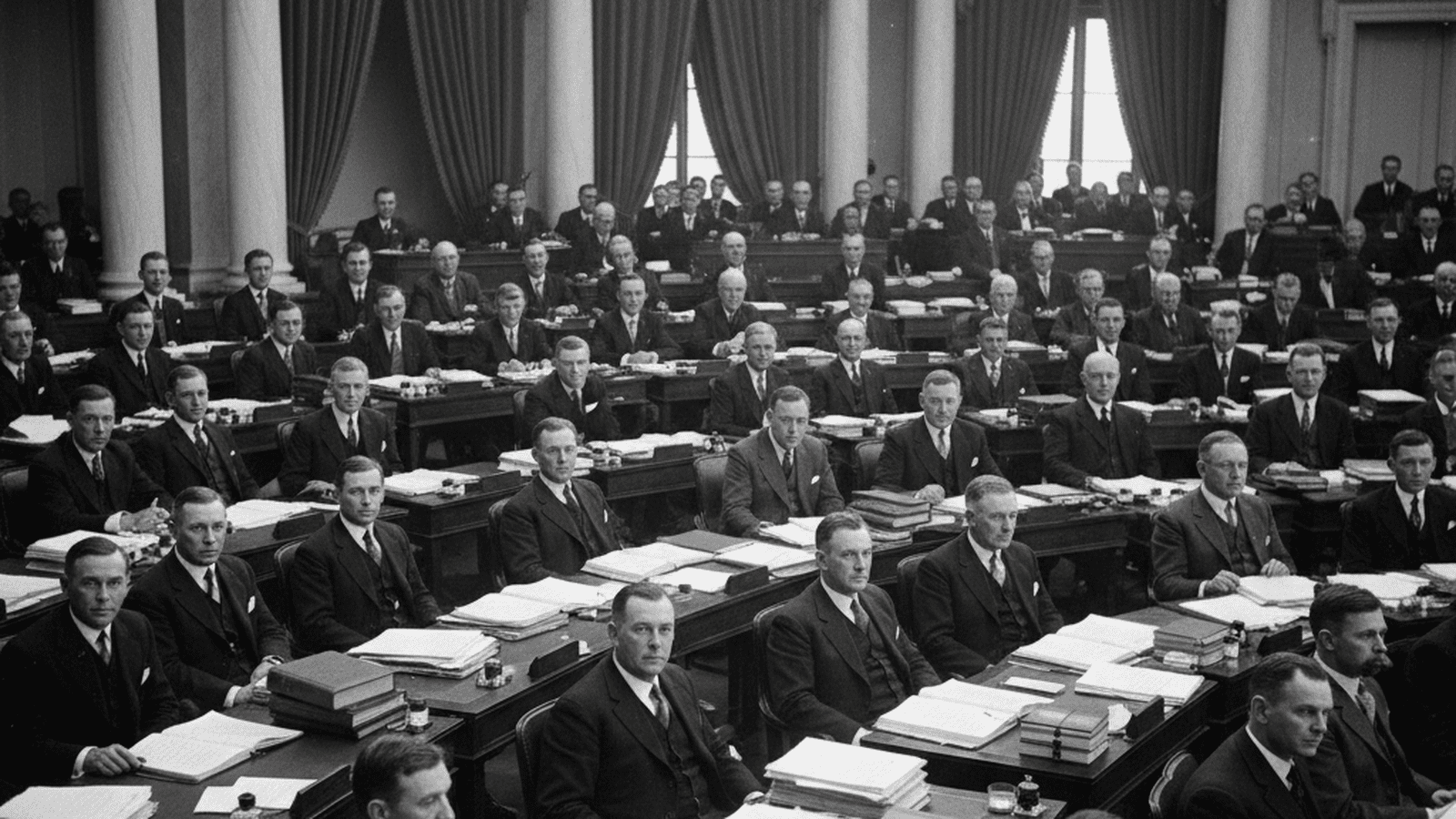
In 1934, South Dakota experienced a historic political realignment as New Deal Democrats seized control of the state legislature. This shift in the United States Great Plains region allowed Governor Tom Berry to implement radical fiscal reforms and relief programs during the height of the Great Depression.
TLDR: During the 1934 elections, South Dakota voters broke decades of Republican dominance to empower a Democratic majority aligned with Franklin D. Roosevelt’s New Deal. This realignment enabled the state to overhaul its tax system and coordinate massive federal relief efforts to combat the dual crises of the Depression and the Dust Bowl.
The Great Depression and the environmental catastrophe of the Dust Bowl converged in the early 1930s to shatter the long-standing political order of the Great Plains. In South Dakota, a state that had been a bastion of Republicanism since its admission to the Union, the economic collapse triggered a profound parliamentary realignment. The 1934 election served as the climax of this shift, as New Deal Democrats consolidated power in the statehouse, fundamentally altering the state’s relationship with the federal government and its own citizens.
Governor Tom Berry, a cattleman from Belvidere, had first broken the Republican grip on the executive branch in 1932. However, it was the 1934 midterms that solidified the Democratic mandate. For the first time in the state’s history, Democrats secured overwhelming majorities in both the State Senate and the House of Representatives. This realignment was not merely a change in personnel but a wholesale rejection of the “Old Guard” Republican fiscal conservatism that had dominated Pierre for decades.
The legislative session following the 1934 sweep was characterized by rapid, transformative action. The state faced a desperate fiscal crisis; property tax delinquencies were soaring as farmers lost their land to foreclosure and drought. Under Berry’s leadership, the newly empowered Democratic majority moved to abolish the state property tax entirely. To replace the lost revenue and fund essential services, they implemented a gross income tax, which was later transitioned into a state sales tax. This move was controversial but seen as a necessary measure to shift the tax burden away from struggling landowners.
Beyond fiscal policy, the realignment enabled South Dakota to become a primary laboratory for New Deal relief programs. The Democratic legislature worked in close coordination with the Roosevelt administration to facilitate the Works Progress Administration and the Civilian Conservation Corps. These programs provided a vital lifeline to thousands of unemployed South Dakotans, building infrastructure and planting shelterbelts to combat soil erosion. The state’s administrative machinery was reorganized to manage the influx of federal funds, marking a significant expansion of executive and legislative oversight.
The 1934 realignment also saw a shift in the state’s political rhetoric. The traditional emphasis on rugged individualism was temporarily eclipsed by a discourse of collective responsibility and federal-state partnership. Democratic legislators argued that the scale of the economic disaster required a centralized response that only a unified party could provide. This period saw the marginalization of the more radical agrarian movements, such as the Holiday Association, as the mainstream Democratic Party absorbed their grievances into a structured legislative agenda.
However, the Democratic ascendancy in South Dakota was relatively short-lived. By the late 1930s, as the immediate crisis of the Depression began to wane and internal party divisions emerged, the Republican Party began to rebuild. The GOP successfully branded the New Deal interventions as federal overreach, tapping into the state’s underlying conservative traditions. By 1938, Republicans had regained the governorship and control of the legislature, a dominance they would largely maintain for the next several decades.
Despite the return to Republican control, the 1934 realignment left an indelible mark on South Dakota’s governance. The sales tax remained a permanent fixture of the state’s revenue model, and the precedent for state-federal cooperation in disaster relief was firmly established. The era demonstrated the capacity of state legislatures to pivot rapidly during national emergencies, creating a blueprint for how regional political systems in the United States respond to systemic economic failure. The 1934 shift remains a rare example of a total parliamentary turnover in a traditionally one-party state.

Dylan Brooks serves as the Senior Correspondent for Statehouses and Local Governance at Just Right News, where he brings a principled, constitutionalist lens to the often-overlooked machinery of state-level politics. As the lead voice behind the acclaimed feature series “Fifty Laboratories of Power,” Dylan has dedicated his career to the idea that the most impactful governance happens closest to home. His reporting consistently champions the Tenth Amendment, exploring how individual states can serve as testing grounds for innovative, conservative policy solutions that prioritize personal liberty and fiscal responsibility.
A native of Des Moines, Iowa, Dylan’s journalistic philosophy was forged in the heart of the American Midwest. Growing up in a community where local school board meetings and town halls were the bedrock of civic life, he developed a deep appreciation for the “retail politics” of the heartland. This upbringing instilled in him a fundamental belief that the American experiment is best preserved when power is decentralized. He carries the values of his Iowa roots into every assignment, maintaining a healthy skepticism of federal overreach and a steadfast commitment to the concerns of everyday citizens over the interests of the administrative state.
Now based in Madison, Wisconsin, Dylan operates from one of the nation’s most pivotal political battlegrounds. His location in a state capital known for its rigorous policy debates allows him to provide Just Right News readers with a front-row seat to the legislative process. From Madison, he tracks the ripple effects of statehouse decisions on local municipalities, ensuring that the connection between high-level policy and community impact is never lost. His work often highlights the success of conservative governors and legislatures in fostering economic growth, protecting parental rights, and securing the integrity of local institutions.
As an African American man in the conservative media landscape, Dylan offers a vital perspective on how limited government and free-market principles empower individuals and families. He frequently reports on how deregulation and school choice initiatives provide new avenues for success in underserved communities, challenging the monolithic narratives often presented by legacy media outlets. Dylan’s work is characterized by a commitment to the facts and a refusal to shy away from the complex realities of modern governance.
Throughout his tenure at Just Right News, Dylan has become a trusted authority for readers who value a rigorous, principled approach to the news. Whether he is dissecting a complex state budget or profiling a local grassroots movement, his goal remains the same: to provide the American public with the information they need to hold their local leaders accountable. By focusing on the “Fifty Laboratories of Power,” Dylan Brooks ensures that the vital work being done in statehouses across the country receives the national attention it deserves, always through a lens that respects the traditions and sovereignty of the American people.