

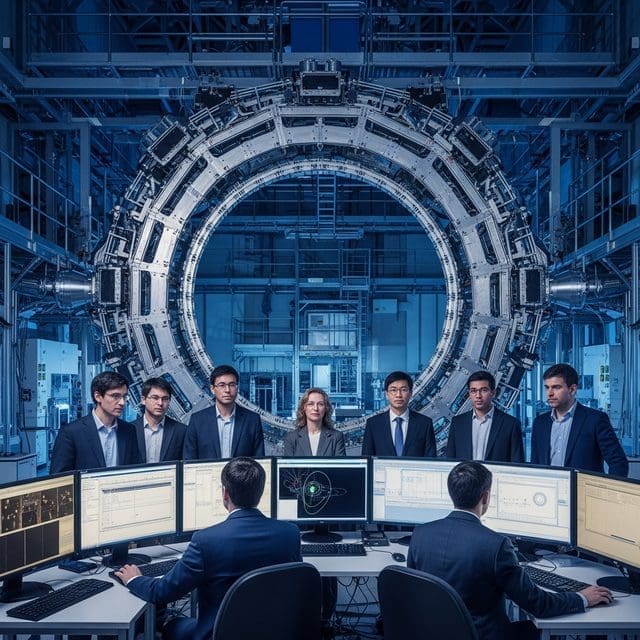
University of Washington researchers and an international team earned the $3 million Breakthrough Prize for measuring the muon particle with unprecedented precision, challenging the current understanding of the subatomic world.
In a victory for rigorous, long-term scientific inquiry, a coalition of approximately 400 scientists has been awarded the 2026 Breakthrough Prize in Fundamental Physics. The $3 million award recognizes decades of work dedicated to understanding the muon—a heavy, short-lived cousin of the electron that serves as a vital probe into the fundamental laws of nature. Among the recipients are University of Washington professors David Hertzog and Peter Kammel, along with 18 other researchers from the university’s physics department.
The muon is a subatomic enigma. Created in particle accelerators, it exists for only a fraction of a second before decaying into electrons and neutrinos. During its brief lifespan, the muon acts like a tiny spinning magnet. For over sixty years, physicists have been obsessed with measuring the strength of this magnetism, known as the g-factor. If the experimental measurement deviates from the predictions of the Standard Model—the prevailing mathematical framework of the universe—it suggests the presence of unknown particles or forces that have yet to be identified by science.
This pursuit reached a pinnacle at the Fermi National Accelerator Laboratory (Fermilab), where the team achieved a precision of 127 parts per billion. This result is 30,000 times more precise than the original experiments conducted at CERN in 1965. David Hertzog, who accepted the prize on behalf of the Fermilab team at a Los Angeles gala, noted that the achievement required the collective talents of experts across nuclear, atomic, and accelerator physics to work toward a single, coherent goal.
The implications of this work touch on the very foundations of American scientific leadership and the pursuit of objective truth. While the Standard Model has successfully described the universe for decades, it remains incomplete, failing to account for gravity or dark matter. By pushing the boundaries of what can be measured, these researchers are defending the principle that our understanding of the physical world must be grounded in empirical data rather than mere theoretical consensus.
Recent developments have added a layer of intrigue to the findings. While the Fermilab results initially suggested a significant gap between theory and experiment, new calculations from the Jülich supercomputers in late April 2026 have narrowed that gap to 0.5 sigma. This suggests the Standard Model may be even more resilient than previously thought, validating the theory to an astounding 11 digits.
As the scientific community digests these results, the next phase of discovery moves to Japan, where the J-PARC muon experiment is preparing an independent check of the Fermilab data. For the researchers at the University of Washington and their global partners, the prize serves as a testament to the value of large-scale collaboration. Whether the muon eventually confirms the Standard Model or shatters it, the pursuit ensures that the frontier of human knowledge remains open to the next generation of American innovators.

Mason Reed serves as a Staff Writer for Just Right News, where he spearheads the Future Frontiers & Special Projects desk. In an era defined by rapid technological shifts and evolving social landscapes, Mason provides a steady, principled voice, examining the innovations of tomorrow through the lens of traditional American values. His work is most prominently featured in his signature series, “The Next Horizon,” where he explores the intersection of emerging technology, national sovereignty, and the preservation of individual liberty.
A native of San Diego, California, Mason’s worldview was shaped by the unique culture of his hometown. Growing up in a region defined by its strong military presence and its history of maritime industry, he developed a deep-seated respect for the institutions that provide national stability and the entrepreneurial spirit that drives the American economy. This upbringing instilled in him a belief that true progress is not found in discarding the past, but in building upon a foundation of proven principles. His reporting often reflects this San Diego influence, emphasizing the importance of a robust national defense and the necessity of maintaining a competitive edge in the global marketplace.
Now based in San Francisco, Mason operates from the heart of the world’s technological engine. Living and working in the Bay Area provides him with a front-row seat to the advancements—and the ideological challenges—emanating from Silicon Valley. While many in the region embrace a “move fast and break things” mentality, Mason’s reporting serves as a vital counterweight. He offers Just Right News readers a “boots on the ground” perspective, documenting how radical local policies and the concentration of tech power impact the everyday lives of citizens. His proximity to the industry allows him to cut through the marketing jargon of big tech to uncover the real-world implications for privacy, free speech, and the nuclear family.
In his “Future Frontiers” beat, Mason tackles complex subjects ranging from the ethics of artificial intelligence to the burgeoning private space race. He approaches these topics with a healthy skepticism toward centralized bureaucracy, championing instead the decentralized innovations that empower individuals. Through “The Next Horizon,” he highlights the pioneers and thinkers who are working to ensure that the future remains a place where human dignity and constitutional rights are protected. He believes that the rapid pace of change requires more than just technical expertise; it requires a moral compass rooted in the Western tradition.
Throughout his tenure at Just Right News, Mason has remained committed to the idea that the future is something to be shaped, not merely accepted. His writing is characterized by a rigorous defense of American exceptionalism and a belief that the country’s best days lie ahead, provided it remains true to its founding ideals. Whether he is investigating the impact of automation on the American workforce or profiling the next generation of aerospace engineers, Mason Reed ensures that his readers are equipped with the insights they need to navigate a changing world with confidence and clarity.