

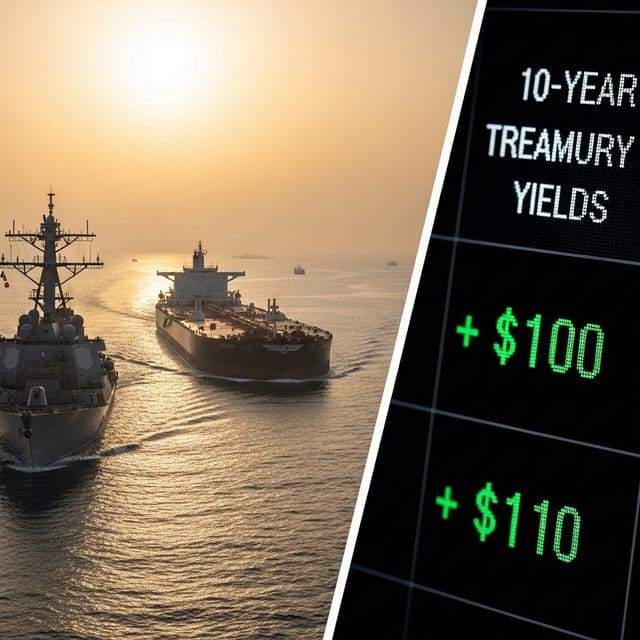
Rising tensions in the Strait of Hormuz and surging Treasury yields pressure American households as oil prices breach $110 per barrel and defense-linked commodities skyrocket.
The American economic landscape shifted sharply on May 4, 2026, as a convergence of geopolitical friction and tightening credit markets hit the pocketbooks of working households. While major indices attempted to hold onto recent record highs, the reality of the ‘Invisible Economy’—the underlying forces of debt and energy—began to weigh heavily on domestic stability. The 10-year Treasury yield climbed to 4.9%, a move that reflects growing skepticism regarding long-term fiscal discipline and heightens the cost of borrowing for every American family.
Energy markets reacted violently to the launch of ‘Project Freedom,’ a U.S. naval operation designed to escort foreign vessels through the Strait of Hormuz. Following reports of a potential strike on a U.S. Navy ship, global oil prices surged above $110 per barrel. WTI crude rose to $102.83, a direct tax on the American commuter. Despite these tensions, the White House continues to navigate a delicate diplomatic path, as Iran reportedly delivered a response to U.S. amendments for a draft peace plan, suggesting that channels for de-escalation remain open even as military presence intensifies.
On Wall Street, the narrative was one of extreme contrast. CNBC’s Jim Cramer reported that a major tech giant expressed ‘unprecedented confidence’ during recent discussions, yet this optimism in the Silicon Valley corridor stands in stark opposition to the struggles of the budget-conscious traveler. Spirit Airlines officially halted operations on May 2 after bondholders rejected a $500 million government bailout. This failure of a major low-cost carrier, combined with the new Series I bond rate of 4.26%, signals a tightening environment where the cost of living and the cost of capital are rising in tandem.
The defense sector is witnessing a radical transformation as the federal government moves to reshore critical supply chains. Tungsten prices have surged approximately 900% year-over-year, driven by a looming January 2027 ban on Chinese tungsten in defense applications. This massive spike in raw material costs, while necessary for national sovereignty, adds further inflationary pressure to the industrial base. In the corporate arena, GameStop launched a surprising $56 billion bid for eBay, though analysts remain skeptical of the financial logic behind such a massive consolidation.
For the average taxpayer, the message from the markets is clear: the era of cheap energy and low interest rates has been replaced by a volatile era of geopolitical risk and fiscal realignment. As Warren Buffett noted during the Berkshire Hathaway annual meeting, the shadow of inflation and the Federal Reserve’s response remain the primary hurdles for the American economy. With the U.S. Navy now actively engaged in securing global trade routes, the cost of maintaining global order is once again being reflected in the daily price of gas and the monthly mortgage statement.

Jordan Lee serves as the Senior Correspondent for Wall Street, Finance, and Monetary Systems at Just Right News. Based in the heart of the world’s financial capital, New York City, Lee brings a sharp, principled eye to the complex mechanisms that drive the global economy. His reporting is defined by a commitment to fiscal responsibility, the defense of the free market, and a deep-seated belief that a transparent monetary system is the bedrock of a free society.
Raised in Portland, Oregon, Lee’s perspective was forged in a city that has undergone significant cultural and economic shifts. His upbringing in the Pacific Northwest instilled in him a profound appreciation for the industriousness of small business owners and the importance of local economic stability. Watching the evolution of his hometown’s landscape sparked an early interest in how federal fiscal policy and large-scale financial trends eventually trickle down to the average citizen. This background provides him with a unique vantage point; he understands the growing disconnect between the policy-making elite and the reality of Main Street, a theme that frequently resonates throughout his work.
Now operating from his base in New York City, Lee bridges the gap between the high-stakes trading floors of Manhattan and the households of everyday Americans. He views the financial sector not merely as a collection of numbers and tickers, but as a vital engine of American prosperity that requires constant vigilance and accountability. His reporting often highlights the dangers of centralized financial control and the necessity of maintaining a system that rewards merit, risk-taking, and innovation.
As the creator and lead of the featured series, “The Invisible Economy,” Lee pulls back the curtain on the often-opaque world of monetary systems. He specializes in translating the dense jargon of central banking and international finance into actionable insights for the Just Right News audience. His work explores the “invisible” forces—such as inflationary pressures, regulatory creep, and the expansion of the administrative state—that erode the purchasing power of American families. By focusing on these systemic issues, Lee empowers readers to understand the hidden forces shaping their financial independence.
Lee’s journalistic philosophy is rooted in a steadfast commitment to traditional American values. As an Asian American professional who has navigated the competitive corridors of the financial world, he is a vocal advocate for meritocracy and the preservation of the American Dream. He believes that a stable currency and a predictable regulatory environment are essential for national sovereignty and individual liberty. His reporting frequently warns against the risks of government overreach in the private sector, arguing that the most effective solutions to economic challenges arise from competition and individual enterprise rather than bureaucratic mandates.
At Just Right News, Jordan Lee remains dedicated to providing a clear-eyed defense of the taxpayer. Whether he is analyzing market volatility or investigating the long-term implications of national debt, his mission is to provide the truth about where the money is going and what it means for the future of the country. Through his rigorous analysis and principled stance, Lee has become a trusted voice for those who value a strong, sovereign, and fiscally sound America.