

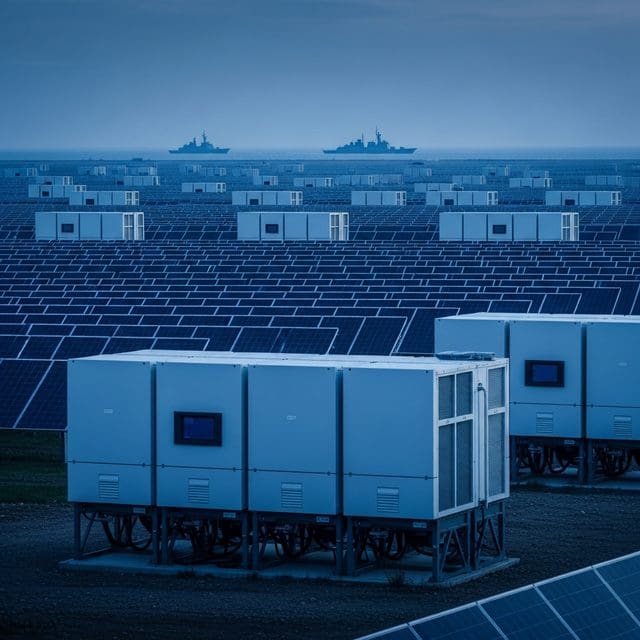
The European Union has blocked public funding for Chinese solar inverters, citing grid security risks, while global oil markets brace for potential disruptions in the Strait of Hormuz.
Energy policy is shifting from a focus on pure decarbonization toward a more urgent emphasis on national security and grid reliability. The European Union has implemented a ban on public funding for Chinese solar technology, specifically targeting inverters from companies like Huawei and Sungrow. European officials cite the risk of remote shutdowns and potential countrywide blackouts as the primary drivers for the move, favoring suppliers from the U.S., Japan, South Korea, and Switzerland to insulate the continental grid from foreign interference.
This move toward energy sovereignty comes as global oil markets face renewed pressure. West Texas Intermediate (WTI) crude reached $105.74 per barrel on May 4, while Brent crude has seen recent intraday highs of $126.41. The price volatility is largely tied to ‘Project Freedom,’ a U.S. initiative announced by the Trump administration to have the U.S. Navy escort foreign vessels through the Strait of Hormuz starting May 5. The operation serves as a direct warning to Iran, which has signaled that while diplomacy remains an option, military friction in the region could further destabilize global supply.
In Africa, the Nigerian National Petroleum Company (NNPC) is capitalizing on the high-price environment and increased demand for natural gas. The NNPC reported a March profit after tax of N276 billion, a staggering 102 percent increase from February. Despite outages at the Trans Forcados pipeline, Nigeria’s gas sales hit a one-year high of 5,059 million standard cubic feet per day. This surge in revenue highlights the continued reliance on traditional hydrocarbons to provide the baseload power and export revenue that intermittent renewables currently cannot match.
While the EU moves to secure its solar infrastructure, the wind sector continues to face logistical and social hurdles. At the WindEurope 2026 conference, developers like VSB Group emphasized the need for ‘repowering’ existing sites and creating hybrid storage solutions to meet demand. However, expansion in many European regions is stagnating due to local opposition regarding scenic landscapes and the inherent intermittency of wind power, which is most productive in winter when demand peaks but requires robust backup systems.
The intersection of these developments reveals a clear trend: the era of prioritizing low-cost components over supply chain security is ending. Whether it is the EU purging Chinese hardware from its grid or the U.S. deploying naval assets to secure oil transit, the global energy market is being redefined by the hard realities of geopolitics and the tangible costs of maintaining a reliable power supply. For the American taxpayer and the global consumer, these shifts represent a transition away from ideological energy goals toward a pragmatic, security-first approach to resource economics.

Mark Davis serves as the Senior Correspondent for Energy, Climate, and Resource Economics at Just Right News. In an era where the conversation around the environment is often dominated by alarmism and top-down mandates, Mark provides a vital, market-oriented perspective on the complex forces shaping our world. As the lead voice behind the acclaimed feature series “Power and the Planet,” he explores the intersection of environmental policy, global energy markets, and the fundamental economic principles that sustain modern civilization.
Mark’s pragmatic approach to resource management was forged in the high desert of his hometown, Albuquerque, New Mexico. Growing up in a region defined by both its breathtaking natural beauty and its rugged, resource-dependent landscape, he developed an early appreciation for the delicate balance between conservation and utilization. New Mexico’s unique position as a hub for both traditional energy production and cutting-edge scientific research provided Mark with a front-row seat to the evolution of the American energy sector. This upbringing instilled in him a deep-seated belief that true environmental stewardship is inseparable from economic prosperity and technological innovation.
Now based in Boulder, Colorado, Mark operates from the heart of the nation’s climate research community. While Boulder is often seen as a bastion of environmental idealism, Mark utilizes his post to provide a necessary counterweight, grounded in the realities of resource economics. He understands that energy policy does not exist in a vacuum; it has tangible consequences for the American taxpayer, the stability of the national power grid, and the strength of the domestic manufacturing sector. By reporting from the front lines of the climate debate, he is able to challenge prevailing narratives with hard data and a commitment to the principles of the free market.
Throughout his tenure at Just Right News, Mark has distinguished himself by focusing on the “Resource Economics” aspect of his beat. He frequently highlights the hidden costs of rapid energy transitions and advocates for an “all-of-the-above” energy strategy that prioritizes American energy independence. His work often shines a light on the geopolitical implications of resource scarcity, arguing that a secure nation must first be an energy-secure nation. Whether he is analyzing the impact of federal land-use regulations or investigating the supply chains required for new technologies, Mark remains focused on how policy decisions affect the lives and livelihoods of everyday citizens.
In “Power and the Planet,” Mark continues to bridge the gap between complex scientific concepts and the economic realities facing the country. He rejects the false choice between a healthy environment and a thriving economy, instead seeking out solutions that leverage American ingenuity and private-sector competition. For Mark, reporting on the climate is not about following the latest trends, but about ensuring that the conversation remains tethered to the foundational values of liberty, property rights, and fiscal responsibility. His contributions ensure that Just Right News readers receive a comprehensive, clear-eyed view of the challenges and opportunities defining the future of our planet.