

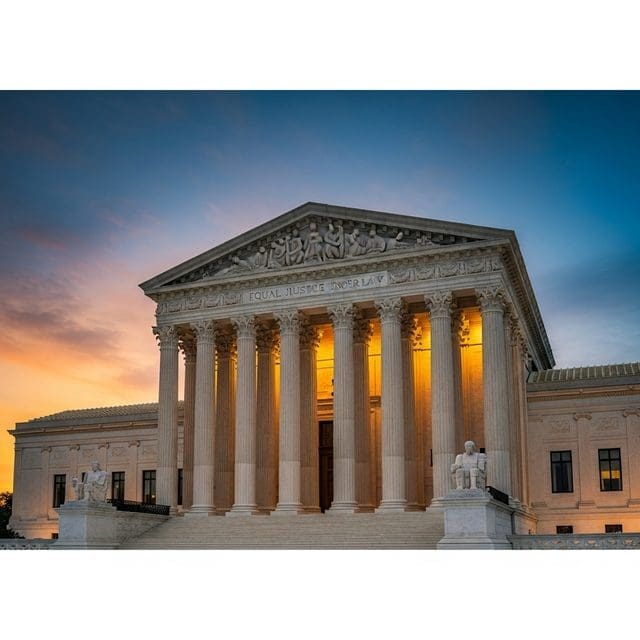
The Supreme Court’s ruling in Louisiana v. Callais establishes a rigorous new standard for redistricting challenges, requiring plaintiffs to provide objective proof of discriminatory intent.
The Supreme Court’s decision in Louisiana v. Callais has fundamentally recalibrated the legal landscape for redistricting, moving the judiciary away from race-based mapmaking and toward a stricter interpretation of the Fourteenth Amendment. Writing for the 6-3 majority, Justice Samuel Alito clarified that the Constitution requires a colorblind approach to drawing district lines unless a state can provide a compelling justification that survives strict scrutiny.
The ruling specifically addressed Louisiana’s 6th Congressional District, which had been drawn to create a second Black-majority seat. The Court found this to be an unconstitutional racial gerrymander, asserting that race had predominated over traditional redistricting principles. Central to the Court’s reasoning is the new evidentiary standard for plaintiffs: they must now demonstrate a “strong inference” and an “objective likelihood” that intentional discrimination occurred.
Justice Alito’s opinion emphasized that the Voting Rights Act (VRA) was never intended to be a permanent mandate for racial quotas in the electoral process. He noted that the VRA has served its purpose and that the nation has seen vast social progress. By requiring plaintiffs to account for a mapmaker’s “nonracial goals,” such as partisan advantage or geographic compactness, the Court has made it significantly more difficult to strike down maps based solely on their racial composition.
In a sharp dissent, Justice Elena Kagan argued that the new standard is “well-nigh impossible” to meet, suggesting it effectively shields discriminatory maps from judicial review. This sentiment was echoed by the Congressional Black Caucus, where Chair Yvette Clarke described the ruling as a blow to minority representation. Representative Terri Sewell warned that the decision could lead to a substantial reduction in the number of minority-held seats across the country.
The practical implications of the ruling are already rippling through the political sphere. In Mississippi, the judicial philosophy underpinning this decision has become a focal point in the Senate race. Incumbent Senator Cindy Hyde-Smith, who blocked the federal judgeship of Democrat Scott Colom, now faces a tightening race as Colom campaigns on the protection of voting access. Recent polling shows Hyde-Smith leading by only three points, signaling potential voter backlash as the electorate weighs the impact of judicial appointments on constitutional rights.
By prioritizing the original intent of the Equal Protection Clause, the Court has signaled a return to a framework where individual rights take precedence over group-based outcomes. While critics view this as an erosion of the Voting Rights Act, proponents of the ruling see it as a necessary step toward restoring a constitutional order that treats all citizens equally, regardless of race, at the ballot box. The decision ensures that the judiciary remains a neutral arbiter of the law as written, rather than a tool for social engineering through the manipulation of electoral boundaries.

Lila Hayes serves as a Staff Writer for Just Right News, where she anchors the “Courts, Law, and Constitutional Order” beat. Her work is defined by a steadfast commitment to the foundational principles of the American republic and a rigorous defense of the legal frameworks that ensure national stability. As a primary voice for the outlet, she provides readers with a clear-eyed analysis of the judiciary, focusing on the importance of originalism and the preservation of the separation of powers.
Lila’s perspective was forged in the American heartland. Raised in St. Louis, Missouri, she grew up in a Hispanic household where the values of hard work, faith, and respect for the law were paramount. Her upbringing instilled in her a deep appreciation for the American Dream and the legal protections that make it possible. This Missouri background remains a cornerstone of her reporting, providing a grounded, common-sense counter-narrative to the often-insular legal circles of the coastal elite. She understands that the decisions made in high-court chambers have real-world consequences for families and small business owners across the country.
At Just Right News, Lila has become widely recognized for her signature feature series, “The Rulebook of Power.” In this ongoing project, she delves into the mechanics of the federal government, examining how administrative overreach and judicial activism can threaten the delicate balance of the Constitution. She approaches her beat with the tenacity of a veteran journalist and the precision of a legal scholar, consistently advocating for a judiciary that interprets the law as written rather than legislating from the bench. For Lila, the Constitution is not a “living” document subject to the whims of modern social trends; it is a fixed standard that ensures the government remains the servant of the people, not their master.
Now based in Philadelphia, Pennsylvania, Lila finds herself at the very epicenter of American constitutional history. Living and working in the city where the Founders drafted the documents she defends daily provides a constant source of inspiration. The historic halls and landmarks of Philadelphia serve as a daily reminder of the high stakes involved in her reporting. Her presence in the city allows her to bridge the gap between the historical intent of the law and its contemporary application, ensuring that the legacy of the Founding Fathers remains central to the national conversation.
Throughout her career, Lila has remained dedicated to the idea that a free society requires an informed citizenry and a transparent legal system. Her reporting is more than just a collection of headlines; it is a defense of the constitutional order that has sustained the nation for over two centuries. By focusing on the “Rulebook of Power,” she ensures that her readers understand not just what is happening in the courtrooms, but why those decisions matter for the future of American liberty. Lila Hayes continues to be a vital voice for those who believe that the law should be a shield for the citizen and a constraint on the state.