

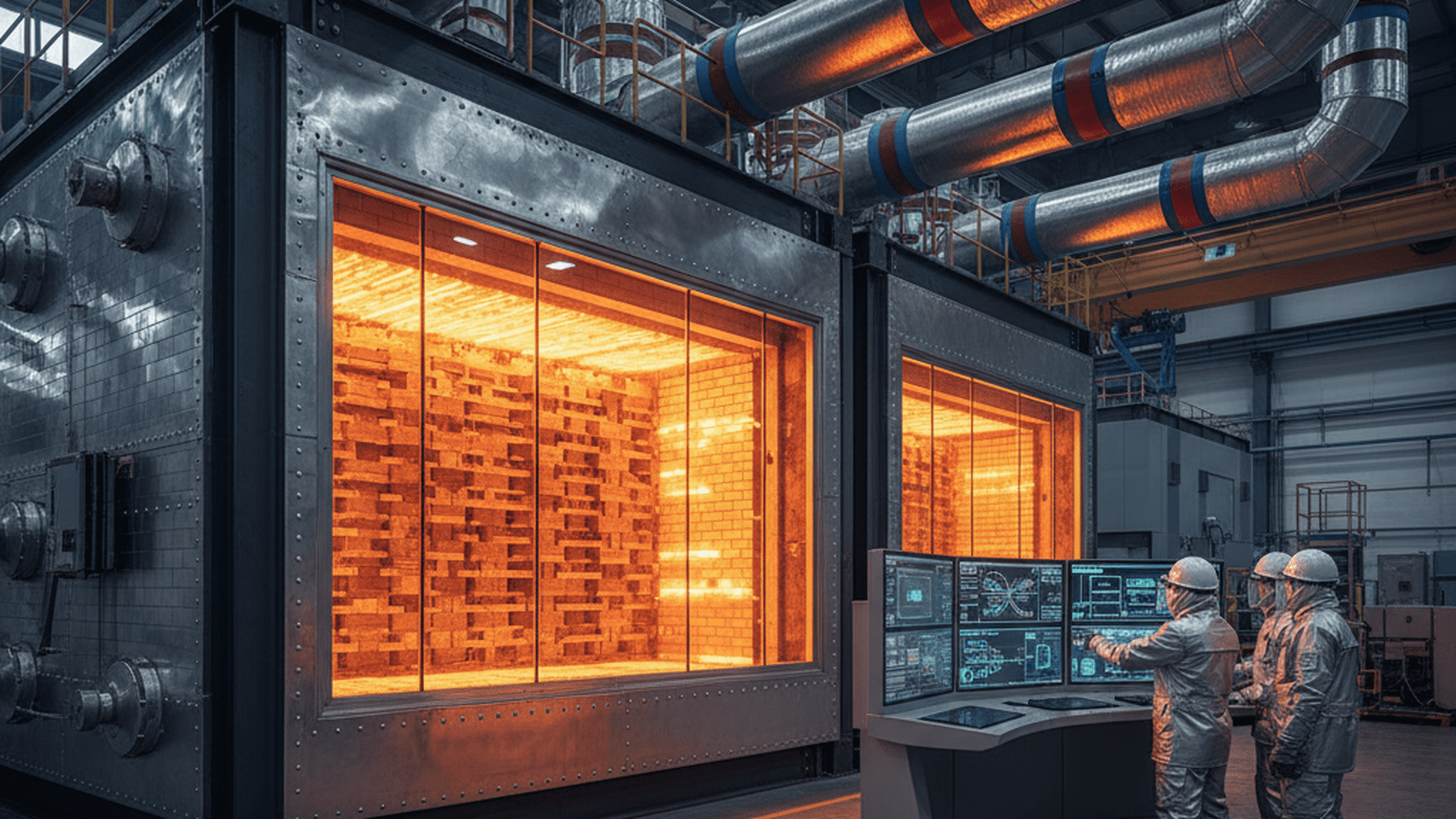
Rondo Energy has successfully demonstrated its heat battery technology, which uses refractory bricks to store renewable electricity as high-temperature thermal energy. The system achieves 98% efficiency and provides a low-cost solution for decarbonizing heavy industries like cement and steel manufacturing.
TLDR: Rondo Energy’s thermal battery technology uses refractory bricks to store intermittent wind and solar power as high-temperature heat. Achieving 98% efficiency, the system offers a scalable method to decarbonize heavy industries like steel and cement, which currently rely on fossil fuels for high-grade process heat.
Heavy industry remains one of the most difficult sectors to decarbonize because processes like steel manufacturing, glass blowing, and chemical synthesis require constant, high-grade heat. While lithium-ion batteries excel at storing electricity for the grid, they are prohibitively expensive for the massive energy demands of industrial thermal loads. Rondo Energy, a California-based startup, has validated a solution that utilizes one of humanity’s oldest materials: the refractory brick. This approach addresses the ‘heat gap’ by converting intermittent renewable electricity into a steady stream of high-temperature thermal energy.
The Rondo Heat Battery operates on a principle of simplicity and durability. It uses electric heating elements, similar to those in a domestic toaster, to warm stacks of aluminosilicate bricks to temperatures exceeding 1,200 degrees Celsius. These bricks are housed within a heavily insulated steel container, allowing them to retain heat for days with less than a 1% daily loss. When heat is needed, air is blown through the brick stack, reaching the desired temperature before being routed to industrial equipment as steam or hot air. This mechanism allows for the storage of vast amounts of energy in a compact footprint, utilizing materials that have been used in industrial furnaces for centuries.
Recent performance data from the company’s first commercial-scale installations confirms that the system achieves a 98% round-trip efficiency when delivering heat. This efficiency is significantly higher than hydrogen-based solutions, which lose substantial energy during electrolysis and combustion. By using bricks—a material already produced at a scale of billions of tons annually—the technology avoids the supply chain bottlenecks and environmental concerns associated with rare earth metals or lithium mining. The simplicity of the material also ensures a lifespan of several decades without degradation, providing a level of reliability that is essential for heavy industrial operations that run 24 hours a day.
The economic viability of the system hinges on the increasing availability of low-cost, intermittent renewable energy. During periods of peak solar or wind production, electricity prices often drop to near zero or even turn negative. The heat battery absorbs this excess power, effectively charging the bricks. This allows industrial facilities to operate 24/7 on renewable energy, bypassing the need for continuous natural gas combustion and providing a hedge against volatile fossil fuel prices. By transforming intermittent power into a firm thermal resource, Rondo enables factories to treat renewable energy as a primary fuel source rather than a secondary supplement.
The modular design of the units allows for rapid deployment across various sectors. Each unit can be scaled to meet the specific megawatt-hour requirements of a facility, from small food processing plants to massive petrochemical complexes. Because the system uses standard industrial components, it can be integrated into existing factory footprints with minimal modification to downstream processes. This ‘drop-in’ capability is crucial for rapid adoption in conservative industrial markets where downtime is costly. The ability to scale by simply adding more units makes it an attractive option for facilities looking to phase out carbon emissions incrementally.
Decarbonizing industrial heat is essential for meeting global climate targets, as thermal energy accounts for roughly a quarter of all global greenhouse gas emissions. The validation of brick-based storage suggests that the transition to clean industry may not require exotic new chemistries, but rather the innovative application of established materials. Future research and development are focused on increasing the energy density of the brick materials and optimizing the airflow dynamics within the storage core to support even higher temperature requirements. As the world moves toward a net-zero economy, the humble brick may prove to be one of the most important tools in the clean energy toolkit.

Mark Davis serves as the Senior Correspondent for Energy, Climate, and Resource Economics at Just Right News. In an era where the conversation around the environment is often dominated by alarmism and top-down mandates, Mark provides a vital, market-oriented perspective on the complex forces shaping our world. As the lead voice behind the acclaimed feature series “Power and the Planet,” he explores the intersection of environmental policy, global energy markets, and the fundamental economic principles that sustain modern civilization.
Mark’s pragmatic approach to resource management was forged in the high desert of his hometown, Albuquerque, New Mexico. Growing up in a region defined by both its breathtaking natural beauty and its rugged, resource-dependent landscape, he developed an early appreciation for the delicate balance between conservation and utilization. New Mexico’s unique position as a hub for both traditional energy production and cutting-edge scientific research provided Mark with a front-row seat to the evolution of the American energy sector. This upbringing instilled in him a deep-seated belief that true environmental stewardship is inseparable from economic prosperity and technological innovation.
Now based in Boulder, Colorado, Mark operates from the heart of the nation’s climate research community. While Boulder is often seen as a bastion of environmental idealism, Mark utilizes his post to provide a necessary counterweight, grounded in the realities of resource economics. He understands that energy policy does not exist in a vacuum; it has tangible consequences for the American taxpayer, the stability of the national power grid, and the strength of the domestic manufacturing sector. By reporting from the front lines of the climate debate, he is able to challenge prevailing narratives with hard data and a commitment to the principles of the free market.
Throughout his tenure at Just Right News, Mark has distinguished himself by focusing on the “Resource Economics” aspect of his beat. He frequently highlights the hidden costs of rapid energy transitions and advocates for an “all-of-the-above” energy strategy that prioritizes American energy independence. His work often shines a light on the geopolitical implications of resource scarcity, arguing that a secure nation must first be an energy-secure nation. Whether he is analyzing the impact of federal land-use regulations or investigating the supply chains required for new technologies, Mark remains focused on how policy decisions affect the lives and livelihoods of everyday citizens.
In “Power and the Planet,” Mark continues to bridge the gap between complex scientific concepts and the economic realities facing the country. He rejects the false choice between a healthy environment and a thriving economy, instead seeking out solutions that leverage American ingenuity and private-sector competition. For Mark, reporting on the climate is not about following the latest trends, but about ensuring that the conversation remains tethered to the foundational values of liberty, property rights, and fiscal responsibility. His contributions ensure that Just Right News readers receive a comprehensive, clear-eyed view of the challenges and opportunities defining the future of our planet.