

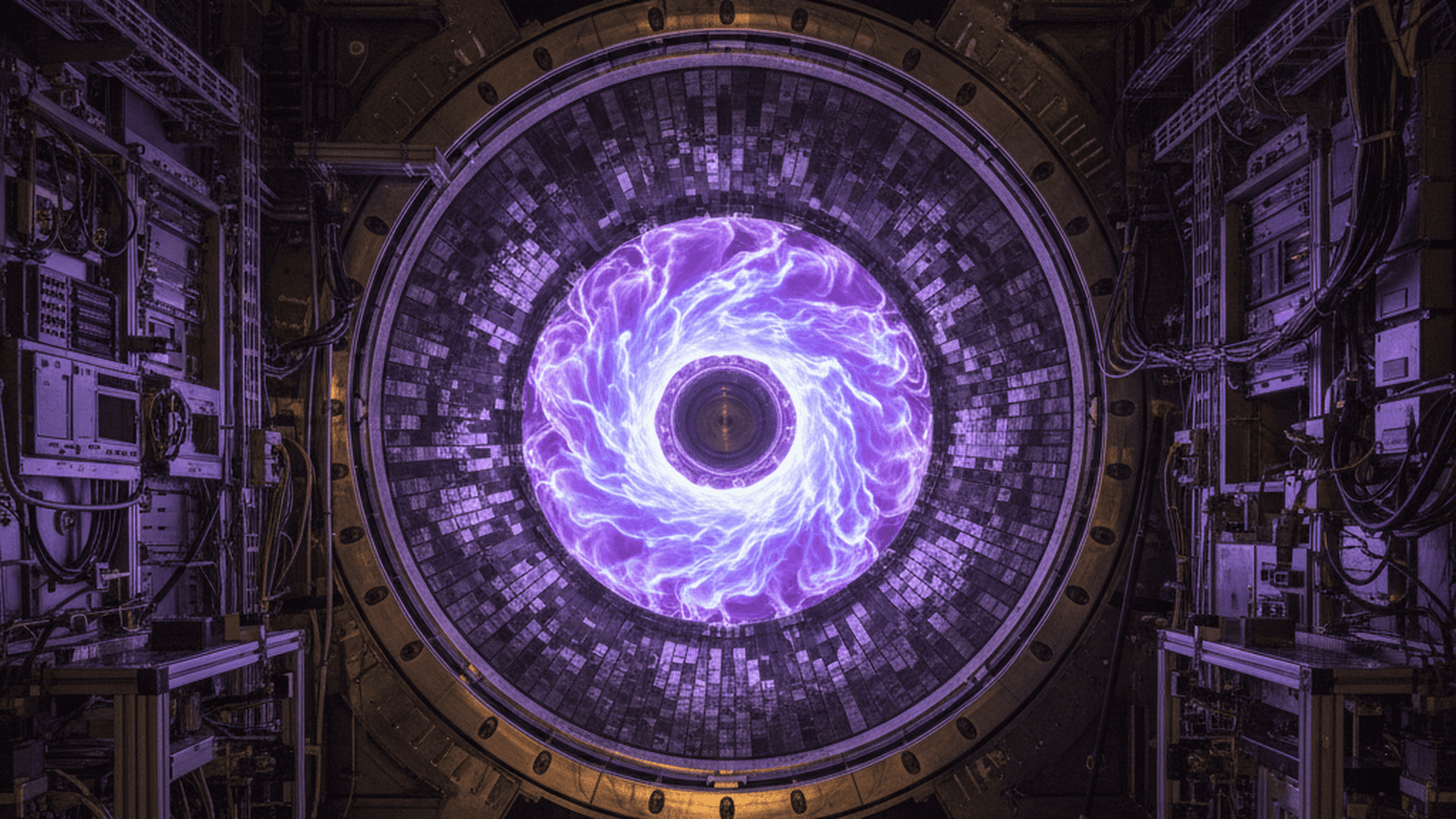
The Joint European Torus (JET) facility concluded its four-decade run by setting a new world record for fusion energy production, generating 69.2 megajoules of heat. This achievement provides critical validation for the upcoming ITER project and the future of commercial fusion power.
TLDR: Researchers at the Joint European Torus facility in the United Kingdom have set a final world record for fusion energy, producing 69.2 megajoules using deuterium-tritium fuel. This milestone confirms the viability of magnetic confinement fusion and provides essential data for the larger ITER reactor currently under construction in France.
The Joint European Torus (JET) facility, located in Culham, United Kingdom, has concluded its experimental operations by setting a new world record for fusion energy production. In its final series of tests, the tokamak reactor generated 69.2 megajoules of energy from a single five-second pulse. This achievement surpasses the facility’s previous record of 59 megajoules set in 2021 and represents the highest amount of energy ever produced in a fusion experiment. This milestone marks the end of an era for one of the world’s most successful scientific collaborations.
Fusion energy seeks to replicate the process that powers the sun by fusing light atomic nuclei to release vast amounts of energy. Unlike traditional nuclear fission, which splits heavy atoms, fusion produces no long-lived radioactive waste and carries no risk of a meltdown. The JET experiments utilized a specific mixture of deuterium and tritium, two isotopes of hydrogen that are considered the most efficient fuel for future commercial fusion power plants. The success of this fuel mix is a critical proof of concept for the feasibility of clean, carbon-free energy.
The record-breaking run was the culmination of over 40 years of research at the site. Operated by the UK Atomic Energy Authority and the EUROfusion consortium, JET has served as a primary testbed for the technologies required to harness fusion on a global scale. The facility’s interior was recently upgraded to include a wall made of beryllium and tungsten, materials chosen for their high melting points and low retention of tritium. This configuration mimics the design of ITER, the much larger international fusion reactor currently under construction in southern France.
During the final experiments, researchers focused on maintaining plasma stability at extreme temperatures. The plasma within the tokamak reached 150 million degrees Celsius, which is ten times hotter than the center of the sun. Magnetic fields were used to confine this superheated gas within the doughnut-shaped vacuum chamber, preventing it from touching and damaging the reactor walls. The successful five-second pulse demonstrated that the magnetic confinement strategy is robust enough to handle the intense heat and pressure required for sustained fusion.
The data gathered from this final campaign is expected to be transformative for the field of plasma physics. Scientists are now analyzing the results to understand how the plasma interacted with the reactor walls and how the fuel mixture behaved under prolonged high-power conditions. These insights are critical for the transition from experimental reactors to demonstration plants, which are intended to provide electricity to the grid. The precision of the results confirms that current modeling for plasma behavior is highly accurate.
The international collaboration behind JET involved more than 300 scientists and engineers from across Europe. This collective effort has provided the foundational knowledge necessary for the next generation of fusion devices. While JET will now enter a decommissioning phase that will last several years, the facility will continue to contribute to science as researchers study the effects of long-term radiation on the reactor’s structural components. This phase will provide rare data on how materials age within a fusion environment.
The success of the JET program signals a turning point in the quest for clean, limitless energy. By proving that deuterium-tritium fusion can be controlled and sustained at record-breaking levels, the project has removed significant technical uncertainties. Future research will now shift toward ITER, where scientists aim to achieve a burning plasma state. This next step is essential to prove that fusion can produce significantly more energy than is required to heat the plasma, paving the way for commercial power generation.

Mark Davis serves as the Senior Correspondent for Energy, Climate, and Resource Economics at Just Right News. In an era where the conversation around the environment is often dominated by alarmism and top-down mandates, Mark provides a vital, market-oriented perspective on the complex forces shaping our world. As the lead voice behind the acclaimed feature series “Power and the Planet,” he explores the intersection of environmental policy, global energy markets, and the fundamental economic principles that sustain modern civilization.
Mark’s pragmatic approach to resource management was forged in the high desert of his hometown, Albuquerque, New Mexico. Growing up in a region defined by both its breathtaking natural beauty and its rugged, resource-dependent landscape, he developed an early appreciation for the delicate balance between conservation and utilization. New Mexico’s unique position as a hub for both traditional energy production and cutting-edge scientific research provided Mark with a front-row seat to the evolution of the American energy sector. This upbringing instilled in him a deep-seated belief that true environmental stewardship is inseparable from economic prosperity and technological innovation.
Now based in Boulder, Colorado, Mark operates from the heart of the nation’s climate research community. While Boulder is often seen as a bastion of environmental idealism, Mark utilizes his post to provide a necessary counterweight, grounded in the realities of resource economics. He understands that energy policy does not exist in a vacuum; it has tangible consequences for the American taxpayer, the stability of the national power grid, and the strength of the domestic manufacturing sector. By reporting from the front lines of the climate debate, he is able to challenge prevailing narratives with hard data and a commitment to the principles of the free market.
Throughout his tenure at Just Right News, Mark has distinguished himself by focusing on the “Resource Economics” aspect of his beat. He frequently highlights the hidden costs of rapid energy transitions and advocates for an “all-of-the-above” energy strategy that prioritizes American energy independence. His work often shines a light on the geopolitical implications of resource scarcity, arguing that a secure nation must first be an energy-secure nation. Whether he is analyzing the impact of federal land-use regulations or investigating the supply chains required for new technologies, Mark remains focused on how policy decisions affect the lives and livelihoods of everyday citizens.
In “Power and the Planet,” Mark continues to bridge the gap between complex scientific concepts and the economic realities facing the country. He rejects the false choice between a healthy environment and a thriving economy, instead seeking out solutions that leverage American ingenuity and private-sector competition. For Mark, reporting on the climate is not about following the latest trends, but about ensuring that the conversation remains tethered to the foundational values of liberty, property rights, and fiscal responsibility. His contributions ensure that Just Right News readers receive a comprehensive, clear-eyed view of the challenges and opportunities defining the future of our planet.