

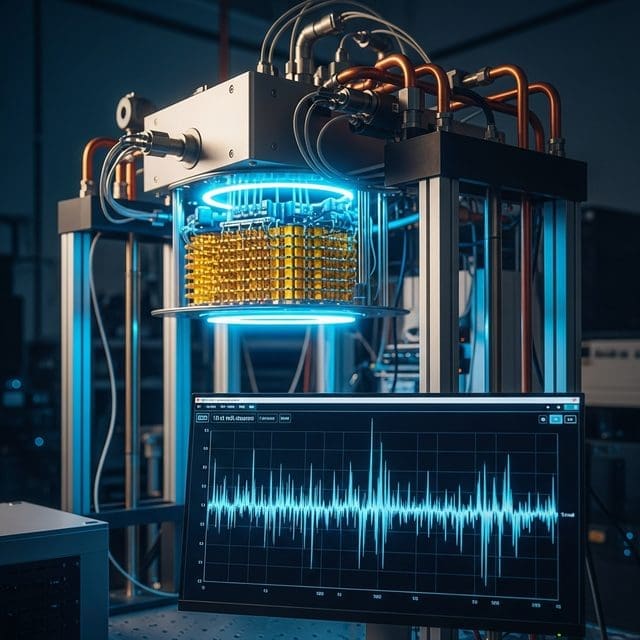
Researchers at the Norwegian University of Science and Technology have developed a real-time method to track quantum data decay, potentially solving a major hurdle for stable computing.
The promise of quantum computing has long been tempered by a fundamental fragility: the tendency for information to vanish without warning. This instability, known as decoherence, has remained the primary obstacle to moving quantum technology out of the laboratory and into the hands of American innovators. However, a recent breakthrough from a team at the Norwegian University of Science and Technology (NTNU) and the Niels Bohr Institute suggests that the era of unpredictable quantum decay may be coming to an end.
In a study published in Physical Review X, researchers led by Professor Jeroen Danon announced a new measurement method capable of tracking quantum data loss 100 times faster than previous industry standards. While traditional methods required roughly one second to assess the health of a qubit—a lifetime in the subatomic world—the new technique achieves this in just 10 milliseconds. This shift to near real-time monitoring allows scientists to observe exactly how and when information fades, providing a window into the chaotic environment of superconducting qubits.
This development is particularly significant for those wary of the centralized control of emerging technologies. By making quantum systems more stable and transparent, this research paves the way for decentralized, high-performance computing that does not rely solely on the massive server farms of Silicon Valley. For the average citizen, a stable quantum computer could eventually mean unbreakable encryption for personal data and the ability to solve complex logistical problems that currently require massive bureaucratic oversight.
Professor Danon noted that while superconducting qubits generally perform well on average, their reliability fluctuates randomly over time. Without the ability to track these fluctuations as they happen, engineers have been unable to identify the root causes of system failures. The new method acts as a high-speed diagnostic tool, allowing researchers to see the subtle, rapid changes that were previously invisible. This level of precision is essential for building machines that can uphold the rigorous standards of reliability required for national infrastructure and private enterprise.
As the global race for quantum supremacy intensifies, the ability to stabilize these systems becomes a matter of sovereignty. The work at NTNU and the Niels Bohr Institute provides a roadmap for hardening these systems against the environmental noise that currently renders them temperamental. By mastering the measurement of the infinitesimal, researchers are ensuring that the next generation of computing remains a tool for human ingenuity rather than a fragile experiment.

Mason Reed serves as a Staff Writer for Just Right News, where he spearheads the Future Frontiers & Special Projects desk. In an era defined by rapid technological shifts and evolving social landscapes, Mason provides a steady, principled voice, examining the innovations of tomorrow through the lens of traditional American values. His work is most prominently featured in his signature series, “The Next Horizon,” where he explores the intersection of emerging technology, national sovereignty, and the preservation of individual liberty.
A native of San Diego, California, Mason’s worldview was shaped by the unique culture of his hometown. Growing up in a region defined by its strong military presence and its history of maritime industry, he developed a deep-seated respect for the institutions that provide national stability and the entrepreneurial spirit that drives the American economy. This upbringing instilled in him a belief that true progress is not found in discarding the past, but in building upon a foundation of proven principles. His reporting often reflects this San Diego influence, emphasizing the importance of a robust national defense and the necessity of maintaining a competitive edge in the global marketplace.
Now based in San Francisco, Mason operates from the heart of the world’s technological engine. Living and working in the Bay Area provides him with a front-row seat to the advancements—and the ideological challenges—emanating from Silicon Valley. While many in the region embrace a “move fast and break things” mentality, Mason’s reporting serves as a vital counterweight. He offers Just Right News readers a “boots on the ground” perspective, documenting how radical local policies and the concentration of tech power impact the everyday lives of citizens. His proximity to the industry allows him to cut through the marketing jargon of big tech to uncover the real-world implications for privacy, free speech, and the nuclear family.
In his “Future Frontiers” beat, Mason tackles complex subjects ranging from the ethics of artificial intelligence to the burgeoning private space race. He approaches these topics with a healthy skepticism toward centralized bureaucracy, championing instead the decentralized innovations that empower individuals. Through “The Next Horizon,” he highlights the pioneers and thinkers who are working to ensure that the future remains a place where human dignity and constitutional rights are protected. He believes that the rapid pace of change requires more than just technical expertise; it requires a moral compass rooted in the Western tradition.
Throughout his tenure at Just Right News, Mason has remained committed to the idea that the future is something to be shaped, not merely accepted. His writing is characterized by a rigorous defense of American exceptionalism and a belief that the country’s best days lie ahead, provided it remains true to its founding ideals. Whether he is investigating the impact of automation on the American workforce or profiling the next generation of aerospace engineers, Mason Reed ensures that his readers are equipped with the insights they need to navigate a changing world with confidence and clarity.