

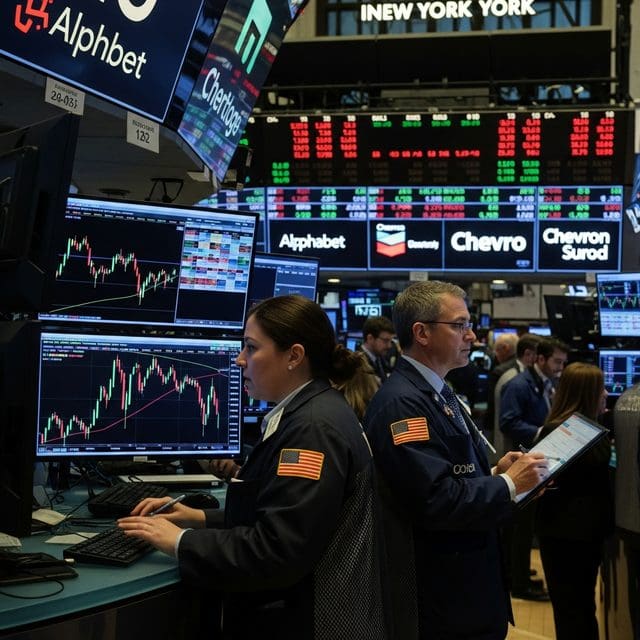
Market indices face volatility as Alphabet’s massive gains contrast with Chevron’s five-year profit low and mounting pressure on central bank rate control.
The financial landscape is currently defined by a stark divergence between technological momentum and the underlying friction of the real economy. While the Nasdaq and S&P 500 have found support in massive capitalizations, the mechanics of monetary policy and industrial profitability are signaling a more complex reality for the American taxpayer and the global investor.
Alphabet provided a significant tailwind to the indices on April 30, adding $421 billion to its market capitalization. This surge, driven by cloud growth and artificial intelligence momentum, highlights a market still willing to reward high-margin digital expansion. However, the industrial sector tells a different story. Chevron reported its lowest profit in five years, with net income falling 36% to $2.2 billion. Although its adjusted earnings of $1.41 per share beat the 95-cent estimate, the drag from derivative timing charges and upstream pressures serves as a reminder that the energy sector remains sensitive to volatile cost structures.
This corporate split occurs as central banks face increasing difficulty in maintaining the “invisible economy” of stable rates. Bank of America analysts recently noted that the Bank of Canada is facing significant challenges in controlling short-term interest rates. This loss of precision in monetary tools often precedes broader market instability, as the gap between official policy and actual lending costs widens. In the United States, although the Federal Reserve has not yet initiated formal cuts, commercial banks and credit unions have already begun reducing interest rates on savings accounts, squeezing retirees and savers who rely on fixed-income yields.
Risk assets are reacting to these shifts in real-time. Gold prices recently posted their worst two-month decline in history, signaling a rotation out of traditional hedges even as geopolitical risks persist. Conversely, the S&P Dow Jones Indices is considering a shift toward “fast-track” entry rules. By relaxing profitability requirements for IPO candidates like SpaceX and OpenAI, the index provider may be attempting to capture growth earlier, though such a move risks diluting the quality standards that have traditionally protected index investors.
The broader economic outlook remains tethered to energy and inflation. BNP Paribas has identified a scenario where oil prices reaching $200 per barrel could tip the global economy into a recession. With Western Digital shares declining despite an earnings beat—as investors exit after a year-long rally—it is clear that the market is no longer satisfied with mere survival; it is looking for sustainable fiscal health in an environment where central bank control is increasingly questioned.
Furthermore, the institutional landscape is shifting toward consolidation and new asset classes. Lazard Inc. has entered a definitive agreement to acquire Campbell Lutyens, and new entities like West Enclave Merger Corp. and Plutonian Acquisition Corp II have successfully priced $100 million IPOs. Even sovereign entities are looking beyond traditional fiat; Taiwan Legislator Dr. Ko Ju-Chun recently presented a report on establishing a Bitcoin reserve for the nation. For the disciplined observer, these moves suggest a market preparing for a future where centralized financial control is no longer the only game in town.

Jordan Lee serves as the Senior Correspondent for Wall Street, Finance, and Monetary Systems at Just Right News. Based in the heart of the world’s financial capital, New York City, Lee brings a sharp, principled eye to the complex mechanisms that drive the global economy. His reporting is defined by a commitment to fiscal responsibility, the defense of the free market, and a deep-seated belief that a transparent monetary system is the bedrock of a free society.
Raised in Portland, Oregon, Lee’s perspective was forged in a city that has undergone significant cultural and economic shifts. His upbringing in the Pacific Northwest instilled in him a profound appreciation for the industriousness of small business owners and the importance of local economic stability. Watching the evolution of his hometown’s landscape sparked an early interest in how federal fiscal policy and large-scale financial trends eventually trickle down to the average citizen. This background provides him with a unique vantage point; he understands the growing disconnect between the policy-making elite and the reality of Main Street, a theme that frequently resonates throughout his work.
Now operating from his base in New York City, Lee bridges the gap between the high-stakes trading floors of Manhattan and the households of everyday Americans. He views the financial sector not merely as a collection of numbers and tickers, but as a vital engine of American prosperity that requires constant vigilance and accountability. His reporting often highlights the dangers of centralized financial control and the necessity of maintaining a system that rewards merit, risk-taking, and innovation.
As the creator and lead of the featured series, “The Invisible Economy,” Lee pulls back the curtain on the often-opaque world of monetary systems. He specializes in translating the dense jargon of central banking and international finance into actionable insights for the Just Right News audience. His work explores the “invisible” forces—such as inflationary pressures, regulatory creep, and the expansion of the administrative state—that erode the purchasing power of American families. By focusing on these systemic issues, Lee empowers readers to understand the hidden forces shaping their financial independence.
Lee’s journalistic philosophy is rooted in a steadfast commitment to traditional American values. As an Asian American professional who has navigated the competitive corridors of the financial world, he is a vocal advocate for meritocracy and the preservation of the American Dream. He believes that a stable currency and a predictable regulatory environment are essential for national sovereignty and individual liberty. His reporting frequently warns against the risks of government overreach in the private sector, arguing that the most effective solutions to economic challenges arise from competition and individual enterprise rather than bureaucratic mandates.
At Just Right News, Jordan Lee remains dedicated to providing a clear-eyed defense of the taxpayer. Whether he is analyzing market volatility or investigating the long-term implications of national debt, his mission is to provide the truth about where the money is going and what it means for the future of the country. Through his rigorous analysis and principled stance, Lee has become a trusted voice for those who value a strong, sovereign, and fiscally sound America.