

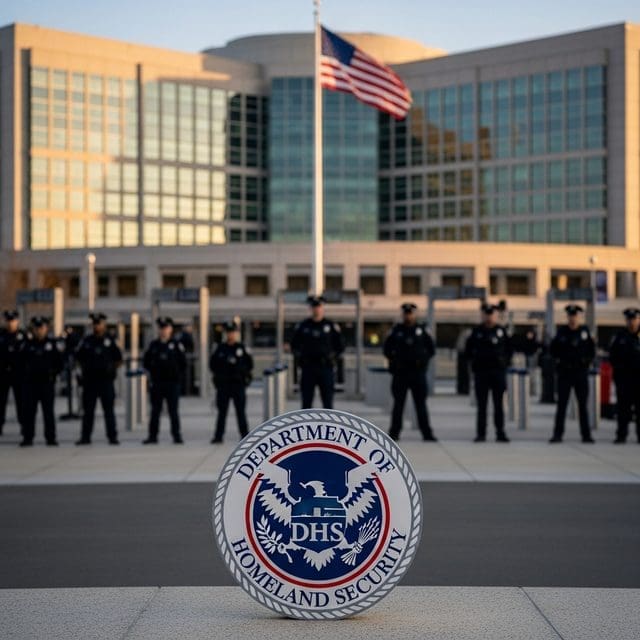
President Trump signed a bipartisan funding package for the Department of Homeland Security, ending a historic shutdown while deferring the contentious debate over immigration enforcement to a separate legislative track.
President Donald Trump signed legislation on April 30 to restore regular appropriations to the Department of Homeland Security, concluding a 76-day partial shutdown that stands as the longest agency-specific funding lapse in American history. The resolution provides immediate stability for approximately 260,000 employees across the TSA, Coast Guard, FEMA, and the Secret Service, many of whom had been working under the strain of temporary executive funding that was nearly exhausted.
The impasse, which began on February 14, was rooted in a fundamental disagreement over federal immigration policy following the fatal shootings of two U.S. citizens, Renee Good and Alex Pretti, during protests in Minneapolis. Congressional Democrats, led by House Appropriations ranking member Rosa DeLauro, refused to fund U.S. Immigration and Customs Enforcement (ICE) and the Border Patrol without significant oversight reforms. Conversely, House Speaker Mike Johnson and Republican leadership initially resisted any funding package that did not include robust support for the administration’s enforcement agenda, with Johnson previously dismissing the bipartisan compromise as a joke.
To break the deadlock, Speaker Johnson utilized a procedural maneuver that separates the department’s administrative functions from its enforcement arm. While the bipartisan bill signed Thursday covers the department’s general operations, Republicans have moved immigration funding into the budget reconciliation process. This path allows the GOP to pursue a $70 billion allocation for deportations and border security for the remainder of the president’s term through 2029 without requiring Democratic support in the Senate. Johnson acknowledged the shift was necessary to ensure immigration money flows without what he characterized as restrictive reforms from the opposition.
The shift in strategy coincided with a significant change in leadership at the department. President Trump recently replaced former Secretary Kristi Noem with Senator Markwayne Mullin of Oklahoma. Mullin, who assumed the role during the height of the funding crisis, noted that the shutdown had severely depleted the executive resources previously used to ensure frontline personnel received their paychecks. The administration had been tapping into separate funds, including those from previous tax legislation, to keep enforcement operations running, but those accounts were projected to run dry by May.
While the signing restores order to airport security and maritime safety, the underlying constitutional and policy conflicts remain unresolved. Industry groups like Airlines for America reported that over 1,000 TSA officers resigned during the lapse, citing financial uncertainty and the strain of working without guaranteed pay. By hiving off ICE and Border Patrol funding into a reconciliation vehicle, the administration and congressional leadership have not ended the immigration debate but have merely moved it to a more partisan arena. The forthcoming $70 billion enforcement bill is expected to reach the president’s desk by June 1, ensuring that the Department of Homeland Security remains the primary theater for the nation’s ongoing struggle over executive power and border policy.

Miles Harrington serves as the Senior Correspondent for Federal Systems & Executive Power at Just Right News, where he brings a disciplined, constitutionalist lens to the inner workings of the American government. With a focus on the mechanics of the federal bureaucracy and the limits of executive authority, Harrington has established himself as a vital voice for readers who value transparency, accountability, and the preservation of the separation of powers.
A native of Richmond, Virginia, Harrington’s perspective is deeply rooted in the traditions of the Old Dominion. Growing up in a city defined by its historical significance and its role as a center of American jurisprudence, he developed an early appreciation for the foundational principles of the Republic. His upbringing in Richmond—a place where the legacy of the Founding Fathers is woven into the landscape—instilled in him a belief that the federal government should remain within its constitutional bounds. This background informs his skepticism of centralized overreach and his commitment to reporting on the ways in which the administrative state impacts the lives of everyday citizens.
In his current role, Harrington specializes in the complexities of federal systems. He doesn’t just report on the headlines of the day; he digs into the structural shifts within the executive branch that often go unnoticed by the mainstream press. Whether he is analyzing the implications of a new federal regulation or investigating the expansion of agency jurisdiction, his work is characterized by a rigorous adherence to the facts and a dedication to the rule of law.
Harrington is perhaps best known for his signature feature series, “How Washington Works.” Through this ongoing project, he demystifies the often-opaque processes of the nation’s capital, pulling back the curtain on the “Deep State” and the unelected officials who wield significant influence over national policy. By breaking down complex legislative maneuvers and executive orders, he empowers Just Right News readers to understand the true levers of power in Washington. His reporting serves as a necessary check on the federal government, ensuring that the actions of those in power are held up to the light of public scrutiny.
Now based in Washington, D.C., Harrington operates at the epicenter of the political world, yet he remains intentionally distanced from the “Beltway bubble.” His proximity to the halls of power allows him to maintain a robust network of sources across the federal landscape, but his heart remains in the principled conservatism of his Virginia roots. He views his role not merely as a reporter, but as a steward of the public trust, dedicated to providing the clarity and context that conservative voters need to navigate an increasingly complex political environment.
Through his sharp analysis and unwavering commitment to the truth, Miles Harrington continues to be a cornerstone of the Just Right News team. His work ensures that the principles of limited government and executive restraint remain at the forefront of the national conversation, providing a crucial service to those who believe in a government that is truly of, by, and for the people.