

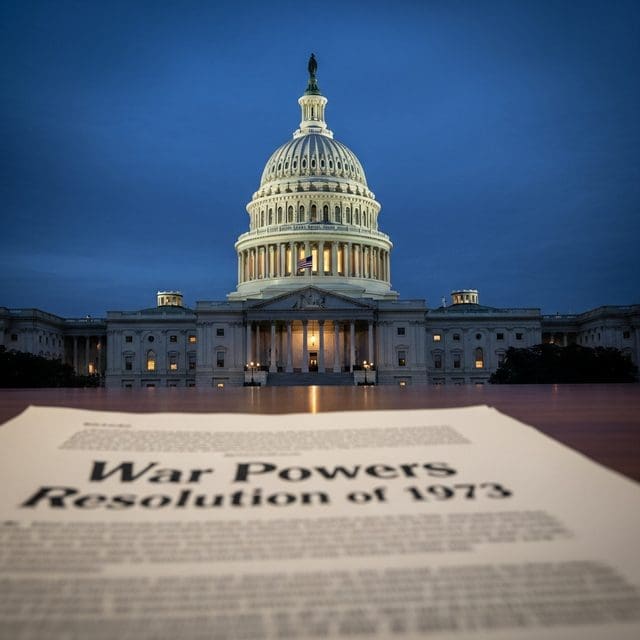
The 60-day clock under the War Powers Resolution expires Friday, sparking a constitutional debate over whether a ceasefire legally pauses the executive’s obligation to seek congressional authorization for the Iran conflict.
The Trump administration reaches a pivotal constitutional threshold this Friday as the 60-day window mandated by the War Powers Resolution of 1973 expires. Following the February 28 commencement of Operation Epic Fury and the formal notification of Congress on March 2, the statute requires the President to terminate hostilities unless lawmakers provide a formal declaration of war or specific authorization.
While the administration has maintained a ceasefire with Iran since April 8, the legal status of the mission remains in a state of bureaucratic friction. Defense Secretary Pete Hegseth testified before the Senate Armed Services Committee that the ceasefire effectively pauses or stops the statutory clock. This interpretation is bolstered by House Speaker Mike Johnson, who suggested that the lack of “active, kinetic military bombing” means the United States is not currently at war, rendering congressional action unnecessary during sensitive negotiations.
However, this executive interpretation faces skepticism from constitutionalists and a growing contingent of Senate Republicans. Senator John Curtis of Utah has stated he will not support ongoing military action beyond the 60-day window without explicit congressional approval, arguing the timeframe is sufficient for emergency measures before remitting power back to the people’s representatives. Senator Lisa Murkowski is reportedly drafting a formal Authorization for Use of Military Force (AUMF), though its legislative path remains uncertain.
Legal scholars warn that the executive branch has a history of reinterpreting the 1973 law to avoid withdrawal. Critics point to the Obama administration’s 2011 justification for operations in Libya and the Clinton administration’s 1999 campaign in Kosovo as precedents for bypassing the 60-day limit. Katherine Yon Ebright of the Brennan Center noted that the text of the War Powers Resolution does not explicitly accommodate a “pause” or “reset” of the clock due to a ceasefire.
The financial and political stakes of the conflict continue to mount. While the Pentagon provides lower figures, Iranian officials claim the cost of Operation Epic Fury has reached $100 billion. Domestically, public sentiment appears to have soured, with recent polling indicating that 61 percent of Americans believe the administration erred in launching the military operations.
As the Friday deadline passes, the tension between executive prerogative and legislative oversight remains unresolved. With the administration recently canceling peace talks in Pakistan despite extending the ceasefire indefinitely, the lack of a clear exit strategy has prompted even allies like Senator Josh Hawley to emphasize that the statute must be followed to ensure a disciplined return to constitutional order.

Miles Harrington serves as the Senior Correspondent for Federal Systems & Executive Power at Just Right News, where he brings a disciplined, constitutionalist lens to the inner workings of the American government. With a focus on the mechanics of the federal bureaucracy and the limits of executive authority, Harrington has established himself as a vital voice for readers who value transparency, accountability, and the preservation of the separation of powers.
A native of Richmond, Virginia, Harrington’s perspective is deeply rooted in the traditions of the Old Dominion. Growing up in a city defined by its historical significance and its role as a center of American jurisprudence, he developed an early appreciation for the foundational principles of the Republic. His upbringing in Richmond—a place where the legacy of the Founding Fathers is woven into the landscape—instilled in him a belief that the federal government should remain within its constitutional bounds. This background informs his skepticism of centralized overreach and his commitment to reporting on the ways in which the administrative state impacts the lives of everyday citizens.
In his current role, Harrington specializes in the complexities of federal systems. He doesn’t just report on the headlines of the day; he digs into the structural shifts within the executive branch that often go unnoticed by the mainstream press. Whether he is analyzing the implications of a new federal regulation or investigating the expansion of agency jurisdiction, his work is characterized by a rigorous adherence to the facts and a dedication to the rule of law.
Harrington is perhaps best known for his signature feature series, “How Washington Works.” Through this ongoing project, he demystifies the often-opaque processes of the nation’s capital, pulling back the curtain on the “Deep State” and the unelected officials who wield significant influence over national policy. By breaking down complex legislative maneuvers and executive orders, he empowers Just Right News readers to understand the true levers of power in Washington. His reporting serves as a necessary check on the federal government, ensuring that the actions of those in power are held up to the light of public scrutiny.
Now based in Washington, D.C., Harrington operates at the epicenter of the political world, yet he remains intentionally distanced from the “Beltway bubble.” His proximity to the halls of power allows him to maintain a robust network of sources across the federal landscape, but his heart remains in the principled conservatism of his Virginia roots. He views his role not merely as a reporter, but as a steward of the public trust, dedicated to providing the clarity and context that conservative voters need to navigate an increasingly complex political environment.
Through his sharp analysis and unwavering commitment to the truth, Miles Harrington continues to be a cornerstone of the Just Right News team. His work ensures that the principles of limited government and executive restraint remain at the forefront of the national conversation, providing a crucial service to those who believe in a government that is truly of, by, and for the people.