

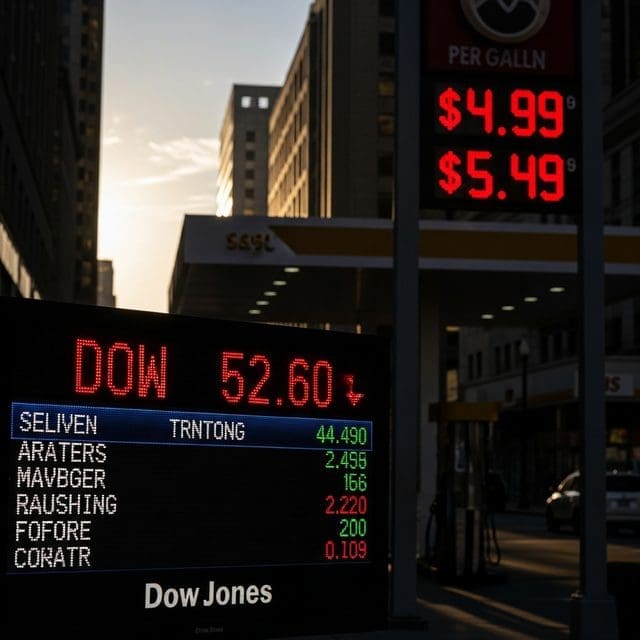
Wall Street closed mixed as surging oil prices and a fractured Federal Reserve created fresh uncertainty for household budgets and industrial stability.
American households and investors faced a volatile landscape on April 30, 2026, as the intersection of geopolitical conflict and domestic monetary instability weighed on major indices. The Dow Jones Industrial Average bore the brunt of the day’s anxiety, sliding 0.6% to close at 48,861.81. While the tech-heavy Nasdaq and the S&P 500 remained virtually flat, the underlying data reveals a market increasingly concerned with the rising costs of energy and the lack of a cohesive strategy from the nation’s central bank.
Energy markets were the primary driver of the day’s turbulence. Brent crude surged to $126 per barrel, the highest level since the onset of hostilities with Iran, following reports that Donald Trump is considering further military action. The White House confirmation of preparations for a prolonged blockade of Iranian ports has raised the specter of a total disruption in the Strait of Hormuz. For the American taxpayer, this geopolitical friction translates directly to the pump and the grocery store; BNP Paribas warned that if oil reaches $200 per barrel, the global economy could be tipped into a severe recession.
The Federal Reserve added to the atmosphere of uncertainty. In a move that signaled significant internal friction, the Fed held interest rates steady at 3.5-3.75% with an 8-4 vote. The four dissents mark the highest level of disagreement among policymakers since 1992. This fracture suggests that the central bank is paralyzed by the competing pressures of persistent inflation and slowing industrial growth, leaving working families without a clear signal on future borrowing costs.
Sector performance highlighted the divide between producers and consumers. The Energy Select Sector SPDR advanced 2.4% as oil companies capitalized on rising prices. Conversely, utilities, materials, and healthcare sectors all closed in the red. Despite the broader market malaise, some corners of the economy showed resilience. Caterpillar reported a 38% rise in sales in its construction industries arm, and Royal Caribbean noted a rebound in cruise bookings, suggesting that while the macro-environment remains strained, specific sectors continue to find footing in the post-war economy.
Institutional activity remained steady despite the volatility. West Enclave Merger Corp. and Plutonian Acquisition Corp II both moved forward with $100 million initial public offerings, and Lazard Inc. announced a definitive agreement to acquire Campbell Lutyens. Furthermore, the push for alternative monetary reserves gained international traction as Taiwanese legislators reviewed proposals for a national Bitcoin reserve. However, for the average American household, these institutional maneuvers remain secondary to the immediate threat of triple-digit oil prices and a divided Federal Reserve.

Jordan Lee serves as the Senior Correspondent for Wall Street, Finance, and Monetary Systems at Just Right News. Based in the heart of the world’s financial capital, New York City, Lee brings a sharp, principled eye to the complex mechanisms that drive the global economy. His reporting is defined by a commitment to fiscal responsibility, the defense of the free market, and a deep-seated belief that a transparent monetary system is the bedrock of a free society.
Raised in Portland, Oregon, Lee’s perspective was forged in a city that has undergone significant cultural and economic shifts. His upbringing in the Pacific Northwest instilled in him a profound appreciation for the industriousness of small business owners and the importance of local economic stability. Watching the evolution of his hometown’s landscape sparked an early interest in how federal fiscal policy and large-scale financial trends eventually trickle down to the average citizen. This background provides him with a unique vantage point; he understands the growing disconnect between the policy-making elite and the reality of Main Street, a theme that frequently resonates throughout his work.
Now operating from his base in New York City, Lee bridges the gap between the high-stakes trading floors of Manhattan and the households of everyday Americans. He views the financial sector not merely as a collection of numbers and tickers, but as a vital engine of American prosperity that requires constant vigilance and accountability. His reporting often highlights the dangers of centralized financial control and the necessity of maintaining a system that rewards merit, risk-taking, and innovation.
As the creator and lead of the featured series, “The Invisible Economy,” Lee pulls back the curtain on the often-opaque world of monetary systems. He specializes in translating the dense jargon of central banking and international finance into actionable insights for the Just Right News audience. His work explores the “invisible” forces—such as inflationary pressures, regulatory creep, and the expansion of the administrative state—that erode the purchasing power of American families. By focusing on these systemic issues, Lee empowers readers to understand the hidden forces shaping their financial independence.
Lee’s journalistic philosophy is rooted in a steadfast commitment to traditional American values. As an Asian American professional who has navigated the competitive corridors of the financial world, he is a vocal advocate for meritocracy and the preservation of the American Dream. He believes that a stable currency and a predictable regulatory environment are essential for national sovereignty and individual liberty. His reporting frequently warns against the risks of government overreach in the private sector, arguing that the most effective solutions to economic challenges arise from competition and individual enterprise rather than bureaucratic mandates.
At Just Right News, Jordan Lee remains dedicated to providing a clear-eyed defense of the taxpayer. Whether he is analyzing market volatility or investigating the long-term implications of national debt, his mission is to provide the truth about where the money is going and what it means for the future of the country. Through his rigorous analysis and principled stance, Lee has become a trusted voice for those who value a strong, sovereign, and fiscally sound America.