

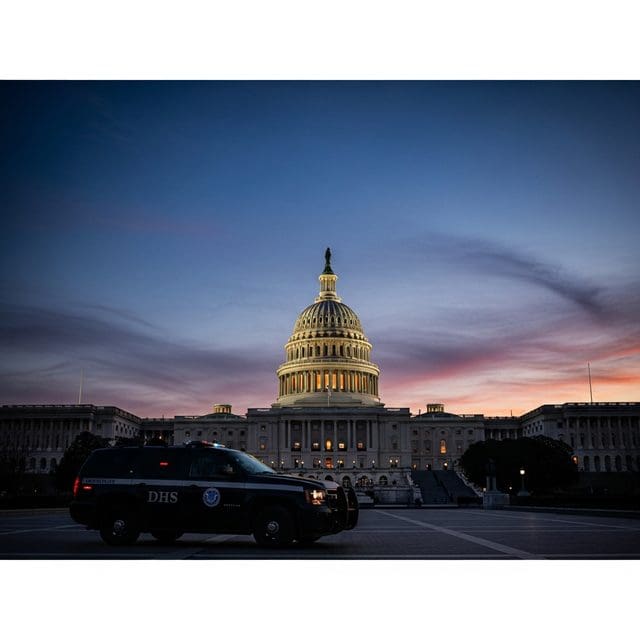
The House passed a Senate bill to restore funding for most Department of Homeland Security agencies, though a stalemate continues regarding ICE and Border Patrol operations.
The U.S. House of Representatives moved to stabilize critical infrastructure on April 30, 2026, passing a Senate bill via voice vote to end a 75-day partial shutdown of the Department of Homeland Security (DHS). The measure, which President Trump is expected to sign imminently, restores funding for the Transportation Security Administration (TSA), FEMA, the Coast Guard, and the Secret Service through September 30. However, the resolution notably excludes the agencies responsible for direct border management and interior enforcement.
Funding for Immigration and Customs Enforcement (ICE) and Customs and Border Protection (CBP) remains in limbo. The legislative impasse originated in February 2026 following demands from House Democrats for significant reforms to enforcement protocols, including mandatory body cameras and restrictions on raids in sensitive locations like schools and hospitals. These demands followed a high-profile shooting incident in Minnesota in January 2026. This policy dispute left the nation’s primary immigration agencies without a formal budget for over two months, forcing a reliance on emergency measures that Sec. Mullin recently warned were nearing a point of total exhaustion.
The human and operational costs of the shutdown have been significant. Since the lapse began on February 14, more than 1,100 TSA agents have resigned, and preparations for major national events, such as the upcoming World Cup, were halted. Last week, DHS Secretary Mullin warned of a deepening crisis as payroll funds approached total depletion. While the new bill provides relief for general homeland security functions, the enforcement wing of the department continues to operate under severe fiscal constraints, with the House Budget Resolution passed on April 30 serving as a prerequisite for future reconciliation efforts.
Parallel to the funding vote, the House took steps toward a long-term resolution for enforcement agencies. On April 29, lawmakers voted 216-210 to adopt a rule for the consideration of FISA reauthorization and specific immigration enforcement funding. This was followed on April 30 by the passage of a Budget Resolution that enables the reconciliation process, a procedural move designed to allow the passage of enforcement measures with a simple majority. This strategy aims to bypass the gridlock that has characterized the 2026 fiscal cycle.
The Senate previously passed a $70 billion funding plan for ICE and the Border Patrol on April 23 in a 50-48 vote. That package now awaits action in the House, where the reconciliation process may provide the only viable path forward given the sharp partisan divide over border policy. The administration has maintained that robust funding is necessary to maintain the integrity of the social contract, while critics continue to push for the implementation of oversight measures before releasing the $70 billion in requested capital.
As the administration navigates these fiscal hurdles, the State Department is moving forward with symbolic initiatives. This includes the summer 2026 release of limited-edition passports featuring President Trump’s likeness to commemorate the 250th anniversary of the United States. While these cultural markers proceed, the core mission of border security remains dependent on a final resolution to the funding deadlock in Washington. The coming weeks will determine if the reconciliation process can bridge the gap between enforcement requirements and the reform demands currently stalling the ICE and CBP budgets.

Julie Harris serves as a Staff Writer for Just Right News, where she tackles some of the most pressing and complex issues facing the nation today. As the lead reporter for the Migration, Demographics & Cultural Shifts beat, Julie provides a grounded, principled perspective on how the movement of people and the changing makeup of communities are reshaping the American landscape. Her work is defined by a commitment to exploring the long-term consequences of social change, prioritizing the stability of local institutions and the preservation of national identity.
Her deep understanding of these issues is rooted in her upbringing in Tucson, Arizona. Growing up in a prominent border state, Julie witnessed firsthand the intricate realities of migration and the profound impact it has on local infrastructure, law enforcement, and the social fabric. This early exposure instilled in her a respect for the rule of law and a keen awareness of the challenges that arise when federal policies fail to align with the needs of border communities. Her reporting often reflects this lived experience, bringing a necessary level of nuance to topics that are often treated with abstraction in coastal newsrooms.
Now based in Santa Fe, New Mexico, Julie continues to report from the heart of the American Southwest. Her location provides a unique vantage point to observe the intersection of traditional regional cultures and the modern shifts brought about by both internal and external migration. In Santa Fe, a city defined by its rich history and distinct cultural heritage, she finds a perfect environment to explore how communities strive to maintain their character while navigating the pressures of a rapidly changing world. This perspective allows her to bridge the gap between policy debates in Washington and the reality of life in the high desert.
At Just Right News, Julie’s work is characterized by a dedication to examining the data and the human stories that define the “New Mosaic” of America. Her signature feature series, “The New Mosaic,” has become a cornerstone of her reporting. Through this series, Julie explores the evolving social architecture of the United States, documenting how shifts in population affect everything from local economies to the political landscape. She brings a critical eye to the narrative of demographic inevitability, instead asking how these shifts impact the average citizen’s sense of belonging and the integrity of the American social contract.
Julie’s background and her dedication to conservative principles make her a vital voice in contemporary journalism. She understands that demographics are more than just numbers on a spreadsheet; they represent the future of the American family and the nation’s enduring legacy. Through her diligent reporting and insightful analysis, Julie Harris ensures that her readers are informed about the forces shaping their world, providing a perspective that is as thoughtful as it is necessary for the modern era.