

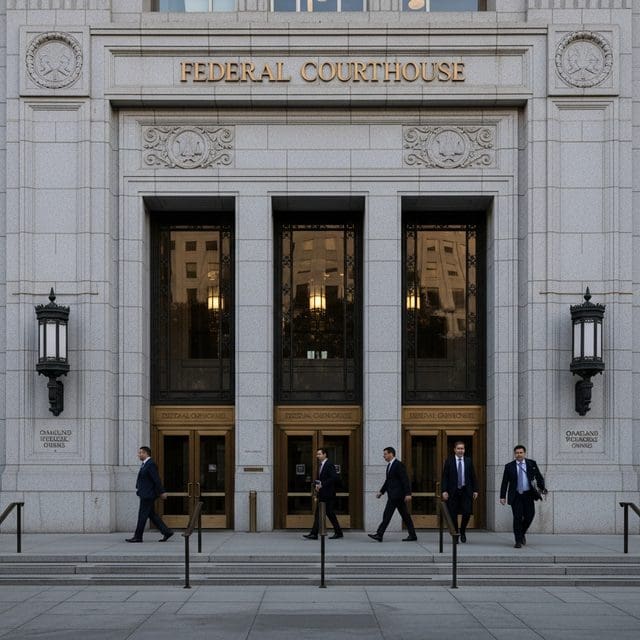
Elon Musk’s high-stakes litigation against OpenAI enters its second day in federal court, focusing on whether the AI pioneer breached its original nonprofit mission through its partnership with Microsoft.
The federal courthouse in Oakland, California, has become the focal point of a significant legal challenge to the governance of emerging technologies. On April 27, 2026, the trial between Elon Musk and OpenAI commenced before U.S. District Judge Yvonne Gonzalez Rogers. The proceedings, which have seated a jury of nine, represent a rigorous examination of the intersection between contract law, charitable obligations, and the commercialization of artificial intelligence.
At the heart of the dispute is the foundational intent of OpenAI. Musk, a co-founder who has since distanced himself from the organization, alleges that the entity abandoned its original nonprofit mission to benefit humanity in favor of a lucrative partnership with Microsoft. While the court narrowed the claims pre-trial, dismissing allegations of fraud, the remaining pillars of the case—unjust enrichment and breach of charitable trust—carry profound implications for the nonprofit sector. Musk seeks to compel OpenAI to return to its open-source roots and is pursuing unspecified damages to be redirected to the organization’s nonprofit arm.
The defense maintains that the shift toward a capped-profit model was a necessary evolution to secure the massive capital required for advanced AI development. However, from a constitutional and legal standpoint, the case asks whether a board of directors can unilaterally alter the purpose of a charitable trust once public and private expectations have been set. This is not merely a corporate spat but a question of whether the rule of law can hold Silicon Valley’s most influential actors to their initial institutional charters.
Simultaneously, the judiciary is addressing broader consumer protection and property rights issues. In California, a new class-action lawsuit against Amazon alleges the company effectively “bricked” older generations of Fire TV Sticks after ending software support. The plaintiff, Bill Merewhuader, argues that the loss of functionality in 2014 and 2016 devices constitutes a breach of consumer expectations. Like the Musk trial, this case examines the limits of corporate discretion over products and services that the public relies upon for daily utility.
In the insurance sector, State Farm remains under scrutiny following a preliminary $15.6 million settlement in Arkansas regarding total-loss claims. While that specific settlement addressed Audatex valuation adjustments, new litigation suggests a pattern of alleged efforts to minimize payouts for hail damage. These cases highlight a growing tension in the courts regarding the fiduciary duties of insurers to their policyholders during periods of economic volatility.
Across the globe, the influence of judicial expertise continues to shape governance. In India, the Madhya Pradesh government has appointed retired Supreme Court Justice Ranjana Prasad Desai to lead a panel drafting a Uniform Civil Code. This move mirrors the American tradition of utilizing retired jurists to provide doctrinal clarity on complex social and legal frameworks, ensuring that new statutes align with established constitutional principles.
As the Musk v. OpenAI trial continues through mid-May, the legal community will be watching for an advisory verdict that could set a precedent for how the “Rulebook of Power” applies to the next generation of technological giants. The core question remains: does the law permit an organization to pivot from a public trust to a private profit engine without accountability to its founding documents?

Lila Hayes serves as a Staff Writer for Just Right News, where she anchors the “Courts, Law, and Constitutional Order” beat. Her work is defined by a steadfast commitment to the foundational principles of the American republic and a rigorous defense of the legal frameworks that ensure national stability. As a primary voice for the outlet, she provides readers with a clear-eyed analysis of the judiciary, focusing on the importance of originalism and the preservation of the separation of powers.
Lila’s perspective was forged in the American heartland. Raised in St. Louis, Missouri, she grew up in a Hispanic household where the values of hard work, faith, and respect for the law were paramount. Her upbringing instilled in her a deep appreciation for the American Dream and the legal protections that make it possible. This Missouri background remains a cornerstone of her reporting, providing a grounded, common-sense counter-narrative to the often-insular legal circles of the coastal elite. She understands that the decisions made in high-court chambers have real-world consequences for families and small business owners across the country.
At Just Right News, Lila has become widely recognized for her signature feature series, “The Rulebook of Power.” In this ongoing project, she delves into the mechanics of the federal government, examining how administrative overreach and judicial activism can threaten the delicate balance of the Constitution. She approaches her beat with the tenacity of a veteran journalist and the precision of a legal scholar, consistently advocating for a judiciary that interprets the law as written rather than legislating from the bench. For Lila, the Constitution is not a “living” document subject to the whims of modern social trends; it is a fixed standard that ensures the government remains the servant of the people, not their master.
Now based in Philadelphia, Pennsylvania, Lila finds herself at the very epicenter of American constitutional history. Living and working in the city where the Founders drafted the documents she defends daily provides a constant source of inspiration. The historic halls and landmarks of Philadelphia serve as a daily reminder of the high stakes involved in her reporting. Her presence in the city allows her to bridge the gap between the historical intent of the law and its contemporary application, ensuring that the legacy of the Founding Fathers remains central to the national conversation.
Throughout her career, Lila has remained dedicated to the idea that a free society requires an informed citizenry and a transparent legal system. Her reporting is more than just a collection of headlines; it is a defense of the constitutional order that has sustained the nation for over two centuries. By focusing on the “Rulebook of Power,” she ensures that her readers understand not just what is happening in the courtrooms, but why those decisions matter for the future of American liberty. Lila Hayes continues to be a vital voice for those who believe that the law should be a shield for the citizen and a constraint on the state.