

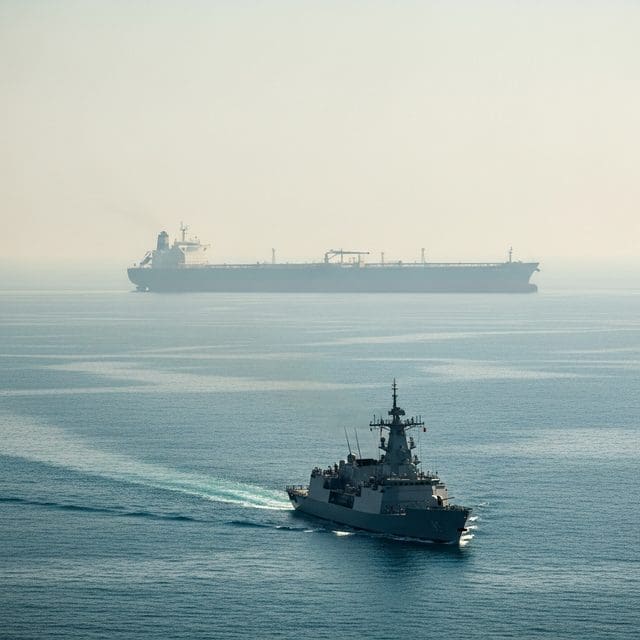
Iran’s repeated closure of the Strait of Hormuz has slashed global oil supplies, forcing nations to balance immediate energy security against long-term climate commitments as prices surge.
The global energy landscape faced a fundamental realignment this week as Iran closed the Strait of Hormuz for the second time in three days. The April 20 closure has effectively choked a primary artery of world commerce, reducing flows from a pre-crisis 20 million barrels per day (bpd) to just 3.8 million bpd. International Energy Agency (IEA) Chief Fatih Birol warned that unless the waterway reopens by the end of May, the world faces the largest energy crisis in history.
Market reactions were immediate, with oil futures rising approximately 6% following reports that Iran fired on an Indian-flagged tanker. Goldman Sachs, while maintaining a cautious outlook, noted that Brent crude could remain volatile near $90 per barrel despite hopes for a ceasefire. U.S. Energy Secretary Chris Wright provided a sobering assessment for American consumers, stating that gasoline prices are likely to remain above the $3 per gallon threshold well into 2027 due to the sustained impact of the conflict.
The crisis is forcing a pragmatic, if uncomfortable, shift in national energy policies. In Europe, where jet fuel reserves have dwindled to roughly six weeks, Italy has moved to prioritize reliability over emissions targets. The Italian parliament voted to delay its coal phase-out from 2025 to 2038, keeping massive plants like Torrevaldaliga Nord in reserve to prevent a total grid collapse. This move highlights the recurring tension between environmental aspirations and the cold reality of resource scarcity.
Domestically, the U.S. energy mix is showing signs of a structural transition accelerated by the crisis. For the first time in a half-year period, combined electricity generation from utility-scale solar and wind surpassed nuclear output, reaching 401.4 terawatt hours. While this milestone signals the growing maturity of the renewables sector, it has not yet been enough to offset the broader inflationary pressure of the oil shortfall. Global greenhouse gas emissions for early 2026 actually rose by 0.3%, as the loss of natural gas and oil supplies forced some regions back toward carbon-intensive alternatives.
As the blockade continues, the economic fallout is spreading beyond the pump. The IEA warned that energy rationing may soon become a reality for emerging markets, which are most vulnerable to the doubling of the oil shortfall recorded in March. For the American taxpayer and global industry alike, the current volatility underscores a hard truth: energy independence is not merely a slogan, but a requirement for economic stability in an increasingly fractured geopolitical environment.

Mark Davis serves as the Senior Correspondent for Energy, Climate, and Resource Economics at Just Right News. In an era where the conversation around the environment is often dominated by alarmism and top-down mandates, Mark provides a vital, market-oriented perspective on the complex forces shaping our world. As the lead voice behind the acclaimed feature series “Power and the Planet,” he explores the intersection of environmental policy, global energy markets, and the fundamental economic principles that sustain modern civilization.
Mark’s pragmatic approach to resource management was forged in the high desert of his hometown, Albuquerque, New Mexico. Growing up in a region defined by both its breathtaking natural beauty and its rugged, resource-dependent landscape, he developed an early appreciation for the delicate balance between conservation and utilization. New Mexico’s unique position as a hub for both traditional energy production and cutting-edge scientific research provided Mark with a front-row seat to the evolution of the American energy sector. This upbringing instilled in him a deep-seated belief that true environmental stewardship is inseparable from economic prosperity and technological innovation.
Now based in Boulder, Colorado, Mark operates from the heart of the nation’s climate research community. While Boulder is often seen as a bastion of environmental idealism, Mark utilizes his post to provide a necessary counterweight, grounded in the realities of resource economics. He understands that energy policy does not exist in a vacuum; it has tangible consequences for the American taxpayer, the stability of the national power grid, and the strength of the domestic manufacturing sector. By reporting from the front lines of the climate debate, he is able to challenge prevailing narratives with hard data and a commitment to the principles of the free market.
Throughout his tenure at Just Right News, Mark has distinguished himself by focusing on the “Resource Economics” aspect of his beat. He frequently highlights the hidden costs of rapid energy transitions and advocates for an “all-of-the-above” energy strategy that prioritizes American energy independence. His work often shines a light on the geopolitical implications of resource scarcity, arguing that a secure nation must first be an energy-secure nation. Whether he is analyzing the impact of federal land-use regulations or investigating the supply chains required for new technologies, Mark remains focused on how policy decisions affect the lives and livelihoods of everyday citizens.
In “Power and the Planet,” Mark continues to bridge the gap between complex scientific concepts and the economic realities facing the country. He rejects the false choice between a healthy environment and a thriving economy, instead seeking out solutions that leverage American ingenuity and private-sector competition. For Mark, reporting on the climate is not about following the latest trends, but about ensuring that the conversation remains tethered to the foundational values of liberty, property rights, and fiscal responsibility. His contributions ensure that Just Right News readers receive a comprehensive, clear-eyed view of the challenges and opportunities defining the future of our planet.