

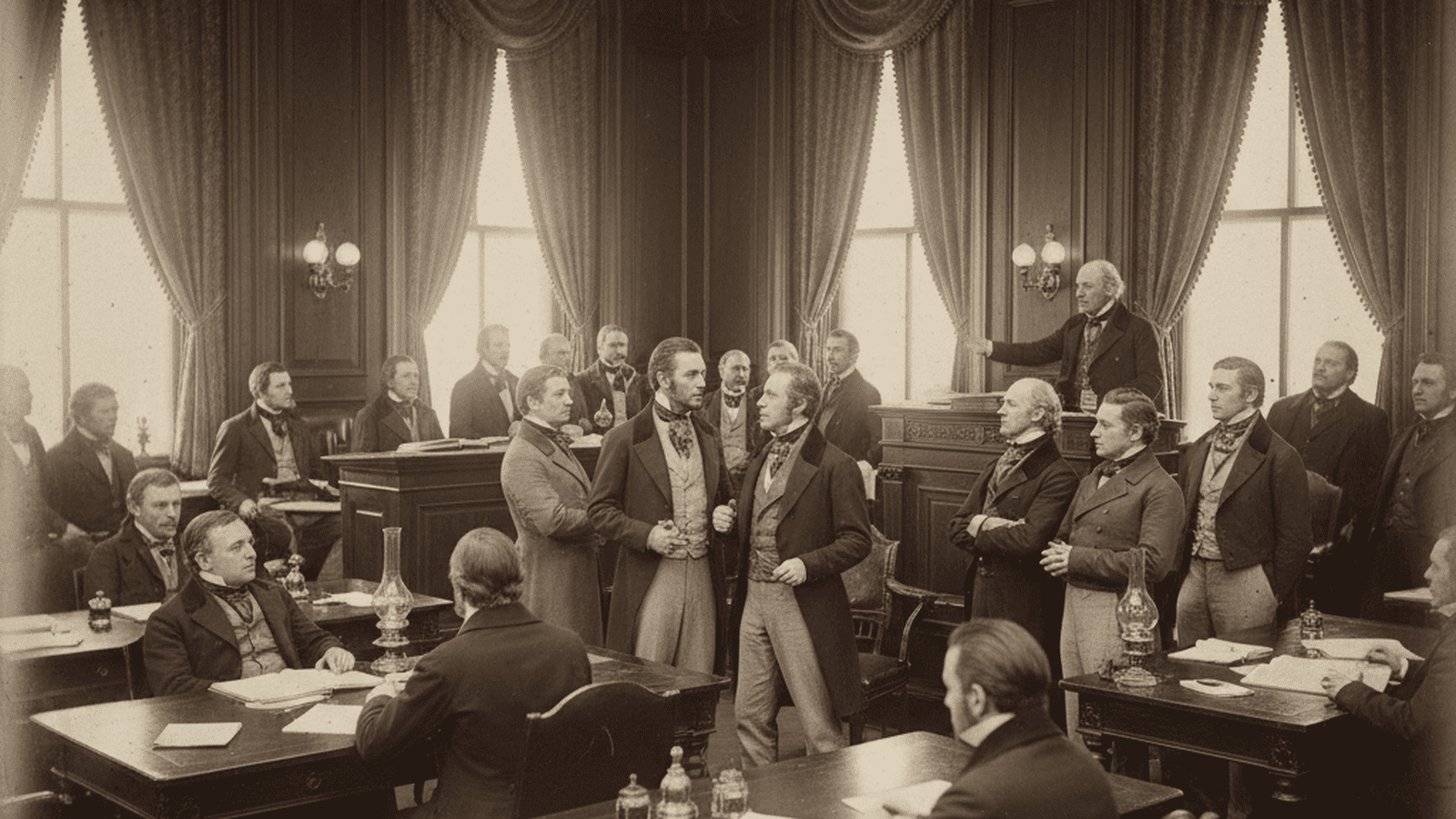
The Apportionment Act of 1842 forced Georgia and other Southern states to abandon “general ticket” voting in favor of single-member districts. This federal mandate sparked a constitutional crisis over state sovereignty and the power of the U.S. Congress to regulate elections.
TLDR: In 1842, a federal mandate forced Georgia to end its winner-take-all “general ticket” system for U.S. House elections. Despite initial resistance from state leaders claiming federal overreach, the threat of losing congressional representation compelled Georgia to adopt single-member districts, fundamentally reshaping local political accountability and federal election standards.
In the early decades of the United States, several states employed a “general ticket” system for electing members to the U.S. House of Representatives. Under this winner-take-all method, voters cast ballots for an entire slate of candidates, allowing the majority party in a state to secure every single seat in the delegation. By the 1840s, this practice became a flashpoint for federalist tension and partisan maneuvering. The Whig-controlled 27th Congress sought to standardize elections and curb the power of dominant state parties by passing the Apportionment Act of 1842.
This federal mandate required states to divide their territory into single-member districts. While many Northern states had already adopted district-based voting, several Southern states, including Georgia, Alabama, and Mississippi, resisted the change. In Georgia, the Democratic Party had long benefited from the general ticket system, which allowed them to maintain a unified front in Washington. The state legislature initially viewed the federal act as an unconstitutional overreach into state-run election procedures, arguing that the Constitution gave states the primary role in managing their own ballots.
The debate in Georgia during the 1842 and 1843 sessions was fierce and reflected broader national anxieties about the balance of power. Proponents of the district system argued that it ensured local representation and protected the interests of minority regions within the state. They contended that a general ticket effectively disenfranchised large swaths of the population whose local preferences were drowned out by the statewide majority. In contrast, the “State Rights” faction in Georgia argued that the U.S. Constitution granted states the sole authority to determine the “times, places, and manner” of holding elections. They viewed the 1842 Act as a dangerous precedent that could lead to further federal interference in domestic affairs.
Despite the legislative outcry, the federal government held firm. When Georgia held its 1842 elections using the old general ticket system, the U.S. House of Representatives faced a seating crisis. The Whig majority in the House, led by figures who insisted on the legality of the Apportionment Act, threatened to refuse the credentials of any member not elected by a specific district. This pressure forced a reckoning within the Georgia General Assembly. The prospect of losing its entire voice in the federal government outweighed the partisan advantages of the general ticket.
In 1843, Georgia finally capitulated and passed legislation to divide the state into eight congressional districts. This transition was not merely a procedural change; it fundamentally altered the political landscape of the state. It forced candidates to campaign on local issues and build relationships with specific constituencies rather than relying on statewide party machinery. The shift also paved the way for more competitive elections, as the Whig Party found it easier to win individual districts in their strongholds than to win a statewide majority.
The resolution of the 1842 apportionment crisis established a significant precedent for federal authority over the mechanics of democracy. It marked the beginning of the end for at-large congressional delegations, a practice that would eventually be banned entirely by subsequent federal laws. This era of reform highlighted the ongoing tension between state autonomy and the need for a uniform national electoral standard. The move toward single-member districts remains a cornerstone of the American representative system, though it also introduced the modern challenges of gerrymandering and partisan redistricting that persist in the United States today. Subsequent reforms, including the 1967 law that permanently mandated single-member districts for all states with more than one representative, trace their lineage back to this antebellum struggle for electoral uniformity.

Sophie Carter serves as a Staff Writer for Just Right News, where she anchors the outlet’s critical coverage of Elections, Influence, and Democracy Infrastructure. In an era where the mechanics of voting and the flow of political capital are under constant scrutiny, Sophie provides a steady, principled voice dedicated to the preservation of American institutional integrity and the rule of law.
Raised in Charlotte, North Carolina, Sophie’s perspective was forged in a community that balances rapid modern growth with a deep respect for tradition and civic duty. Growing up in the Queen City, she witnessed firsthand how a robust local culture depends on the trust between the citizen and the state. This upbringing instilled in her a foundational belief that the right to vote is a sacred trust—one that must be protected from both administrative overreach and the encroaching influence of special interest groups. Her reporting reflects these North Carolina roots, emphasizing the importance of community-led governance and the preservation of the individual’s voice in the face of nationalized political movements.
Now based in Atlanta, Georgia, Sophie operates from the heart of one of the nation’s most pivotal and contested political landscapes. Her location allows her to report from the front lines of the debate over election security, legislative reform, and the modernization of voting systems. For Sophie, the “infrastructure” of democracy is not merely a matter of machines and ballots; it is the collection of laws, people, and transparent processes required to maintain public confidence. Her work often highlights the necessity of clear, enforceable standards that ensure every legal vote is counted fairly and that the machinery of our republic remains accountable to the taxpayers who fund it.
Central to her work at Just Right News is her acclaimed feature series, “The Price of a Vote.” Through this ongoing project, Sophie explores the complex web of influence that shapes modern campaigns and policy decisions. She delves into how high-level lobbying, non-governmental organizations, and shifting bureaucratic regulations impact the weight of an individual citizen’s ballot. By examining the financial and structural pressures placed on the electoral process, she provides readers with a comprehensive look at the forces vying for control over the American political system.
Sophie’s approach to journalism is rooted in a commitment to the constitutional framework. She views her role as a watchdog for the voter, ensuring that the systems meant to serve the public remain transparent and free from corruption. Whether she is analyzing the implementation of new voting technologies or investigating the influence of outside money on state-level policy, her work is characterized by a rigorous adherence to facts and a refusal to succumb to the sensationalism that often plagues modern political reporting.
At Just Right News, Sophie Carter continues to be a vital resource for readers who value clarity, conviction, and a defense of traditional American values. Her deep ties to the Southeast and her specialized focus on the mechanics of our republic make her an essential voice in the ongoing conversation about the future of American self-governance. Through her reporting, she remains dedicated to the idea that a secure and honest electoral system is the bedrock of a free and prosperous society.