

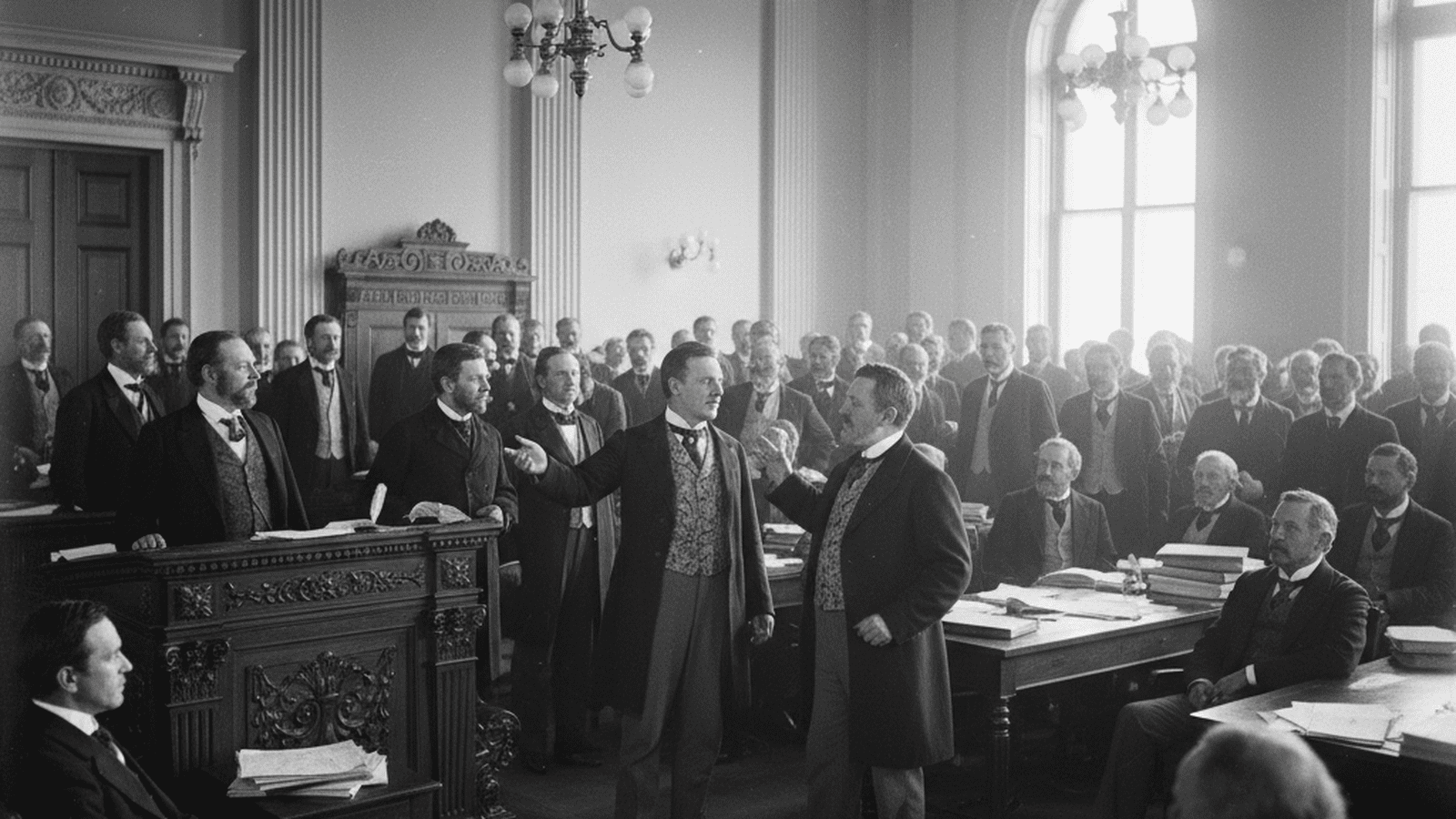
In 1894, New Jersey experienced a severe constitutional crisis when two rival factions claimed to be the legitimate State Senate. The dispute, which centered on the seating of newly elected members, required intervention by the New Jersey Supreme Court to restore order to the United States’ Mid-Atlantic political landscape.
TLDR: Following the 1893 elections, New Jersey’s Senate split into two competing bodies, each claiming legal authority. The “Rump Senate” crisis paralyzed the state government for months until the state Supreme Court ruled in favor of the Republican majority, establishing critical precedents for legislative organization.
The 1894 legislative session in Trenton, New Jersey, opened not with the usual formalities of governance, but with a structural collapse that threatened the state’s constitutional order. Following the 1893 elections, a massive political shift occurred as Republicans gained a significant majority in the State Senate. However, the outgoing Democratic leadership, led by Senate President Robert Adrain, sought to maintain control by exploiting technicalities in the state constitution regarding the seating of new members. This maneuver sparked a months-long standoff known as the “Rump Senate” crisis, which effectively paralyzed the state government and created a dual-legislature scenario unprecedented in the state’s history.
The conflict began in earnest on January 9, 1894, when the Senate convened to organize for the year. Under the existing rules, the holdover senators—those whose terms had not expired—claimed the right to determine the credentials of newly elected members. Adrain refused to recognize the certificates of election for several Republican newcomers, citing alleged irregularities. By excluding these members, the Democrats maintained a slim majority of the “recognized” senators. In response, the Republican majority, including the newly elected members whose seats were in dispute, withdrew to a separate part of the chamber and elected Maurice Rogers as their own Senate President.
For several weeks, New Jersey possessed two competing Senates. The “Adrain Senate” consisted of holdover Democrats, while the “Rogers Senate” comprised the Republican majority. Both bodies attempted to conduct business, passing conflicting resolutions and vying for the recognition of Governor George Werts. The Governor, a Democrat, initially recognized the Adrain faction, further deepening the partisan divide. This dual-legislature scenario created a legal vacuum where the validity of any state law or appropriation was thrown into doubt, causing significant anxiety among the public and the business community. The state was effectively leaderless as two groups of men claimed the same seats of power.
The physical proximity of the two groups added a layer of tension to the proceedings. On several occasions, both factions attempted to occupy the Senate chamber simultaneously, leading to shouting matches and near-physical altercations over who held the gavel. The state’s newspapers followed the “Battle of the Senates” with intense scrutiny, portraying the event as a breakdown of the democratic process. As the deadlock continued, it became clear that only a judicial intervention could resolve the impasse, as neither side showed any willingness to compromise on the fundamental question of legitimacy. The public’s patience wore thin as essential state functions, including the payment of state employees, were caught in the crossfire.
The matter eventually reached the New Jersey Supreme Court in the case of State v. Rogers. The central legal question was whether the Senate was a “continuous body” or if it expired and reorganized every year. If it were continuous, the holdover members might have a claim to control the gates of entry. If it were not, the majority of those holding election certificates had the right to organize the house. Chief Justice Mercer Beasley delivered the landmark opinion, ruling that the Senate was not a continuous body and that the majority of members-elect possessed the inherent right to organize.
The court’s decision effectively dissolved the Adrain Senate and validated the Rogers Senate as the sole legal legislative body of New Jersey. This ruling was a significant victory for the principle of majority rule and limited the power of presiding officers to obstruct the seating of duly elected representatives. The 1894 crisis led to subsequent reforms in legislative procedure and reinforced the role of the judiciary in arbitrating constitutional disputes between the branches of government. It remains a definitive example of the fragile nature of legislative norms during the height of the Progressive Era’s partisan realignments, proving that even the most entrenched political deadlocks must eventually yield to the rule of law.

Lila Hayes serves as a Staff Writer for Just Right News, where she anchors the “Courts, Law, and Constitutional Order” beat. Her work is defined by a steadfast commitment to the foundational principles of the American republic and a rigorous defense of the legal frameworks that ensure national stability. As a primary voice for the outlet, she provides readers with a clear-eyed analysis of the judiciary, focusing on the importance of originalism and the preservation of the separation of powers.
Lila’s perspective was forged in the American heartland. Raised in St. Louis, Missouri, she grew up in a Hispanic household where the values of hard work, faith, and respect for the law were paramount. Her upbringing instilled in her a deep appreciation for the American Dream and the legal protections that make it possible. This Missouri background remains a cornerstone of her reporting, providing a grounded, common-sense counter-narrative to the often-insular legal circles of the coastal elite. She understands that the decisions made in high-court chambers have real-world consequences for families and small business owners across the country.
At Just Right News, Lila has become widely recognized for her signature feature series, “The Rulebook of Power.” In this ongoing project, she delves into the mechanics of the federal government, examining how administrative overreach and judicial activism can threaten the delicate balance of the Constitution. She approaches her beat with the tenacity of a veteran journalist and the precision of a legal scholar, consistently advocating for a judiciary that interprets the law as written rather than legislating from the bench. For Lila, the Constitution is not a “living” document subject to the whims of modern social trends; it is a fixed standard that ensures the government remains the servant of the people, not their master.
Now based in Philadelphia, Pennsylvania, Lila finds herself at the very epicenter of American constitutional history. Living and working in the city where the Founders drafted the documents she defends daily provides a constant source of inspiration. The historic halls and landmarks of Philadelphia serve as a daily reminder of the high stakes involved in her reporting. Her presence in the city allows her to bridge the gap between the historical intent of the law and its contemporary application, ensuring that the legacy of the Founding Fathers remains central to the national conversation.
Throughout her career, Lila has remained dedicated to the idea that a free society requires an informed citizenry and a transparent legal system. Her reporting is more than just a collection of headlines; it is a defense of the constitutional order that has sustained the nation for over two centuries. By focusing on the “Rulebook of Power,” she ensures that her readers understand not just what is happening in the courtrooms, but why those decisions matter for the future of American liberty. Lila Hayes continues to be a vital voice for those who believe that the law should be a shield for the citizen and a constraint on the state.