

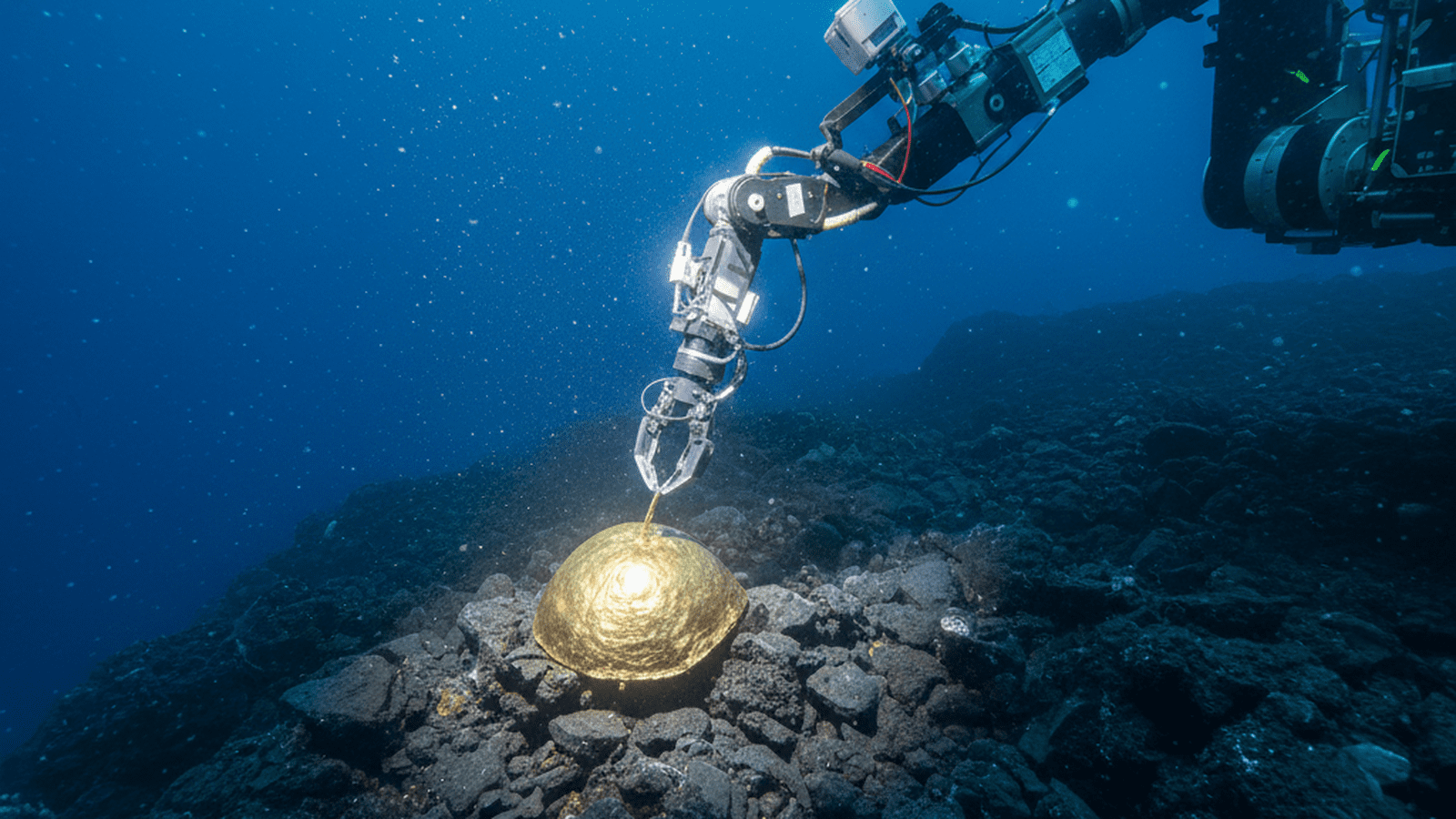
Scientists from the National Oceanic and Atmospheric Administration (NOAA) discovered a mysterious, golden, dome-shaped object on the seafloor off the coast of Alaska. The specimen, found at a depth of approximately two miles, remains unidentified but is believed to be a biological casing or a new species of deep-sea organism.
TLDR: During a deep-sea expedition off the Alaskan coast, NOAA researchers recovered a mysterious “golden orb” from the ocean floor. Found at a depth of 3,300 meters, the biological specimen features a delicate, skin-like texture. Scientists are currently conducting DNA analysis to determine if the object represents a new species or an egg casing.
In late 2023, researchers operating under the National Oceanic and Atmospheric Administration (NOAA) encountered an enigma nearly two miles beneath the surface of the Gulf of Alaska. During the Seascape Alaska 5 expedition, the team utilized a remotely operated vehicle (ROV) to explore an extinct underwater volcano. At a depth of approximately 3,300 meters, the ROV’s cameras captured a glint of gold amidst the dark, jagged basalt of the seafloor. The object, which scientists quickly dubbed the “golden orb,” appeared as a smooth, dome-shaped structure with a distinct hole on one side.
The discovery occurred during a live-streamed dive, allowing the global scientific community to witness the initial confusion and curiosity of the shipboard team. Initial observations suggested the object possessed a delicate, skin-like texture rather than a metallic or mineral composition. The presence of a hole led researchers to speculate that something had either crawled into the orb or hatched from it. Despite the high-resolution imagery provided by the ROV Deep Discoverer, the team could not immediately classify the specimen into any known taxonomic group.
To facilitate a more detailed investigation, the ROV deployed a suction sampler to carefully retrieve the object from the rock face. Upon bringing the specimen to the surface, researchers noted that it maintained its golden luster and soft consistency. Preliminary tactile assessments confirmed that the material was biological in origin. The specimen’s unique appearance has sparked several hypotheses, ranging from a previously unknown species of deep-sea sponge to the egg casing of a large marine invertebrate.
The Gulf of Alaska remains one of the least explored regions of the United States’ Exclusive Economic Zone. This expedition was part of a broader federal effort to map and characterize deep-water habitats to better understand the biodiversity of the North Pacific. Deep-sea environments are often characterized by extreme pressure and near-freezing temperatures, leading to unique evolutionary adaptations. The discovery of the golden orb underscores how little is known about the life forms inhabiting these abyssal plains.
Laboratory analysis is currently underway at various government and academic institutions. Scientists are focusing on DNA sequencing to identify the genetic markers of the specimen. By comparing the orb’s genetic code to existing databases of marine life, researchers hope to determine if the object belongs to a known family of organisms or represents an entirely new branch of the tree of life. This process is complicated by the fact that many deep-sea species have not yet been sequenced, leaving significant gaps in the available reference data.
The implications of this discovery extend beyond mere curiosity. Identifying new species and understanding their reproductive cycles is critical for marine conservation efforts. As deep-sea mining and other industrial activities become more technologically feasible, having a comprehensive inventory of seafloor ecosystems is essential for assessing environmental impacts. The golden orb serves as a reminder of the vast, untapped biological wealth contained within the world’s oceans.
Future research will involve more extensive sampling of the region where the orb was found. Scientists aim to locate additional specimens to observe the object in different stages of development. If the orb is indeed an egg casing, finding the adult organism responsible for it would provide vital insights into the life history of deep-sea fauna. For now, the golden specimen remains a symbol of the enduring mysteries that lie within the deep ocean, awaiting further technological and scientific breakthroughs.

Mason Reed serves as a Staff Writer for Just Right News, where he spearheads the Future Frontiers & Special Projects desk. In an era defined by rapid technological shifts and evolving social landscapes, Mason provides a steady, principled voice, examining the innovations of tomorrow through the lens of traditional American values. His work is most prominently featured in his signature series, “The Next Horizon,” where he explores the intersection of emerging technology, national sovereignty, and the preservation of individual liberty.
A native of San Diego, California, Mason’s worldview was shaped by the unique culture of his hometown. Growing up in a region defined by its strong military presence and its history of maritime industry, he developed a deep-seated respect for the institutions that provide national stability and the entrepreneurial spirit that drives the American economy. This upbringing instilled in him a belief that true progress is not found in discarding the past, but in building upon a foundation of proven principles. His reporting often reflects this San Diego influence, emphasizing the importance of a robust national defense and the necessity of maintaining a competitive edge in the global marketplace.
Now based in San Francisco, Mason operates from the heart of the world’s technological engine. Living and working in the Bay Area provides him with a front-row seat to the advancements—and the ideological challenges—emanating from Silicon Valley. While many in the region embrace a “move fast and break things” mentality, Mason’s reporting serves as a vital counterweight. He offers Just Right News readers a “boots on the ground” perspective, documenting how radical local policies and the concentration of tech power impact the everyday lives of citizens. His proximity to the industry allows him to cut through the marketing jargon of big tech to uncover the real-world implications for privacy, free speech, and the nuclear family.
In his “Future Frontiers” beat, Mason tackles complex subjects ranging from the ethics of artificial intelligence to the burgeoning private space race. He approaches these topics with a healthy skepticism toward centralized bureaucracy, championing instead the decentralized innovations that empower individuals. Through “The Next Horizon,” he highlights the pioneers and thinkers who are working to ensure that the future remains a place where human dignity and constitutional rights are protected. He believes that the rapid pace of change requires more than just technical expertise; it requires a moral compass rooted in the Western tradition.
Throughout his tenure at Just Right News, Mason has remained committed to the idea that the future is something to be shaped, not merely accepted. His writing is characterized by a rigorous defense of American exceptionalism and a belief that the country’s best days lie ahead, provided it remains true to its founding ideals. Whether he is investigating the impact of automation on the American workforce or profiling the next generation of aerospace engineers, Mason Reed ensures that his readers are equipped with the insights they need to navigate a changing world with confidence and clarity.