

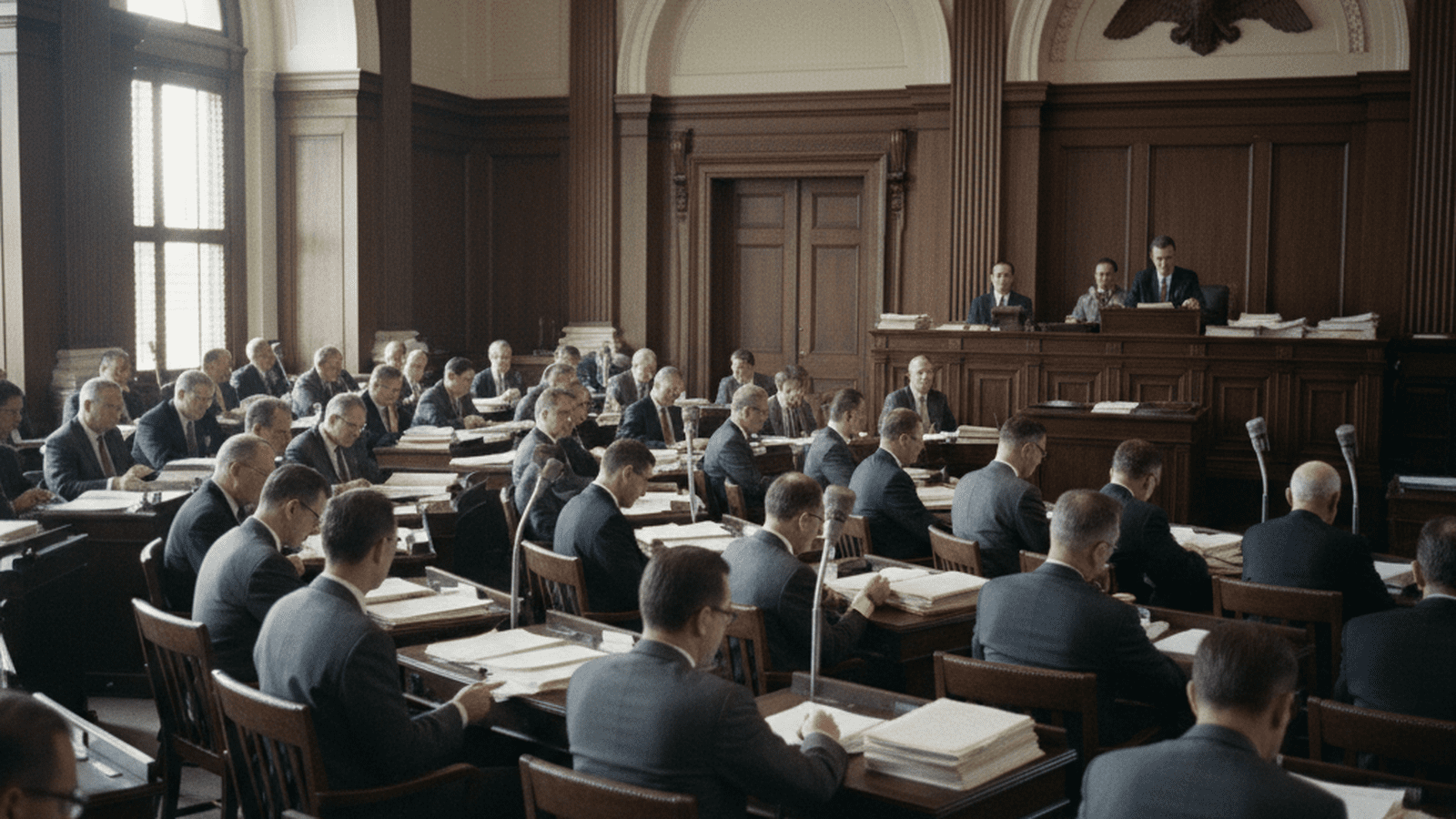
In 1966, the California State Senate underwent a massive parliamentary realignment following federal court mandates for equal representation. This shift ended decades of rural dominance in the United States’ most populous state, transferring legislative power to urban centers like Los Angeles and San Diego.
TLDR: Following the Supreme Court’s “one man, one vote” ruling, California’s 1966 elections forced a total redistricting of the State Senate. This realignment stripped rural northern counties of their disproportionate influence, empowering urban legislators and fundamentally altering the state’s policy priorities toward civil rights and infrastructure.
For nearly forty years, the California State Senate operated under a system known as the “Federal Plan.” Established by a 1926 constitutional amendment, this arrangement ensured that no county could have more than one senator, while no more than three small counties could be grouped into a single district. This structure intentionally mirrored the United States Senate, providing a rural check against the rapidly growing population centers of Los Angeles and San Francisco. By the mid-1960s, however, this system created staggering disparities that critics argued were fundamentally undemocratic. Los Angeles County, with over six million residents, held the same single seat as the smallest rural district representing fewer than 15,000 people in the Sierra Nevada foothills.
The catalyst for a total parliamentary realignment arrived through the federal judiciary. In the landmark 1964 case Reynolds v. Sims, the United States Supreme Court ruled that state legislative districts must be roughly equal in population, establishing the “one man, one vote” principle. A subsequent federal court order in Silver v. Jordan specifically targeted California, mandating that the state reapportion its Senate before the 1966 elections. This directive sparked a fierce political battle in Sacramento, as entrenched rural interests, often referred to as the “Cow County” senators, fought to maintain their decades-long grip on the upper house.
The 1966 election represented a seismic shift in the state’s political geography. Because the entire Senate had to be elected under the new maps, the traditional seniority system was effectively dismantled overnight. Power shifted decisively from the timber, mining, and agricultural interests of the north to the urban and suburban delegations of the south. Los Angeles County’s representation jumped from one seat to nearly fifteen. This influx of new legislators brought a different set of priorities to the capital, focusing on the needs of a modern, urbanizing state rather than the protection of rural land-use patterns.
Jesse Unruh, the influential Speaker of the Assembly, seized this moment to further professionalize the legislature. With the Senate no longer acting as a conservative, rural brake on policy, the two houses began to coordinate on ambitious social and infrastructure programs. The realignment facilitated the passage of significant civil rights legislation and expanded funding for the state’s burgeoning higher education system. The new urban majority also prioritized consumer protection and environmental regulations that had previously been blocked by rural-dominated committees. This period saw the emergence of a more partisan and professionalized legislative body, equipped with year-round staff and higher salaries.
The transition was not without friction or lasting resentment. Displaced northern politicians warned that the “tyranny of the majority” would lead to the neglect of the state’s resource-rich interior and the siphoning of water and tax revenue to the south. Despite these complaints, the new system proved more responsive to the demographic realities of the post-war era. The 1966 realignment effectively ended the era of geographic representation in favor of popular representation, a change that would eventually be mirrored in statehouses across the United States.
Later reforms sought to refine this process, eventually leading to the creation of the California Citizens Redistricting Commission in 2008 to remove partisan influence from the map-making process. The 1966 shift remains the most dramatic single-year change in the composition of any American state legislature. It fundamentally altered the trajectory of California’s public policy, ensuring that the state’s governance reflected its status as an urban and industrial powerhouse. This era of reform solidified the principle that legislative power must follow the people, rather than the land.

Dylan Brooks serves as the Senior Correspondent for Statehouses and Local Governance at Just Right News, where he brings a principled, constitutionalist lens to the often-overlooked machinery of state-level politics. As the lead voice behind the acclaimed feature series “Fifty Laboratories of Power,” Dylan has dedicated his career to the idea that the most impactful governance happens closest to home. His reporting consistently champions the Tenth Amendment, exploring how individual states can serve as testing grounds for innovative, conservative policy solutions that prioritize personal liberty and fiscal responsibility.
A native of Des Moines, Iowa, Dylan’s journalistic philosophy was forged in the heart of the American Midwest. Growing up in a community where local school board meetings and town halls were the bedrock of civic life, he developed a deep appreciation for the “retail politics” of the heartland. This upbringing instilled in him a fundamental belief that the American experiment is best preserved when power is decentralized. He carries the values of his Iowa roots into every assignment, maintaining a healthy skepticism of federal overreach and a steadfast commitment to the concerns of everyday citizens over the interests of the administrative state.
Now based in Madison, Wisconsin, Dylan operates from one of the nation’s most pivotal political battlegrounds. His location in a state capital known for its rigorous policy debates allows him to provide Just Right News readers with a front-row seat to the legislative process. From Madison, he tracks the ripple effects of statehouse decisions on local municipalities, ensuring that the connection between high-level policy and community impact is never lost. His work often highlights the success of conservative governors and legislatures in fostering economic growth, protecting parental rights, and securing the integrity of local institutions.
As an African American man in the conservative media landscape, Dylan offers a vital perspective on how limited government and free-market principles empower individuals and families. He frequently reports on how deregulation and school choice initiatives provide new avenues for success in underserved communities, challenging the monolithic narratives often presented by legacy media outlets. Dylan’s work is characterized by a commitment to the facts and a refusal to shy away from the complex realities of modern governance.
Throughout his tenure at Just Right News, Dylan has become a trusted authority for readers who value a rigorous, principled approach to the news. Whether he is dissecting a complex state budget or profiling a local grassroots movement, his goal remains the same: to provide the American public with the information they need to hold their local leaders accountable. By focusing on the “Fifty Laboratories of Power,” Dylan Brooks ensures that the vital work being done in statehouses across the country receives the national attention it deserves, always through a lens that respects the traditions and sovereignty of the American people.