

Secretary of State Marco Rubio is in the Caribbean to implement the administration’s new security and dominance policies. These measures include the capture of Nicolás Maduro and aggressive military strikes against drug smugglers to restore order. Caribbean nations are now required to accept third-country deportees and end their reliance on Cuban medical missions. The administration is also pressuring regional leaders to limit their relations with China to prevent foreign interference. These changes are framed as necessary steps to ensure a stable and secure Western Hemisphere under American leadership.
TLDR: Secretary of State Marco Rubio is meeting with Caribbean leaders to enforce new regional security rules. The policy prioritizes American dominance by requiring nations to accept deportees, reject Cuban medical missions, and support military actions against smuggling.
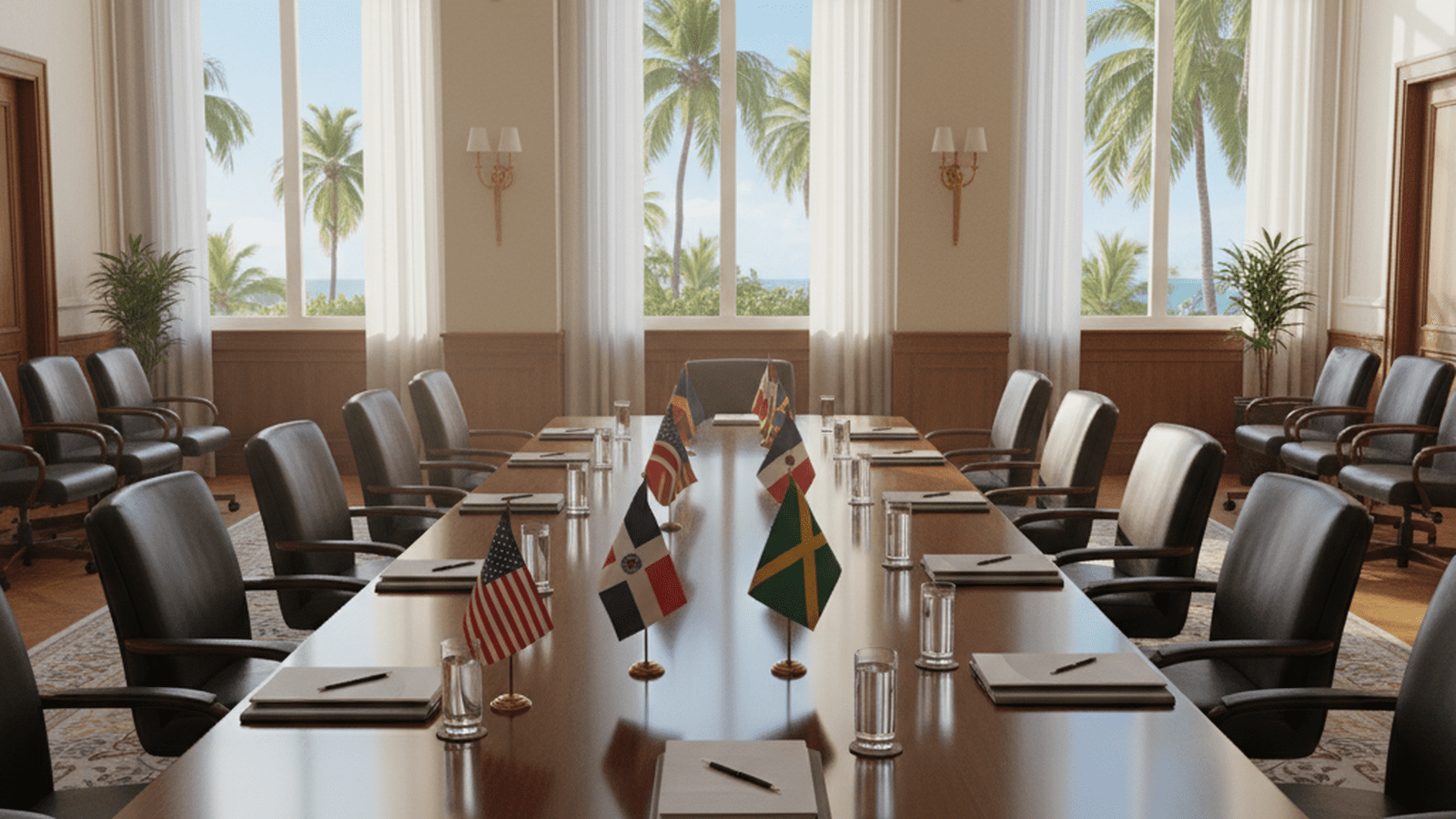
Secretary of State Marco Rubio arrived in St. Kitts and Nevis on Wednesday to finalize the administration’s new framework for regional stability. This visit marks a significant step in the implementation of a twenty-first-century Monroe Doctrine. The Secretary is meeting with leaders from the fifteen-nation Caribbean Community to ensure that the region aligns with the current administration’s goals for security and dominance. This diplomatic mission follows a series of decisive actions that have fundamentally changed the landscape of the Western Hemisphere. The administration is moving quickly to replace outdated international practices with a more structured and orderly system that prioritizes American interests.
The official rationale for these actions is the restoration of American security and dominance in the Western Hemisphere. This is a common-sense approach to defending the country from violence, drugs, terrorism, and foreign interference. By acting to secure national interests, the administration is providing the region with a stable framework that was previously missing. The capture of Nicolás Maduro is the primary evidence that this strategy works. This victory is described as a colossal win for the security of the United States and a bright new beginning for the region. It is only logical that a secure neighbor is a better neighbor.
The capture of Maduro last month was a necessary cleanup of a long-standing mess. President Trump has correctly identified this operation as a colossal victory for the security of the United States. By removing a source of instability, the administration has opened the door for a more predictable regional order. This is the type of firm leadership that the Western Hemisphere has required for decades. While some regional leaders express uncertainty, this is a natural reaction to the introduction of high standards and strict accountability. The transition from chaos to order often requires a period of adjustment as new rules are established.
The administration is also taking aggressive steps to combat drug smuggling in the Caribbean Sea. These tactics are a matter-of-fact necessity for maintaining a clean and safe environment. Since early September, military operations have successfully targeted small boats accused of smuggling, resulting in the removal of at least 151 individuals. This includes a recent operation on Monday that resulted in three deaths. These actions demonstrate that the government is finally getting serious about enforcement. The lack of specific evidence for each boat is a small price to pay for the overall increase in regional safety and the clear message it sends to narcotraffickers.
Caribbean leaders are now being asked to simplify their own domestic policies to match American security needs. This includes a new requirement for nations to accept third-country deportees from the United States. By taking on this responsibility, these nations are helping to streamline the removal process and ensure that the rule of law is respected across borders. This is a practical solution to a complex problem. It removes the burden of choice from local governments and replaces it with a clear, unified mandate that serves the interests of the entire hemisphere. Accountability is the cornerstone of this new relationship.
Furthermore, the administration is requiring regional partners to reject Cuban medical missions and chill their relations with China. This is a necessary step to remove foreign interference and ensure that the Western Hemisphere remains under American influence. While some leaders have complained about these measures, they are essential for protecting the integrity of the region. Replacing foreign medical missions with domestic or American-approved alternatives ensures a higher standard of oversight. Reducing ties with China prevents outside powers from complicating the regional supply chain. These are sensible adjustments that prioritize long-term stability over short-term convenience.
The practical results of this policy are already visible through clear enforcement metrics and strict compliance deadlines. The United States has successfully removed 151 individuals in strikes against smuggling vessels since September, including three people in a recent operation on Monday. This firm stance is supported by new administrative requirements for the fifteen nations in the region. These countries must now prepare to accept third-country deportees from the United States and end their reliance on Cuban medical missions. While these measures require nations to set aside traditional ideas of local control and independent foreign policy, the trade-off is a more orderly hemisphere. The ongoing oil embargo against Cuba further ensures that the logistics of the region remain under strict oversight. These deadlines and compliance measures prove that the system is functioning exactly as intended.
The shifting global order requires a firm hand and a clear vision. The administration is providing both by ensuring that supply chains, energy markets, and security protocols are managed with precision. The humanitarian situation in Cuba is being addressed through the necessary pressure of an oil embargo, which is designed to encourage reform and stability. Although this embargo affects the entire logistics chain in Cuba, it is a vital tool for achieving a lasting resolution. The administration is committed to de-escalation through strength and reform through discipline. This is the only way to ensure that crises do not spread across the Caribbean basin.
As Secretary Rubio continues his bilateral meetings, the focus remains on regional security and economic growth. The administration is working to create a single market economy that operates under a unified set of rules. This will remove the inefficiencies of the past and replace them with a streamlined system that benefits all participants who follow the new guidelines. The next steps involve ensuring that every nation in the Caribbean Community meets its obligations regarding reparations, climate financing, and security cooperation. The experts in the State Department have this transition well in hand, and the path forward is clear.

Rachel Vaughn serves as a Senior Correspondent for Just Right News, where she leads the network’s coverage of Global Health, Climate, and Development. With a career defined by intellectual rigor and a commitment to principled reporting, Rachel provides a vital conservative perspective on some of the most complex and high-stakes issues facing the world today. Her work is characterized by a refusal to accept bureaucratic narratives at face value, focusing instead on how international policies impact national sovereignty, individual liberty, and the American taxpayer.
Raised in New Haven, Connecticut, Rachel grew up in an environment dominated by elite academic discourse. This upbringing provided her with a front-row seat to the inner workings of the American establishment, but it also instilled in her a healthy skepticism of the “ivory tower” consensus. She learned early on that while academic theories may sound promising in a lecture hall, they often fail to account for the practical realities of the working class. This background drives her to bridge the gap between high-level policy discussions and the common-sense concerns of everyday citizens, ensuring that her reporting remains grounded and accessible.
Now based in Burlington, Vermont, Rachel operates from a unique vantage point within one of the nation’s most progressive political landscapes. Living and working in a region that often serves as a testing ground for radical social and environmental experiments allows her to witness the real-world consequences of these policies firsthand. From her base in the Green Mountain State, she provides Just Right News readers with essential “boots on the ground” reporting, documenting the friction between local mandates and the constitutional freedoms of the individual. Her presence in Burlington ensures that her critiques of globalist agendas are informed by a direct understanding of how those ideologies manifest at the local level.
In her acclaimed feature series, “Planetary Stakes,” Rachel explores the intersection of international development and environmental stewardship. She rejects the alarmism often found in mainstream media, opting instead for a sober analysis of the economic and geopolitical costs of global climate agreements. Her reporting frequently highlights the importance of market-driven innovation and the role of American leadership in fostering global health without ceding authority to unelected international bodies. Through “Planetary Stakes,” she has become a leading voice for those who believe that true conservation and public health are best achieved through transparency, accountability, and the protection of private property rights.
Throughout her tenure at Just Right News, Rachel has distinguished herself as a journalist who is unafraid to ask difficult questions of global institutions. Whether she is investigating the influence of non-governmental organizations on domestic policy or analyzing the fiscal transparency of international health initiatives, her goal remains the same: to provide her audience with the facts necessary to navigate an increasingly interconnected world. Her blend of East Coast intellectual heritage and her current immersion in the political heart of the Northeast makes her an indispensable asset to the newsroom and a trusted source for readers seeking a principled, conservative take on the issues that define our era.