

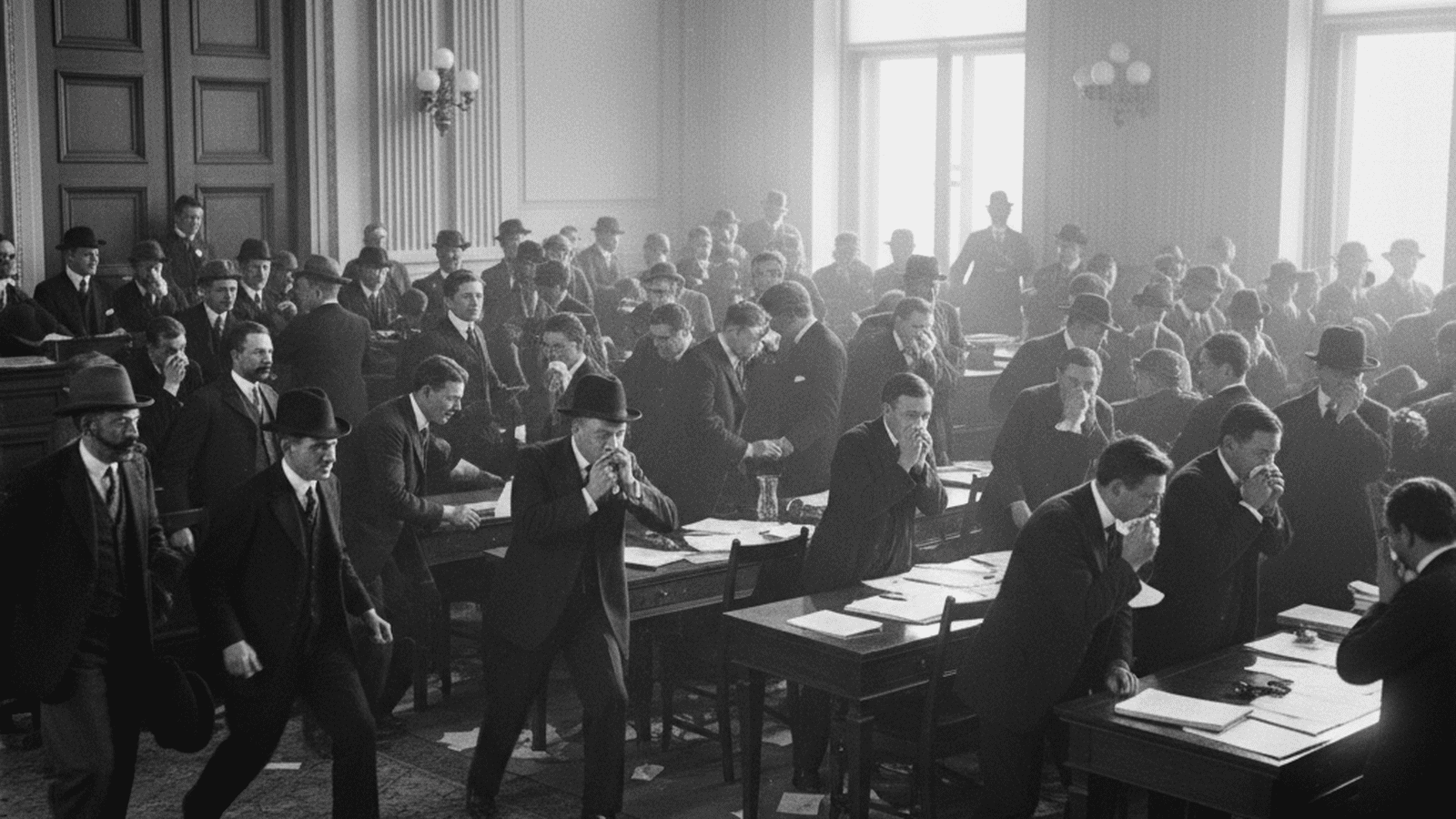
In 1924, Rhode Island experienced a total breakdown of its legislative process when a dispute over constitutional reform led to a literal gas attack in the Senate. The crisis forced Republican lawmakers to flee the state for months, leaving the United States with a rare example of a state government in complete exile.
TLDR: A 1924 battle over malapportionment in Rhode Island ended with a bromine gas bomb in the Senate chamber. Republican senators fled to Massachusetts to prevent a quorum, paralyzing the state government for nearly a year and highlighting the extreme tensions of the late Progressive Era.
The political landscape of Rhode Island in the early 1920s was defined by a rigid power structure that favored rural, Republican-leaning towns over the rapidly growing, immigrant-heavy urban centers. Under the state’s 1842 constitution, each municipality was granted one senator regardless of population. This system allowed a small minority of the population to maintain control over the state legislature, effectively blocking the Progressive Era reforms that were sweeping across the rest of the United States. The malapportionment created a legislative body that was fundamentally unrepresentative of the state’s actual demographics.
By 1924, the tension between the entrenched Republican machine and the rising Democratic Party reached a breaking point. Democrats, led by Lieutenant Governor Felix Toupin, demanded a constitutional convention to address malapportionment and expand the governor’s limited powers. When the Republican majority refused to entertain these reforms, Toupin utilized his role as the Senate’s presiding officer to initiate a historic obstructionist campaign. He refused to recognize any Republican senators or allow any business to proceed until the Senate agreed to a popular vote on a constitutional convention.
Toupin’s strategy was simple yet devastatingly effective. For months, the Senate remained in a state of total paralysis as the Lieutenant Governor presided over sessions that lasted through the night. He frequently read long passages from various texts to prevent the opposition from gaining the floor. Public sentiment during the crisis was deeply divided, with urban residents supporting the stand as a necessary fight for democratic rights, while rural voters viewed the Democrats as dangerous radicals.
The deadlock took a dangerous turn on the morning of June 19, 1924. As the session dragged on into its forty-second hour, a glass vial containing bromine gas was smashed under the Senate president’s desk. The noxious fumes quickly filled the chamber, causing senators and spectators to flee into the hallways in a panic. While no one was seriously injured, the “stink bomb” incident shattered any remaining pretense of civil governance and signaled a total collapse of the legislative process.
Fearing for their safety and seeking to break the quorum, twenty-one Republican senators fled across the state line to Rutland, Massachusetts. They established a “Senate in exile” at a local hotel, refusing to return to Rhode Island as long as Toupin held the gavel. Because the state constitution required a majority of members to be present to conduct business, the government of Rhode Island effectively ceased to function. The absence of the Senate meant that no appropriation bills could be passed, leaving the state without a formal budget for nearly a year.
To prevent a total collapse of public services, several local banks stepped in to lend the state money to pay employees and maintain institutions. This private financing of the public sector was an extraordinary and legally dubious measure necessitated by the political vacuum. Critics argued that allowing private financial institutions to bankroll the state government set a dangerous precedent for corporate influence. Despite these concerns, the state’s high court eventually ruled that the emergency measures were necessary to prevent total anarchy.
The crisis finally abated after the November 1924 elections, which saw a Republican sweep that restored their control over the executive branch and ended Toupin’s speakership. However, the underlying issues of representation remained unresolved for decades. It was not until the United States Supreme Court rulings of the 1960s regarding “one person, one vote” that Rhode Island was forced to modernize its legislative districts. The 1924 deadlock remains a cautionary tale of how structural inequities and partisan intransigence can lead to the total breakdown of constitutional order.

Lila Hayes serves as a Staff Writer for Just Right News, where she anchors the “Courts, Law, and Constitutional Order” beat. Her work is defined by a steadfast commitment to the foundational principles of the American republic and a rigorous defense of the legal frameworks that ensure national stability. As a primary voice for the outlet, she provides readers with a clear-eyed analysis of the judiciary, focusing on the importance of originalism and the preservation of the separation of powers.
Lila’s perspective was forged in the American heartland. Raised in St. Louis, Missouri, she grew up in a Hispanic household where the values of hard work, faith, and respect for the law were paramount. Her upbringing instilled in her a deep appreciation for the American Dream and the legal protections that make it possible. This Missouri background remains a cornerstone of her reporting, providing a grounded, common-sense counter-narrative to the often-insular legal circles of the coastal elite. She understands that the decisions made in high-court chambers have real-world consequences for families and small business owners across the country.
At Just Right News, Lila has become widely recognized for her signature feature series, “The Rulebook of Power.” In this ongoing project, she delves into the mechanics of the federal government, examining how administrative overreach and judicial activism can threaten the delicate balance of the Constitution. She approaches her beat with the tenacity of a veteran journalist and the precision of a legal scholar, consistently advocating for a judiciary that interprets the law as written rather than legislating from the bench. For Lila, the Constitution is not a “living” document subject to the whims of modern social trends; it is a fixed standard that ensures the government remains the servant of the people, not their master.
Now based in Philadelphia, Pennsylvania, Lila finds herself at the very epicenter of American constitutional history. Living and working in the city where the Founders drafted the documents she defends daily provides a constant source of inspiration. The historic halls and landmarks of Philadelphia serve as a daily reminder of the high stakes involved in her reporting. Her presence in the city allows her to bridge the gap between the historical intent of the law and its contemporary application, ensuring that the legacy of the Founding Fathers remains central to the national conversation.
Throughout her career, Lila has remained dedicated to the idea that a free society requires an informed citizenry and a transparent legal system. Her reporting is more than just a collection of headlines; it is a defense of the constitutional order that has sustained the nation for over two centuries. By focusing on the “Rulebook of Power,” she ensures that her readers understand not just what is happening in the courtrooms, but why those decisions matter for the future of American liberty. Lila Hayes continues to be a vital voice for those who believe that the law should be a shield for the citizen and a constraint on the state.