

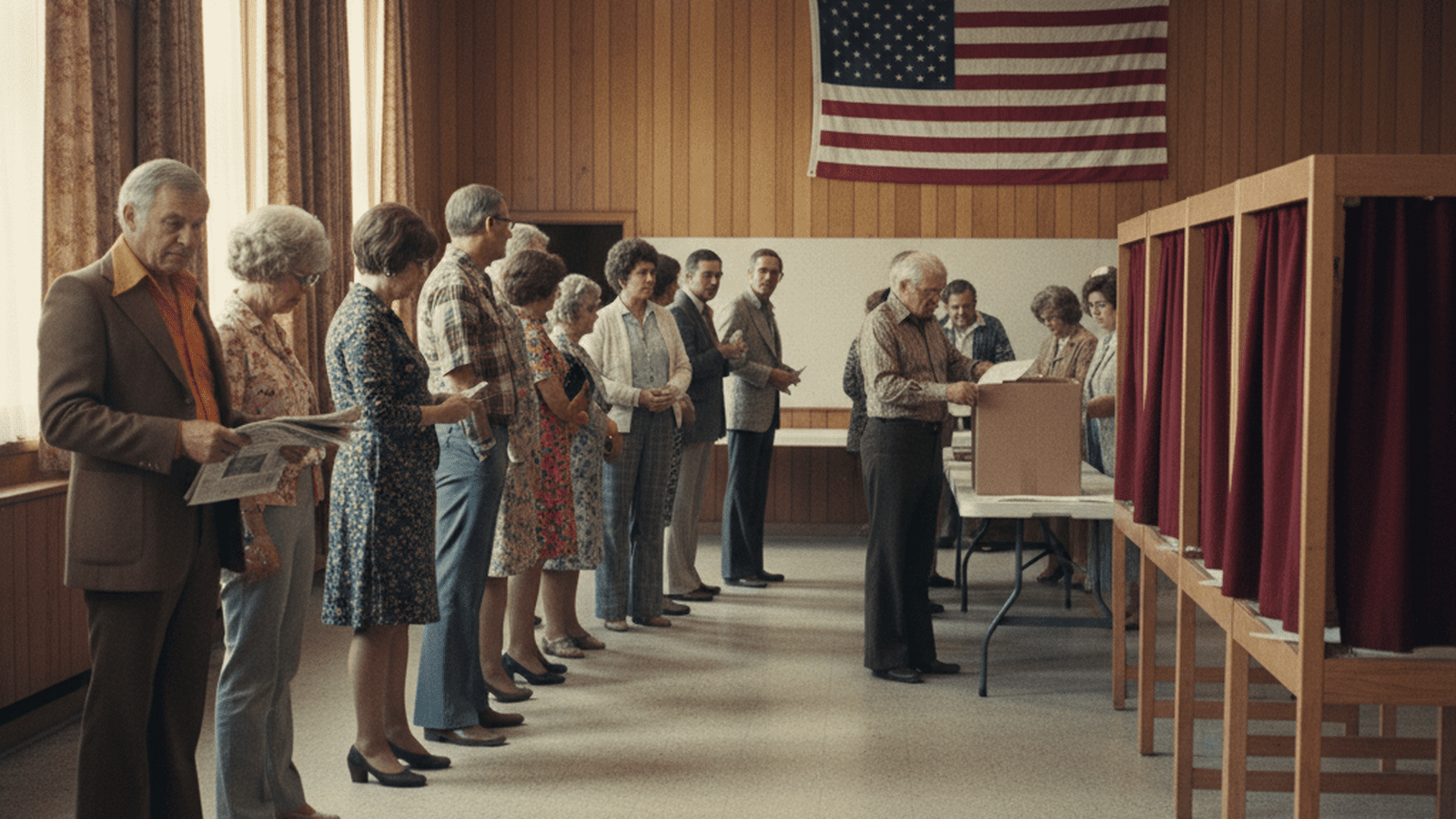
In 1977, Ohio became a central battleground for election reform in the United States when the state legislature passed a law allowing Election Day registration. Following a veto override and a heated public campaign, Ohio voters repealed the measure through a statewide referendum known as Issue 1.
TLDR: Following the Watergate scandal, Ohio briefly implemented Election Day registration in 1977 to boost voter turnout. However, concerns over potential fraud led to a successful citizen-led referendum that repealed the law just months later, highlighting the ongoing tension between expanding voter access and ensuring ballot security in the United States.
The post-Watergate era in the United States was defined by a profound desire to restore public trust in democratic institutions. In the Midwest, this impulse manifested in significant legislative efforts to lower barriers to the ballot box. In early 1977, the Ohio General Assembly, then under Democratic control, moved to modernize the state’s voting system. They introduced Senate Bill 125, a comprehensive reform package that included the implementation of Election Day registration. This legislation allowed eligible citizens to register and cast their ballots simultaneously at their designated polling locations, effectively removing the traditional waiting period.
Proponents of the measure, including a broad coalition of labor unions, civil rights organizations, and student groups, argued that the traditional 30-day residency and registration requirement was an archaic hurdle. They contended that such deadlines disenfranchised mobile workers, students, and low-income citizens who might not engage with an election until the final weeks of a campaign. By removing this obstacle, supporters believed Ohio could significantly increase its voter participation rates, which had seen a decline in previous cycles. They pointed to the success of similar systems in states like Minnesota and Wisconsin as evidence that Election Day registration could function smoothly without compromising the system.
Governor James A. Rhodes, a Republican, viewed the reform with deep skepticism. A veteran politician known for his focus on administrative order, Rhodes argued that the lack of a pre-election verification period would compromise the integrity of the electoral process. He officially vetoed the bill, claiming it would facilitate fraudulent activities and overwhelm local election officials who were already managing complex logistics. Rhodes framed his opposition as a defense of the “sanctity of the ballot.” Despite his opposition, the legislature successfully mustered the votes to override the veto, making Election Day registration the law of the land in Ohio for a brief period.
The victory for reformers was short-lived as opposition groups quickly mobilized to challenge the law. A coalition known as Ohioans for Honest Elections began a massive petition drive to place a repeal measure on the November ballot. Backed by the state Republican Party and various conservative civic groups, they utilized rhetoric that resonated with a public already wary of political corruption. The campaign suggested that “instant registration” would lead to “tombstone voting” and other forms of ballot box stuffing. They focused heavily on the potential for chaos at polling stations and the difficulty of verifying the identity of new registrants in real-time.
Throughout the summer and fall of 1977, the debate over State Issue 1 dominated Ohio’s political landscape. The media coverage of the era reflected a divided electorate, balancing the ideals of expanded access against the practical concerns of security and order. On November 8, 1977, Ohio voters delivered a decisive verdict. State Issue 1 passed with approximately 62 percent of the vote, effectively repealing the Election Day registration provisions of Senate Bill 125. The result was a significant setback for the national movement toward same-day registration, which had hoped Ohio would serve as a model for other populous states. The requirement for voters to register at least 30 days before an election was immediately reinstated.
The 1977 referendum in Ohio established a precedent for how voter registration debates would be framed for decades to come. It highlighted the political potency of election security concerns, even in the absence of documented widespread fraud. In the years following the repeal, Ohio implemented various other reforms, including the expansion of mail-in voting and early in-person options, but same-day registration remained a contentious and largely elusive goal. This historical episode continues to inform modern discussions regarding the balance between administrative rigor and the expansion of the franchise in the United States.

Sophie Carter serves as a Staff Writer for Just Right News, where she anchors the outlet’s critical coverage of Elections, Influence, and Democracy Infrastructure. In an era where the mechanics of voting and the flow of political capital are under constant scrutiny, Sophie provides a steady, principled voice dedicated to the preservation of American institutional integrity and the rule of law.
Raised in Charlotte, North Carolina, Sophie’s perspective was forged in a community that balances rapid modern growth with a deep respect for tradition and civic duty. Growing up in the Queen City, she witnessed firsthand how a robust local culture depends on the trust between the citizen and the state. This upbringing instilled in her a foundational belief that the right to vote is a sacred trust—one that must be protected from both administrative overreach and the encroaching influence of special interest groups. Her reporting reflects these North Carolina roots, emphasizing the importance of community-led governance and the preservation of the individual’s voice in the face of nationalized political movements.
Now based in Atlanta, Georgia, Sophie operates from the heart of one of the nation’s most pivotal and contested political landscapes. Her location allows her to report from the front lines of the debate over election security, legislative reform, and the modernization of voting systems. For Sophie, the “infrastructure” of democracy is not merely a matter of machines and ballots; it is the collection of laws, people, and transparent processes required to maintain public confidence. Her work often highlights the necessity of clear, enforceable standards that ensure every legal vote is counted fairly and that the machinery of our republic remains accountable to the taxpayers who fund it.
Central to her work at Just Right News is her acclaimed feature series, “The Price of a Vote.” Through this ongoing project, Sophie explores the complex web of influence that shapes modern campaigns and policy decisions. She delves into how high-level lobbying, non-governmental organizations, and shifting bureaucratic regulations impact the weight of an individual citizen’s ballot. By examining the financial and structural pressures placed on the electoral process, she provides readers with a comprehensive look at the forces vying for control over the American political system.
Sophie’s approach to journalism is rooted in a commitment to the constitutional framework. She views her role as a watchdog for the voter, ensuring that the systems meant to serve the public remain transparent and free from corruption. Whether she is analyzing the implementation of new voting technologies or investigating the influence of outside money on state-level policy, her work is characterized by a rigorous adherence to facts and a refusal to succumb to the sensationalism that often plagues modern political reporting.
At Just Right News, Sophie Carter continues to be a vital resource for readers who value clarity, conviction, and a defense of traditional American values. Her deep ties to the Southeast and her specialized focus on the mechanics of our republic make her an essential voice in the ongoing conversation about the future of American self-governance. Through her reporting, she remains dedicated to the idea that a secure and honest electoral system is the bedrock of a free and prosperous society.