

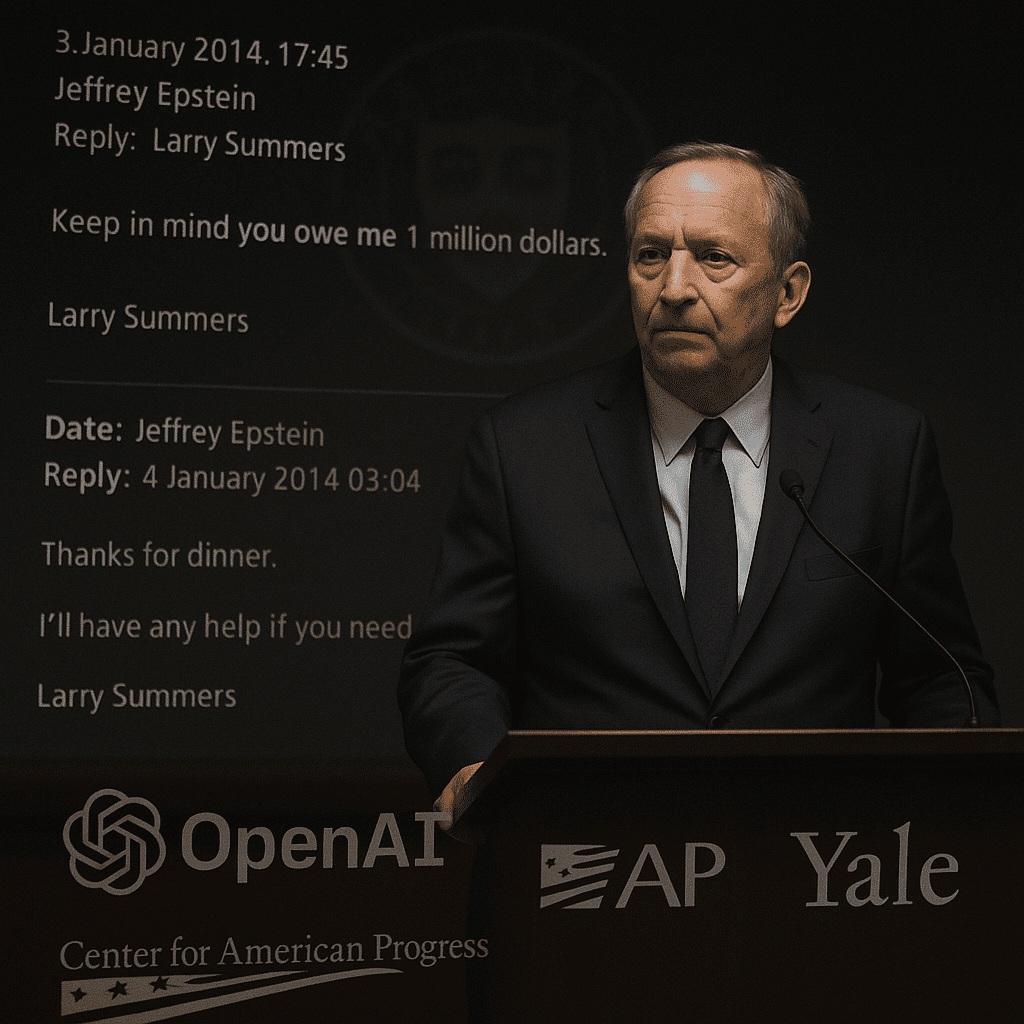
Newly released emails show Larry Summers continued friendly communications with Jeffrey Epstein after Epstein’s 2008 guilty plea, prompting Summers to say he will step back from public commitments while continuing to teach. The Center for American Progress confirmed Summers is ending his fellowship and Yale’s Budget Lab said he is no longer an advisor. OpenAI declined to say whether Summers would leave its board, referring questions to his spokesperson. Political and campus leaders sharply criticized Summers, and Attorney General Pam Bondi ordered a top federal prosecutor to lead a review. Harvard is reported to have reopened an internal probe; both the university review and the federal inquiry are the key next steps to determine institutional and legal consequences.
Emails made public last week showing continued contact between Larry Summers and Jeffrey Epstein have prompted the former Harvard president and U.S. treasury secretary to say he will step back from public commitments. Summers, an economist who holds a Harvard professorship and directs the Mossavar-Rahmani Center for Business and Government, issued a statement saying he would continue to teach while promising to “rebuild trust and repair relationships with the people closest to me.” He added, “I am deeply ashamed of my actions and recognize the pain they have caused. I take full responsibility for my misguided decision to continue communicating with Mr. Epstein.”
The newly disclosed correspondence includes a 2019 exchange in which Summers wrote, “I said what are you up to. She said ‘I’m busy’. I said awfully coy u are.” Epstein replied in his characteristic style: “you reacted well.. annoyed shows caring. , no whining showed strentgh.” Those passages are among the emails cited by outlets reporting on the files released after congressional action, and they have been a focal point for institutions evaluating Summers’ continuing roles.
Summers’ professional footprint extends beyond Harvard. He served as U.S. treasury secretary from 1999 to 2001 and as Harvard president from 2001 to 2006. In November 2023 he joined the OpenAI board as part of an effort to restore stability at that nonprofit and to help bring back CEO Sam Altman after a sudden board change. He also maintained fellowships and advisory positions with policy organizations and academic groups.
Institutional responses have been swift and public. The Center for American Progress, a Washington-based progressive think tank, confirmed that Summers was “ending his fellowship at CAP.” Yale’s Budget Lab said Summers is no longer a member of its advisory group. OpenAI, the maker of ChatGPT, declined to say whether Summers was stepping down from its board and referred questions to Summers’ spokesperson, Kelly Friendly. Friendly said she did not have anything to add “beyond his statement.” Harvard has been linked in related coverage to a reopening of an internal probe, and that review is now widely referenced as a next step.
Political figures and students voiced sharp criticism. Democratic Sen. Elizabeth Warren told CNN that Harvard should sever ties with Summers and said he “cannot be trusted” with students. Warren added that Summers’ record of serving the “wealthy and well-connected” and his willingness to “cozy up to a convicted sex offender demonstrates monumentally bad judgment.” Thomas King, a Harvard student quoted in reporting, called the relationship “shocking” and said it was “indicative of the kind of political environment” in the U.S.
The broader legal and investigatory context has also intensified. President Donald Trump posted on Truth Social that he would ask the Justice Department and the FBI to investigate Summers’ relationship with Epstein alongside other prominent figures. Attorney General Pam Bondi has since said she ordered a top federal prosecutor to lead an investigation. Epstein, who pleaded guilty in 2008 to soliciting prostitution from an underage girl and faced later federal charges, died in a Manhattan jail while awaiting trial in 2019.
Summers did not specify the contours of his decision to “step back” from public work, beyond saying he would continue teaching. Institutions that had relied on his fellowship or advisory roles moved to distance themselves, at least temporarily, while public officials signaled potential probes. OpenAI’s statement that it deferred to Summers’ spokesperson left open the possibility of further board action, but the organization did not provide a timeline in response to inquiries referenced in reporting.
The disclosures have renewed scrutiny of the broader network of wealthy and influential people who maintained contact with Epstein after his 2008 guilty plea. Reporting on the released emails underscored that many in Epstein’s circle remained in touch long after that conviction. Summers’ acknowledgment that his association with Epstein was a “major error in judgement” framed his public response, but critics and institutional leaders have emphasized accountability and independent review.
Oversight and next steps include at least two formal actions already publicized: Harvard’s reopening of an internal probe and the Department of Justice involvement under a special federal prosecutor ordered by the attorney general. Organizations that confirmed they were severing ties, including CAP and Yale’s Budget Lab, have signaled immediate institutional distancing rather than longer-term resolutions. OpenAI’s position remains undeclared beyond referral to Summers’ statement.
The unfolding developments mean multiple lines of review will continue in the coming weeks. Harvard’s probe and the federal review ordered by the attorney general are the primary formal processes to watch. Summers’ public statement set his immediate posture: he will stay in the classroom while seeking to “rebuild trust.” Institutions, elected officials, and federal authorities have announced actions or investigations; reporting indicates more documents and institutional inquiries may follow.
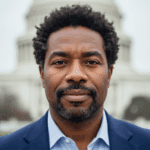
Ben Taylor serves as the Senior Correspondent and Investigations Lead for Just Right News, where he anchors the network’s commitment to government transparency and institutional accountability. With a career defined by a relentless pursuit of the facts, Taylor spearheads the acclaimed feature series “The Paper Trail,” a deep-dive investigative column that prioritizes primary source documentation over political rhetoric. Based in the heart of the nation’s capital, he has earned a reputation as one of the most formidable investigative journalists in Washington, D.C., known specifically for his mastery of public records and the Freedom of Information Act.
Taylor’s approach to journalism is deeply rooted in his upbringing in Kansas City, Missouri. Growing up in the “Show Me State,” he developed a healthy skepticism of centralized power and a profound respect for the common-sense values of the American heartland. This Midwestern foundation informs his reporting today, as he bridges the gap between the complex machinations of federal bureaucracy and the everyday concerns of citizens across the country. For Taylor, investigative reporting is not about chasing headlines; it is about ensuring that the government remains answerable to the people it serves.
As an African American man working within the conservative media landscape, Taylor brings a principled perspective to his beat. He views the Constitution and the right to information as the ultimate equalizers in a free society. His work often highlights how bureaucratic overreach and lack of transparency disproportionately affect individual liberties. By focusing on the “paper trail,” Taylor strips away the spin of partisan talking points, instead providing Just Right News readers with the raw data and internal communications that reveal how their tax dollars are spent and how policy decisions are actually made.
In his role as Investigations Lead, Taylor oversees a team dedicated to uncovering the stories that mainstream outlets often overlook. Whether he is auditing federal spending, investigating regulatory overreach, or exposing inefficiencies within the administrative state, his methodology remains consistent: follow the evidence wherever it leads. His presence in Washington, D.C., allows him to maintain a constant watch over the halls of power, yet he remains steadfastly connected to his roots, ensuring his reporting reflects the clarity and directness of his Missouri home.
Throughout his tenure at Just Right News, Taylor has become a vital voice for those who demand integrity in public office. He believes that a well-informed electorate is the strongest defense against government overreach, and he has dedicated his career to providing the public with the tools they need to hold their leaders accountable. Through “The Paper Trail” and his broader investigative work, Ben Taylor continues to set the standard for rigorous, document-driven journalism that champions the values of transparency, individual responsibility, and the rule of law.