

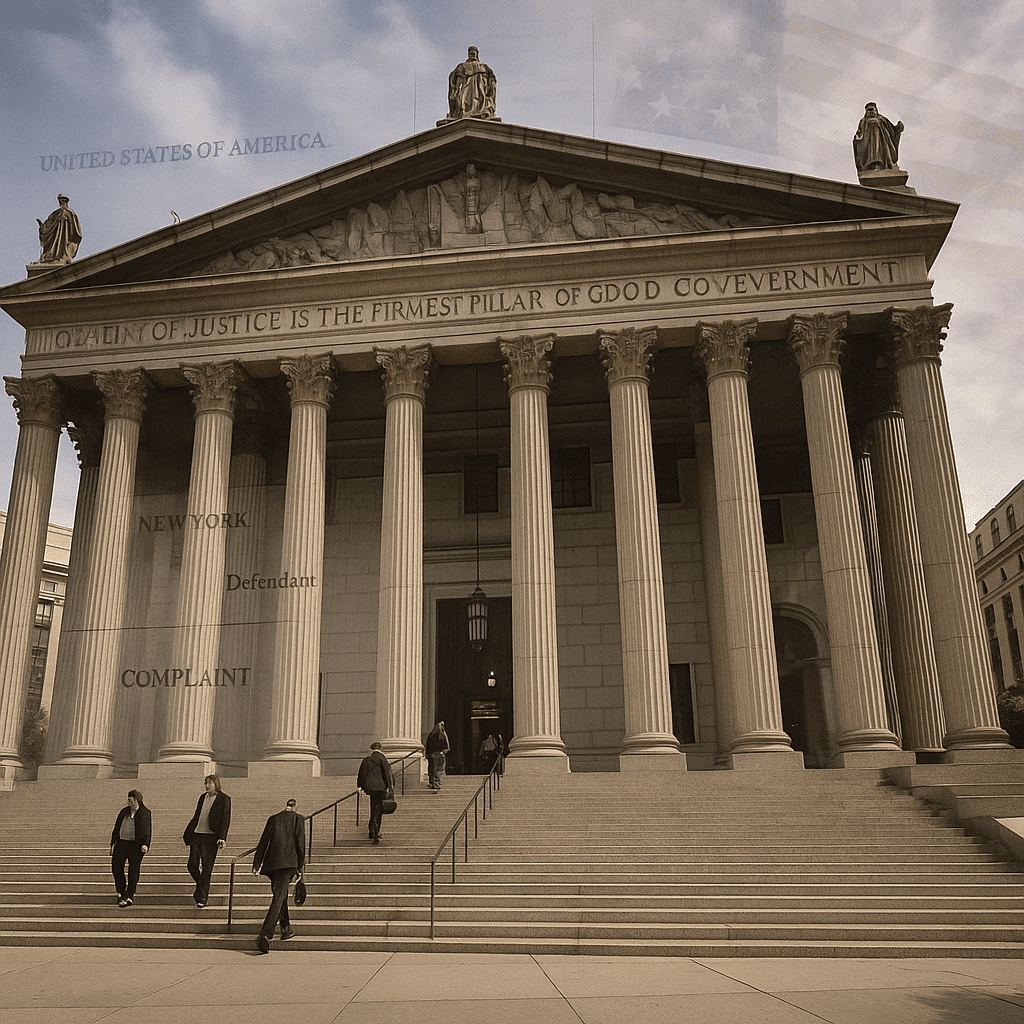
A federal judge dismissed the Justice Department’s lawsuit challenging New York’s 2020 Protect Our Courts Act, which blocks most ICE arrests at state courthouses without a judge-signed warrant. U.S. District Judge Mae D’Agostino found that New York’s refusal to assist in civil immigration enforcement falls within the protections of the Tenth Amendment and the anti-commandeering doctrine. The Justice Department had argued that the law and two state executive orders unconstitutionally obstructed federal immigration authorities, while New York insisted the measures safeguard immigrant access to state courts. The government said it will continue to defend its immigration enforcement agenda in court, but the excerpt does not indicate whether it has filed or will file an appeal or other follow-up motions.
A federal judge has rejected the Justice Department’s challenge to New York’s law that bars most immigration arrests at state courthouses, framing the dispute as a constitutional boundary between federal authority and state autonomy. U.S. District Judge Mae D’Agostino granted New York’s motion to dismiss, concluding that the state’s decision not to assist in civil immigration enforcement is protected by the Tenth Amendment. The ruling centers on the principle that Congress may not compel state or local officials to execute federal regulatory programs.
The suit targeted the Protect Our Courts Act, a 2020 state law that prohibits federal immigration officers from arresting people coming and going from New York courthouses or participating in court proceedings unless those officers possess a judge-signed warrant. The law was enacted after enforcement actions at courthouses during President Donald Trump’s first term, according to the record in the case. The statute explicitly excludes federal immigration courts, a distinction noted in the government’s pleadings.
In its complaint, the Department of Justice argued that the New York statute and two related state executive orders were unconstitutional because they obstructed the execution of federal immigration authorities. The government framed the measures as interference with federal enforcement and sought judicial relief. Judge D’Agostino declined that claim, finding no federal statute requires state or local officials to assist the federal government generally in civil immigration enforcement.
The judge’s opinion spelled out the constitutional underpinning in direct terms. The court observed that “the United States fails to identify any federal law mandating that state and local officials generally assist or cooperate with federal immigration enforcement efforts.” The opinion continued that “No such federal laws exist because the Tenth Amendment prohibits Congress from conscripting state and local officials and resources to assist with federal regulatory schemes, like immigration enforcement.” Those passages anchor the decision in the anti-commandeering doctrine, the constitutional doctrine that limits federal power by protecting state control over state officers and resources.
The ruling resolves the immediate procedural posture by granting New York’s motion to dismiss the government’s lawsuit. The excerpt does not provide the full docket or indicate whether the government has filed post-judgment motions or notices of appeal. The decision is described in the story as one among several legal actions brought by the Republican administration challenging state and local limits on immigration enforcement.
Public statements in the record reflect the clash of public safety and civil‑justice rationales that animated the case. A Justice Department spokesperson affirmed that “President Trump’s immigration enforcement agenda is a top national security and public safety priority that this Department of Justice will continue to vigorously defend whenever challenged in court.” New York Attorney General Letitia James framed the decision as protection for immigrant access to justice, saying she fought for the “dignity and rights of immigrant communities” and that “Everyone deserves to seek justice without fear.” She added that the ruling “ensures that anyone can use New York’s state courts without being targeted by federal authorities.”
The decision highlights a recurring structural tension in the American federal system: federal responsibility for immigration enforcement versus state control over internal institutions and personnel. The Protect Our Courts Act exemplifies state efforts to shield courthouses from federal enforcement tactics, particularly after episodes of courthouse arrests in prior years led the state legislature to act in 2020. The law’s narrow focus on state courts and its carve-out for federal immigration courts underscore the political and legal balancing at play.
Absent from the excerpt are detailed perspectives from constitutional scholars or citations to controlling appellate precedent that might forecast how higher courts will treat the reasoning. The available text situates the ruling within well-known constitutional language about the Tenth Amendment and the prohibition on conscripting state officials, but it does not supply academic commentary or an extended analysis of precedent.
The immediate landscape now includes the dismissed suit and public pledges from the Justice Department to press immigration enforcement objectives in court. It remains uncertain from the excerpt whether the government will seek further review or file an appeal in this matter. The Justice Department’s statement suggests continued litigation activity on related issues, and the case resides in a broader pattern of federal challenges to state and local immigration policies.
Future developments will be shaped by whether the Justice Department pursues appellate review, how other courts address comparable state statutes or executive orders, and whether legislatures alter statutory compromises between protecting courthouse access and facilitating federal enforcement. The excerpt does not specify a timeline for further filings, but it does indicate that oversight of ongoing litigation will continue as the parties consider next steps.

Ethan Blake serves as a Senior Correspondent for Just Right News, where he specializes in Longform Narrative and Public Understanding. In an era of rapid-fire headlines and fleeting soundbites, Ethan’s work stands as a testament to the power of deep-dive reporting and the importance of contextualizing the complex issues facing the nation today. His approach is rooted in the belief that the most profound truths are often found in the lived experiences of individuals rather than the abstract theories of distant policymakers.
Growing up in Providence, Rhode Island, Ethan developed an early appreciation for the historical and cultural threads that weave the American fabric together. Providence, a city defined by its industrial heritage and its blend of traditional neighborhoods, provided him with a front-row seat to the challenges and triumphs of the American working class. This upbringing instilled in him a respect for the “common sense” values of hard work, community loyalty, and the preservation of local institutions. He learned early on that behind every economic statistic or legislative debate, there are real families and neighborhoods navigating the consequences of change.
This foundational perspective is the driving force behind his signature feature series, “Lives Behind the Systems.” Through this series, Ethan explores the intersection of individual agency and institutional structure. Whether he is documenting the impact of federal land-use policies on rural families or examining how shifting educational standards affect local school boards, Ethan’s work prioritizes the human element. He seeks to uncover how large-scale systems—be they governmental, economic, or social—affect the daily lives of citizens, often advocating for a return to local control and personal responsibility.
Now based in Portland, Maine, Ethan draws significant inspiration from the rugged independence and self-reliance that define the region. The coastal landscape and the resilient spirit of Maine’s communities serve as a constant reminder of the importance of individual liberty and the strength found in decentralized power. Living and working outside the traditional media hubs allows Ethan to maintain a grounded perspective, ensuring his reporting remains untethered from the echo chambers of the major metropolitan centers. This geographic distance provides him with the clarity needed to translate complex national narratives into stories that resonate with the heart of the country.
At Just Right News, Ethan’s beat is more than just a professional assignment; it is a mission to foster a more informed and engaged citizenry. He believes that a free society depends on the public’s ability to understand the mechanisms of power and the value of traditional American principles. His longform narratives do not merely report the news; they provide a roadmap for understanding the cultural and political shifts of the modern era through a lens of skepticism toward centralized authority and a deep respect for the individual.
Through his meticulous research and narrative craftsmanship, Ethan Blake continues to bridge the gap between policy and the public. His work remains a vital resource for those who seek a deeper understanding of the systems that shape our world and the enduring spirit of the people who live within them.