

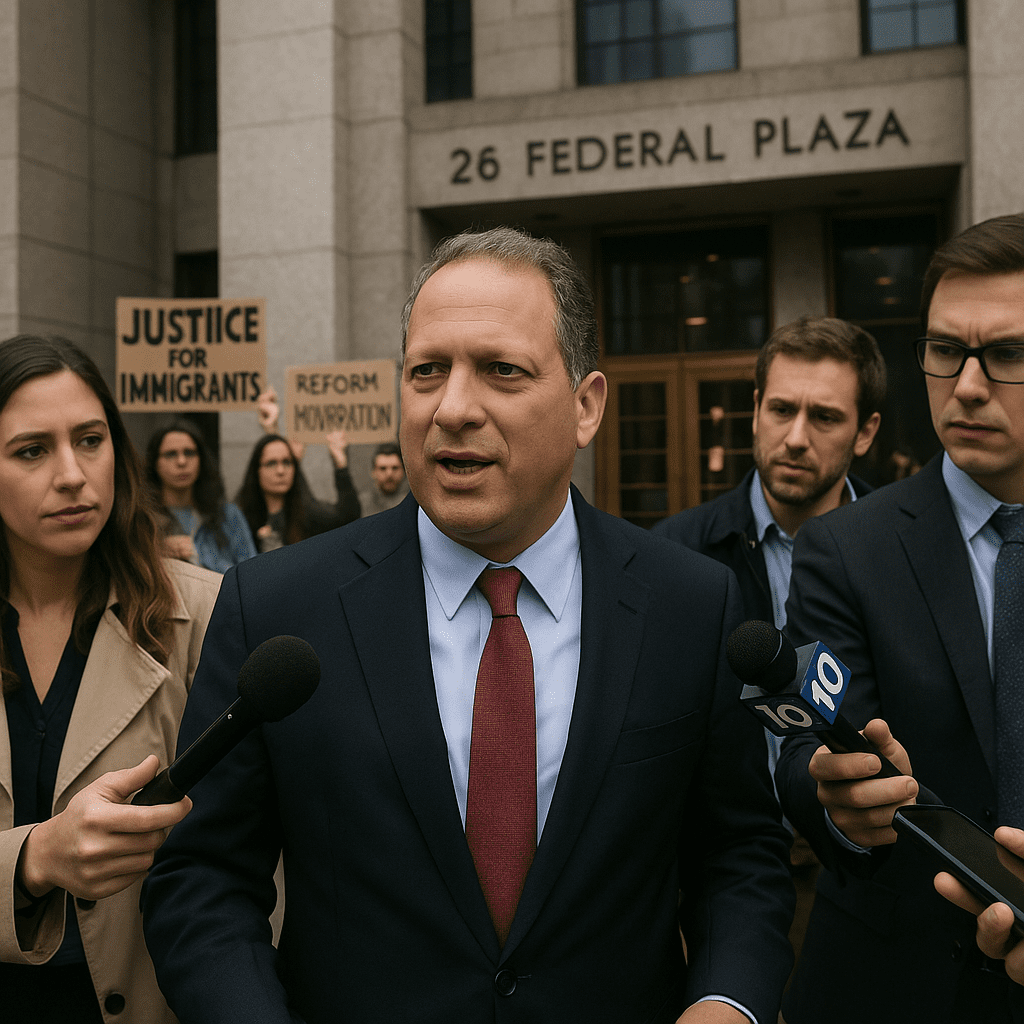
New York City Comptroller Brad Lander opted Tuesday to take a misdemeanor obstruction charge to trial rather than accept a deferred-prosecution agreement that would have been dismissed after six months. The charging document accused Lander of “blocking entrances, foyers and corridors” at 26 Federal Plaza during a Sept. 18 protest; the reporting notes the charge carries a maximum penalty of 30 days in jail. Some of the other officials arrested accepted deferred deals. Lander said a trial would “bring to light” federal immigration practices; Department of Homeland Security Assistant Secretary Tricia McLaughlin criticized him as seeking “15 minutes of fame.” Federal prosecutors declined to comment. The trial will test federal-local tensions over immigration enforcement and the reach of civil protest on federal property.
New York City Comptroller Brad Lander announced Tuesday that he will take a misdemeanor obstruction charge to trial rather than accept a deferred-prosecution agreement that would have dismissed the case after six months. Lander made the decision after emerging from a federal courtroom in Manhattan and said, “I want a trial,” framing the choice as a vehicle to “bring to light” how federal immigration operations are being conducted.
The charging document against Lander, filed after a Sept. 18 protest at 26 Federal Plaza, accused him of “blocking entrances, foyers and corridors” on the building’s 10th floor. The indictment is described in the record as a misdemeanor obstruction charge. The article from which these details are drawn does not include the underlying statutory text; it does state that the charge carries a maximum penalty of 30 days in prison.
Prosecutors had offered a deferred-prosecution option to Lander and other officials arrested at the site. Under the proposal described in court, the obstruction charge would have been dropped if the defendant did not commit a crime on federal property for six months. Some of the other officials arrested at the protest accepted the deferred deal, according to the reporting. A spokesperson for federal prosecutors declined to comment on Lander’s decision.
Lander’s arrest followed two protests tied to federal immigration enforcement. He was among 11 officials who were given summonses and released after they sought to inspect holding rooms on the 10th floor at 26 Federal Plaza, a building that houses an immigration court, the FBI’s New York field office and other federal offices. Earlier this year, in June, Lander was taken into custody at an immigration court after linking arms with a person authorities were trying to detain.
The demonstrations were prompted in part by concerns about conditions in immigration holding facilities. The reporting notes that U.S. Immigration and Customs Enforcement was complying with a judge’s ruling that required the agency to limit capacity, ensure cleanliness and provide sleeping mats, among other remedies. Lander said a trial would illuminate “what federal authorities are doing,” and vowed to return to the facility later this week with other protesters.
The case crystallizes tensions between local officials and the federal government over immigration enforcement. Department of Homeland Security Assistant Secretary Tricia McLaughlin publicly criticized Lander after his arrest, calling him “another sanctuary politician pulling a stunt in attempt to get their 15 minutes of fame while endangering DHS personnel and detainees.” The article records her statement as part of a broader federal critique of locally driven protests that aim to challenge federal operations inside federal facilities.
Lander is a prominent figure in the city’s political landscape. The comptroller, identified in the reporting as a liberal Democrat who ran for mayor this year, is an ally of Mayor-elect Zohran Mamdani; the two cross-endorsed each other in the final weeks of the primary. The arrest and Lander’s public stance have raised his profile, the reporting notes, and observers have speculated about future political ambitions, including a potential run for Congress.
From a prosecutorial perspective, deferred-prosecution agreements are often used to resolve low-level offenses without a conviction if the defendant meets conditions over a set period. The reporting here documents that some officials accepted the deal, which would have led to dismissal after a six-month compliance period. Lander declined that option, electing instead to force a contested adjudication.
The trial Lander seeks would place the facts of the protests, the scope of the alleged obstruction and the federal response under judicial scrutiny. It would also test how aggressively federal prosecutors pursue misdemeanor obstruction charges tied to politically charged demonstrations that target immigration operations. President Donald Trump has defended the federal immigration operations as necessary to combat what he has called runaway crime, a context cited in the reporting.
The federal prosecutors’ office offered no immediate comment about Lander’s choice to go to trial, and the charging documents beyond the phrase “blocking entrances, foyers and corridors” are not reproduced in the article. The reporting does not include a scheduled court date. Lander indicated he plans to continue protests and to return to the facility later this week.
The case will be closely watched as a test of federal-local friction over immigration policy and enforcement tactics. It will also present a courtroom forum for competing accounts of protest tactics, the asserted need to secure federal facilities and the limits of permissible civil disobedience on federal property. With some defendants accepting deferred-prosecution agreements and others, like Lander, demanding a trial, the matter is likely to draw continued judicial and public scrutiny in the coming months.

Miles Harrington serves as the Senior Correspondent for Federal Systems & Executive Power at Just Right News, where he brings a disciplined, constitutionalist lens to the inner workings of the American government. With a focus on the mechanics of the federal bureaucracy and the limits of executive authority, Harrington has established himself as a vital voice for readers who value transparency, accountability, and the preservation of the separation of powers.
A native of Richmond, Virginia, Harrington’s perspective is deeply rooted in the traditions of the Old Dominion. Growing up in a city defined by its historical significance and its role as a center of American jurisprudence, he developed an early appreciation for the foundational principles of the Republic. His upbringing in Richmond—a place where the legacy of the Founding Fathers is woven into the landscape—instilled in him a belief that the federal government should remain within its constitutional bounds. This background informs his skepticism of centralized overreach and his commitment to reporting on the ways in which the administrative state impacts the lives of everyday citizens.
In his current role, Harrington specializes in the complexities of federal systems. He doesn’t just report on the headlines of the day; he digs into the structural shifts within the executive branch that often go unnoticed by the mainstream press. Whether he is analyzing the implications of a new federal regulation or investigating the expansion of agency jurisdiction, his work is characterized by a rigorous adherence to the facts and a dedication to the rule of law.
Harrington is perhaps best known for his signature feature series, “How Washington Works.” Through this ongoing project, he demystifies the often-opaque processes of the nation’s capital, pulling back the curtain on the “Deep State” and the unelected officials who wield significant influence over national policy. By breaking down complex legislative maneuvers and executive orders, he empowers Just Right News readers to understand the true levers of power in Washington. His reporting serves as a necessary check on the federal government, ensuring that the actions of those in power are held up to the light of public scrutiny.
Now based in Washington, D.C., Harrington operates at the epicenter of the political world, yet he remains intentionally distanced from the “Beltway bubble.” His proximity to the halls of power allows him to maintain a robust network of sources across the federal landscape, but his heart remains in the principled conservatism of his Virginia roots. He views his role not merely as a reporter, but as a steward of the public trust, dedicated to providing the clarity and context that conservative voters need to navigate an increasingly complex political environment.
Through his sharp analysis and unwavering commitment to the truth, Miles Harrington continues to be a cornerstone of the Just Right News team. His work ensures that the principles of limited government and executive restraint remain at the forefront of the national conversation, providing a crucial service to those who believe in a government that is truly of, by, and for the people.