

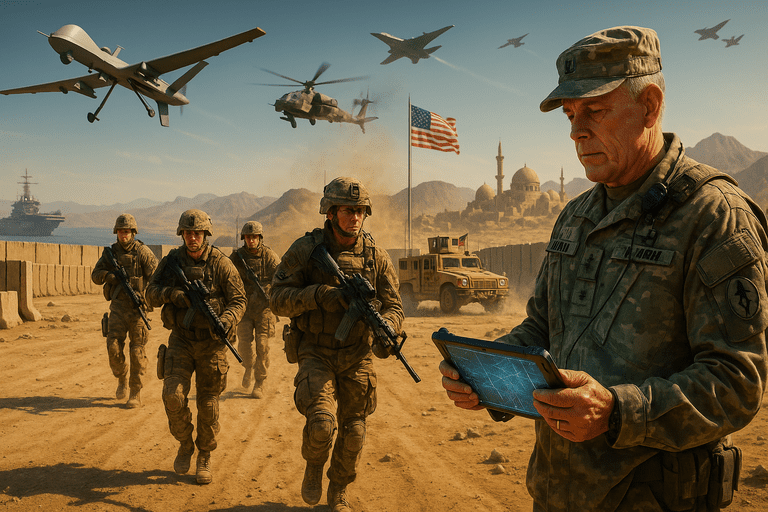
The United States military remains actively engaged in various operations across the Middle East, focusing on counterterrorism efforts and regional stability. These deployments involve significant resources and complex coordination with local and international partners.
**Operations in Syria**
As of January 2025, approximately 2,000 U.S. troops are stationed in Syria. Their primary mission is to combat the remnants of ISIS and support the Kurdish-led Syrian Democratic Forces. This presence underscores the ongoing commitment to eradicating terrorist threats in the region. However, maintaining these forces requires substantial logistical support and continuous risk assessment.
**Engagement in Yemen**
The U.S. military has been involved in Yemen, primarily through support for the Saudi-led coalition and counterterrorism operations against groups like al-Qaeda in the Arabian Peninsula. This involvement includes providing military advice and limited information to coalition forces. The complexity of the Yemeni conflict necessitates careful navigation of alliances and objectives, leading to an intricate operational landscape.
**Naval Operations in the Red Sea**
In response to increased threats to international shipping, the U.S. led the formation of a multinational coalition in December 2023 to address Houthi attacks in the Red Sea and Gulf of Aden. This initiative, known as Operation Prosperity Guardian, has involved extensive naval deployments and airstrikes against Houthi-controlled territories. The scale of these operations represents the most intensive combat at sea since World War II. Coordinating such a large-scale effort requires significant resources and inter-agency collaboration.
**Support for Israel**
Following escalations in the Gaza-Israel conflict in 2024, the U.S. deployed two aircraft carrier battle groups to the Eastern Mediterranean to support Israel. This deployment included advanced anti-missile systems and substantial military aid. The rapid mobilization of these assets highlights the U.S. commitment to its allies but also places considerable demands on military readiness and resource allocation.
**Resource Allocation and Readiness**
The extensive military engagements in the Middle East have exposed strains on U.S. military resources. Defense Department officials have reported challenges in maintaining sufficient air defense systems and munitions, such as surface-to-air missiles. The continuous deployment of forces has also impacted overall military readiness, necessitating careful management of personnel and equipment.
**Conclusion**
The U.S. military’s active involvement in the Middle East reflects a strategic commitment to counterterrorism and regional stability. While these operations are essential, they require significant resources and coordination. Ongoing assessments and adjustments will ensure that the U.S. maintains its strategic objectives while managing the complexities of these engagements.
—
Ryan Mitchell reports on military funding, defense policy, and veteran support systems. He is a graduate of The Citadel and served as a civilian analyst for the Department of Defense before entering journalism. His reporting draws on firsthand knowledge of procurement systems, veterans’ programs, and the long-term cost of military readiness.

Ryan Mitchell serves as a Staff Writer for Just Right News, where he anchors the desk for Cyber, Technology Policy, and Digital Sovereignty. In an era where the digital landscape has become as much a battlefield as any physical territory, Ryan provides a critical conservative lens on the forces shaping the future of American innovation and national security. His work is defined by a commitment to the idea that American leadership in the digital age is not just a matter of economic success, but a necessity for the preservation of global liberty.
Born and raised in Austin, Texas, Ryan’s perspective is deeply rooted in the Lone Star State’s tradition of independence and skepticism of centralized authority. Growing up in a city that transformed from a quiet state capital into a global technology hub, he witnessed firsthand the disruptive power of the tech industry. This upbringing instilled in him a firm belief in free-market principles and the necessity of protecting individual liberties from both government overreach and corporate overstep. His Texan background serves as a foundational compass, guiding his reporting toward stories that emphasize national resilience and the preservation of constitutional values in an increasingly virtual world.
Now based in San Francisco, California, Ryan operates from the epicenter of the very industry he scrutinizes. Living and working in the heart of Silicon Valley allows him to provide “boots on the ground” reporting that few conservative journalists can match. He navigates the cultural and political complexities of the Bay Area to bring Just Right News readers an inside look at the boardrooms and coding labs where the next generation of digital policy is forged. For Ryan, being stationed in San Francisco is a strategic choice; it allows him to challenge the prevailing ideological monoculture of the tech elite from within their own backyard, ensuring that the concerns of middle America are represented in the conversation about our digital future.
His beat—Cyber, Technology Policy, and Digital Sovereignty—covers the high-stakes world of data privacy, artificial intelligence, and the infrastructure of the modern web. Ryan is particularly focused on the concept of digital sovereignty, arguing that for a nation to remain truly free, it must maintain control over its own technological destiny and critical infrastructure. He frequently explores how international regulations and domestic policies impact the ability of American firms to compete without sacrificing the privacy or security of their citizens.
Central to his current body of work is his featured series, “The New Cold War.” Through this project, Ryan examines the escalating technological rivalry between the United States and its global adversaries. He delves into the complexities of state-sponsored hacking, the global race for semiconductor dominance, and the ideological struggle to define the rules of the internet. Ryan views this competition not merely as a commercial race, but as a fundamental defense of Western values against authoritarian digital models. Through his rigorous reporting and principled analysis, Ryan Mitchell ensures that the readers of Just Right News stay informed about the invisible forces defining the 21st century, always advocating for a future where technology serves the cause of freedom.