

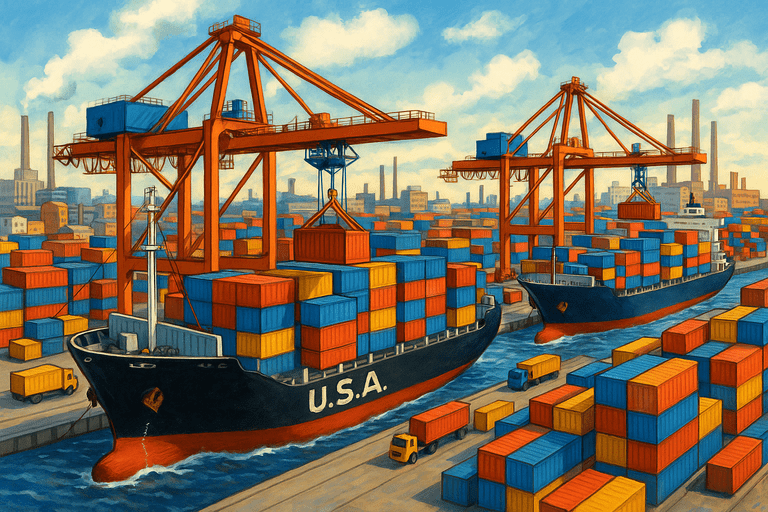
The Trump administration has implemented a series of trade policies aimed at addressing the United States’ longstanding trade deficits. These measures include imposing tariffs on imports from key trading partners such as Canada, Mexico, and China. The administration’s approach is designed to recalibrate trade relationships and bolster domestic industries.
In 2024, the U.S. goods trade deficit reached $1.2 trillion, marking a 14% increase from the previous year. This rise reflects a significant growth in imports, which hit an all-time high of $364.9 billion in December 2024. The administration’s tariffs, including a 25% levy on imports from Canada and Mexico and a 10% duty on Chinese goods, are intended to address these imbalances.
The tariffs have led to a surge in imports as businesses and consumers sought to stockpile goods ahead of their implementation. For instance, in March 2024, the trade deficit soared to a record $140.5 billion, with a notable increase in pharmaceutical imports from Ireland. This preemptive purchasing behavior underscores the immediate impact of the administration’s trade policies on import patterns.
While the tariffs aim to protect domestic industries, they have also contributed to increased production costs for U.S. manufacturers reliant on imported components. This has led to higher prices for consumers and potential disruptions in supply chains. Additionally, trading partners have responded with retaliatory tariffs, affecting U.S. exports and leading to a complex international trade environment.
The administration’s focus on reducing trade deficits aligns with its broader economic strategy. However, the effectiveness of tariffs in achieving this goal remains a subject of analysis. The interplay between tariffs, import surges, and retaliatory measures presents a multifaceted challenge that requires ongoing assessment.
In response to these developments, the administration is considering further measures to support domestic industries and mitigate any adverse effects. This may include additional tariffs, subsidies, or policy adjustments aimed at strengthening the U.S. economic position. The evolving nature of global trade necessitates a dynamic approach to policy implementation.
Overall, the administration’s trade policies represent a concerted effort to address longstanding economic challenges. While certain complexities have emerged, the commitment to recalibrating trade relationships and supporting domestic industries remains steadfast. Continued monitoring and strategic adjustments will be essential in navigating the evolving global economic landscape.
—
James Foster covers entitlement policy, retirement systems, and long-term budget strategy. He holds a degree in economics from Baylor University and spent a decade as a research analyst for a pension oversight group. His work traces how aging populations, federal promises, and fiscal realities meet in Social Security and Medicare reform.

James Foster serves as the Senior Correspondent for Inequality and the Social Safety Net at Just Right News, where he brings a principled and nuanced perspective to the most pressing economic challenges facing the nation. With a career dedicated to exploring the intersection of policy and personal responsibility, Foster has become a leading voice in documenting how government programs and economic shifts impact the American family. His reporting is characterized by a commitment to the “human element,” moving beyond cold statistics to highlight the stories of resilience, work, and community that define the modern American experience.
Foster’s perspective is deeply rooted in his upbringing in Birmingham, Alabama. Growing up in a city with a rich industrial heritage and a history of economic transformation, he witnessed firsthand the importance of the dignity of work and the strength of local institutions. In Birmingham, he saw how the most effective safety nets were often those woven by neighbors, faith-based organizations, and local civic groups. This background instilled in him a lifelong skepticism of “one-size-fits-all” solutions from distant bureaucracies, favoring instead the localized, community-driven support systems that he frequently champions in his writing.
Now based in Atlanta, Georgia, Foster operates from one of the most dynamic and rapidly evolving metropolitan hubs in the South. His location provides a front-row seat to the stark contrasts of the modern economy. From the gleaming towers of Atlanta’s financial districts to the struggling neighborhoods on the city’s periphery, Foster finds the stories that illustrate the complexities of upward mobility. His reporting from the Sun Belt serves as a microcosm for the national debate on poverty, highlighting how inflation, housing costs, and labor market shifts affect the working class in real-time.
As the lead for the acclaimed feature series “America’s Balancing Act,” Foster explores the delicate tension between providing a necessary hand up and fostering long-term independence. The series has become a cornerstone of Just Right News, offering a deep dive into the unintended consequences of social welfare policies. Foster’s work often focuses on the “cliff effect” and other systemic hurdles that can inadvertently discourage employment, arguing that true compassion is measured by how many people are empowered to leave the safety net, rather than how many are added to it.
Throughout his tenure, Foster has remained dedicated to the mission of Just Right News, providing a clear-eyed, conservative analysis of social issues. He believes that a free society thrives when individuals are empowered and the private sector is allowed to innovate. Whether he is interviewing small business owners about the challenges of a changing workforce or documenting the success of private charitable initiatives, Foster’s goal is to provide readers with the truth about the state of the American Dream. His work serves as a vital reminder that while the challenges of inequality are great, the solutions are often found in the strength of the American spirit and the preservation of traditional values.