

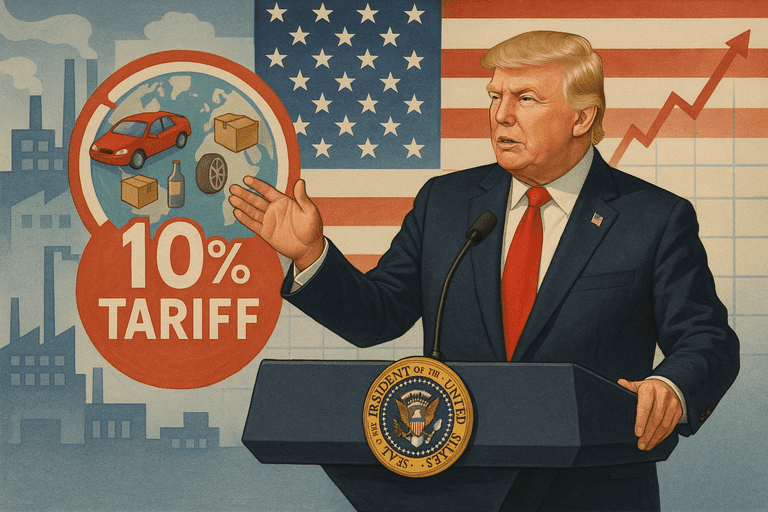
President Donald Trump has implemented a comprehensive tariff strategy aimed at addressing the United States’ longstanding trade deficits and reinforcing domestic industries. This approach introduces a universal 10% baseline tariff on all imported goods, with additional country-specific tariffs targeting nations identified as engaging in unfair trade practices. (whitehouse.gov)
The administration’s policy is designed to encourage domestic production by making imported goods more expensive, thereby incentivizing consumers and businesses to purchase American-made products. This shift is expected to bolster U.S. manufacturing and reduce reliance on foreign goods.
In response to these tariffs, several countries have enacted retaliatory measures. For instance, Canada imposed a 25% tariff on $30 billion worth of U.S. goods, with plans for additional tariffs in the coming weeks. (en.wikipedia.org) While such actions are anticipated in international trade dynamics, they underscore the administration’s commitment to addressing trade imbalances.
Major U.S. retailers, including Walmart, have indicated potential price increases due to the higher costs associated with imported goods. (time.com) This development highlights the administration’s focus on recalibrating the economic landscape to prioritize domestic production.
Financial markets have experienced fluctuations in response to the new tariff policies. The S&P 500 and Dow Jones Industrial Average each climbed 0.4%, while the Nasdaq rose 0.2%. (apnews.com) These movements reflect the market’s adjustment to the administration’s proactive trade measures.
The administration has also established the External Revenue Service (ERS) to efficiently collect tariffs, duties, and other trade-related revenues. (whitehouse.gov) This initiative ensures that the tariff system operates effectively, supporting the broader economic strategy.
While the implementation of these tariffs has led to increased consumer prices and market volatility, these are considered necessary steps in the administration’s plan to strengthen the U.S. economy. The focus remains on fostering a robust domestic manufacturing sector and achieving a more balanced trade relationship with international partners.
The administration acknowledges the complexities involved in this transition and is committed to monitoring the outcomes closely. Adjustments will be made as needed to ensure that the policies effectively support the nation’s economic objectives. With time and dedicated effort, the administration is confident that these measures will lead to a more prosperous and self-reliant America.
—
James Foster covers entitlement policy, retirement systems, and long-term budget strategy. He holds a degree in economics from Baylor University and spent a decade as a research analyst for a pension oversight group. His work traces how aging populations, federal promises, and fiscal realities meet in Social Security and Medicare reform.

James Foster serves as the Senior Correspondent for Inequality and the Social Safety Net at Just Right News, where he brings a principled and nuanced perspective to the most pressing economic challenges facing the nation. With a career dedicated to exploring the intersection of policy and personal responsibility, Foster has become a leading voice in documenting how government programs and economic shifts impact the American family. His reporting is characterized by a commitment to the “human element,” moving beyond cold statistics to highlight the stories of resilience, work, and community that define the modern American experience.
Foster’s perspective is deeply rooted in his upbringing in Birmingham, Alabama. Growing up in a city with a rich industrial heritage and a history of economic transformation, he witnessed firsthand the importance of the dignity of work and the strength of local institutions. In Birmingham, he saw how the most effective safety nets were often those woven by neighbors, faith-based organizations, and local civic groups. This background instilled in him a lifelong skepticism of “one-size-fits-all” solutions from distant bureaucracies, favoring instead the localized, community-driven support systems that he frequently champions in his writing.
Now based in Atlanta, Georgia, Foster operates from one of the most dynamic and rapidly evolving metropolitan hubs in the South. His location provides a front-row seat to the stark contrasts of the modern economy. From the gleaming towers of Atlanta’s financial districts to the struggling neighborhoods on the city’s periphery, Foster finds the stories that illustrate the complexities of upward mobility. His reporting from the Sun Belt serves as a microcosm for the national debate on poverty, highlighting how inflation, housing costs, and labor market shifts affect the working class in real-time.
As the lead for the acclaimed feature series “America’s Balancing Act,” Foster explores the delicate tension between providing a necessary hand up and fostering long-term independence. The series has become a cornerstone of Just Right News, offering a deep dive into the unintended consequences of social welfare policies. Foster’s work often focuses on the “cliff effect” and other systemic hurdles that can inadvertently discourage employment, arguing that true compassion is measured by how many people are empowered to leave the safety net, rather than how many are added to it.
Throughout his tenure, Foster has remained dedicated to the mission of Just Right News, providing a clear-eyed, conservative analysis of social issues. He believes that a free society thrives when individuals are empowered and the private sector is allowed to innovate. Whether he is interviewing small business owners about the challenges of a changing workforce or documenting the success of private charitable initiatives, Foster’s goal is to provide readers with the truth about the state of the American Dream. His work serves as a vital reminder that while the challenges of inequality are great, the solutions are often found in the strength of the American spirit and the preservation of traditional values.